


 Treatment Approach:
The best way to avoid or get rid of a sinus headache is to treat the underlying sinus inflammation. Your doctor may prescribe antibiotics or corticosteroids. Lifestyle changes, such as using a humidifier or irrigating your nasal passages with salt water, may also help. Several dietary supplements and herbs may help prevent colds and flu or shorten their duration, or work together with antibiotics to treat your infection and support your immune system.
Lifestyle
Doing the following things can help reduce congestion in your sinuses:
Using a humidifier
Using a saline nasal spray
Breathing in steam 2 - 4 times per day (for example, sitting in the bathroom with the shower running)
Quickly treating allergic and asthma attacks
Other techniques that might help include:
Stretches for the head and neck
Relaxation techniques (see Mind-Body Medicine section)
Medications
Antibiotics -- Your doctor may prescribe antibiotics if he or she suspects you have a bacterial infection. To treat acute sinusitis, you may take from 10 - 14 days of antibiotics. Treating chronic sinusitis may take longer, usually 3 - 4 weeks.
Nasal corticosteroids -- These prescription sprays reduce inflammation of the nose and help relieve sneezing, itching, and runny nose. They are most effective at reducing symptoms, although it can take from a few days to a week after you start using them to see improvement.
Beclomethasone (Beconase)
Fluticasone (Flonase)
Mometasone (Nasonex)
Triacinolone (Nasacort)
Antihistamines -- Antihistamines are available in both oral and nasal spray forms, and as prescription drugs and over-the-counter remedies, to treat allergies. Over the counter antihistamines are short acting and can relieve mild to moderate symptoms. All work by blocking the release of histamine in your body.
Over the counter antihistamines: Include diphenhydramine (Benadryl), chlorpheniramine (Chlor-Trimeton), clemastine (Tavist). These older antihistamines can cause sleepiness. Fexofenadine (Allegra), cetrizine (Zyrtec), and loratadine (Claritin) are newer antihistamines that do not cause as much drowsiness.
Decongestants -- Many over the counter and prescription decongestants are available in tablet or nasal spray form. They are often used with antihistamines.
Oral and nasal decongestants: Include Sudafed, Actifed, Afrin, Neo-Synephrin. Some decongestants may contain pseudoephedrine, which can raise blood pressure. People with high blood pressure or enlarged prostate should not take drugs containing pseudoephedrine. Avoid using nasal decongestants for more than 3 days in a row, unless specifically instructed by your doctor, because they can cause rebound congestion. Do not use them if you have emphysema or chronic bronchitis.
Triptans -- In one study, 82% of patients with sinus headaches had a significant response to triptans, a medication commonly used for migraines.
Surgery and Other Procedures
For chronic sinusitis that doesn' t respond to medication, your doctor may recommend endoscopic sinus surgery, which may be done to remove polyps or bone spurs. Enlarging the sinus opening is also sometimes recommended. A newer procedure called balloon rhinoplasty involves inserting a balloon inside the sinus cavity and then inflating it.
Sinus surgeries are done by an ENT specialist.
Nutrition and Dietary Supplements
Several supplements may help prevent or treat sinus headaches, either by reducing sinus inflammation or by helping to ward off colds. (See Sinusitis for more details.) Because supplements may have side effects or interact with medications, you should take them only under the supervision of a knowledgeable health care provider.
Bromelain -- Several studies suggest that bromelain, an enzyme derived from pineapples, may help reduce inflammation and swelling and relieve symptoms of sinusitis. However, not all studies agree. Bromelain is often combined with quercetin, a flavonoid or plant pigment responsible for the colors found in fruits and vegetables, that may act as an antihistamine. Bromelain may increase the risk of bleeding, so people who take blood-thinners such as warfarin (Coumadin) or clopidogrel (Plavix) should not take bromelain without talking to their doctor first. Taking bromelain with ACE inhibitors may cause a drop in blood pressure, called hypotension.
Quercetin -- Quercetin is a flavonoid, a plant pigment responsible for the colors found in fruits and vegetables. In test tubes, it stops the production and release of histamine, which causes allergy symptoms such as a runny nose and watery eyes. It' s often combined with bromelain, a supplement made from pineapples. However, there is not yet much evidence that quercetin would work the same way in humans. More studies are needed. Some people may prefer water-soluble forms of quercetin, such as hesperidin methyl chalcone (HMC) or quercetin chalcone. Quercetin may interact with certain medications, so ask your doctor before taking it.
Probiotics (Lactobacillus) -- Probiotics, or "friendly" bacteria, may help if you are taking antibiotics for sinusitis. They may also reduce your chances of developing allergies. People who have weakened immune systems or who take drugs to suppress the immune system should ask their doctor before taking probiotics.
Herbs
The use of herbs is a time honored approach to strengthening the body and treating disease. Herbs, however, can trigger side effects and can interact with other herbs, supplements, or medications. For these reasons, you should take herbs with care, under the supervision of a health care practitioner.
As with supplements, there are many herbs that may help reduce your chances of getting a sinus headache by preventing or treating a cold, boosting your immune system, or reducing sinus inflammation.
Sinupret, a proprietary formulation containing European elder (Sambucus nigra), common sorrel (Rumex acetosa), cowslip (Primula veris), European vervain (Verbena officinalis), and gentian (Gentiana lutea) -- In two studies, Sinupret was found to work better than placebo in relieving symptoms of sinusitis. The herbs it contains may work by thinning mucus and helping the sinuses to drain, and they may also help strengthen the immune system.
Although research is lacking, other herbs have been used traditionally to treat headaches:
Chinese skullcap (Scutellaria baicalensis)
Feverfew (Tanacetum parthenium)
Willow bark (Salix spp.)
People who take blood thinners or women who are pregnant or breastfeeding should not take these herbs. People who allergic to aspirin should not take willow bark. Feverfew can interact with several medications. If you are allergic to ragweed you may also be allergic to feverfew.
Homeopathy
One of the most common reasons people seek homeopathic care is to relieve chronic headaches. Few studies have examined the effectiveness of specific homeopathic remedies. Professional homeopaths, however, may recommend treatments for sinus headaches based on their knowledge and clinical experience. In one study of homeopathy for sinusitis, more than 80% of the participants had significant improvement in their symptoms after taking the homeopathic remedy for 2 weeks.
Before prescribing a remedy, homeopaths take into account a person's constitutional type. In homeopathic terms, a person's constitution is his or her physical, emotional, and intellectual makeup. An experienced homeopath assesses all of these factors when determining the most appropriate remedy for a particular individual.
The following are remedies commonly prescribed for sinus congestion and headache:
Arsenicum album -- for throbbing, burning sinus pain that is relieved by lying upright in a cool room with open windows
Belladonna -- for throbbing headaches that come on suddenly and feel worse with motion and light; pain is partially relieved by pressure, standing, sitting, or leaning backwards
Bryonia -- for headaches with a steady, sharp pain that occurs most often in the forehead but may radiate to the back of the head; symptoms tend to worsen with movement and light touch, but firm pressure alleviates the pain; the person for whom this remedy is most appropriate is usually irritable and may experience nausea, vomiting, and constipation
Hepar sulphuricum -- for headaches described as "a nail being driven between the eyes;" these types of headaches are often accompanied by thick, yellow nasal discharge; symptoms tend to worsen with movement and light touch of the scalp and improve with pressure
Iris versicolor -- for throbbing headaches that occur on one side of the head, especially after eating sweets; visual disturbances may also occur; these headaches are worse in the early morning, during spring and fall, and symptoms tend to worsen with vomiting
Kali bichromicum -- for sinus headaches and congestion; pain often occurs between and behind the eyes; symptoms generally progress throughout the morning, worsen with cold and motion, and improve with warmth and pressure
Mercurius -- for raw, swollen nostrils; this remedy is most appropriate for individuals whose pain feels as though the head has been placed in a vise; pain may also extend to the teeth; symptoms tend to worsen at night and the individual may alternate between sweating and having the chills; nasal discharge may be bloody
Natrum muriaticum -- for headaches and congestion associated with allergies
Pulsatilla -- for headaches triggered by eating rich, fatty foods, particularly ice cream; pain may move around the head but tends to be concentrated in the forehead or on one side of the head and may be accompanied by digestive problems or occur around the time of menstruation; symptoms tend to worsen at night and with coughing and blowing the nose; children often develop these symptoms while at school
Silicea -- for sinus pain that improves with pressure, head wraps, and warm compresses
Spigelia -- for stinging, burning, or throbbing sinus pain that often occurs on the left side of the head; symptoms tend to worsen with cold weather and motion but may be temporarily relieved by cold compresses and lying on the right side with the head propped up
Acupuncture
Although studies are few and have found conflicting results, some people may find that acupuncture helps relieve symptoms of sinusitis. An acupuncturist diagnoses headaches not as migraine, tension, or sinus, but rather as conditions deriving from "energetic" imbalances. Acupuncturists usually describe sinusitis as "dampness" which creates inflammation and congestion in the mucus membranes. This dampness is cleared by strengthening the spleen meridian and by working with the stomach meridian. Practitioners often perform needling therapy and/or moxibustion, a technique in which the herb mugwort is burned over specific acupuncture points, for this condition.
Chiropractic
Although there are no studies on using chiropractic to treat sinus headaches, some practitioners suggest that it may decrease pain and improve sinus drainage for some people.
Mind-Body Medicine
For headaches in general, relaxation techniques can be helpful. That's especially true if the headaches are come back often, as sinus headaches often do. You may want to try these techniques:
Biofeedback to control muscle tension
Learn to meditate, breathe deeply, or try other relaxation exercises, such as yoga or hypnotherapy
Try guided imagery techniques
Other Considerations:
If you are not better in a few weeks, your primary care physician may send you to see an ear, nose, and throat specialist for tests to find the cause of your sinus congestion.
Pregnancy
Sinus congestion often acts up during pregnancy. There are many herbs and medications that pregnant and breastfeeding women should not use. Check with your doctor before using any herbs or supplements if you are pregnant or breastfeeding.
Warnings and Precautions
You should go to the emergency room or call 911 if you experience the following:
Sudden and severe headache that persists or increases in intensity over 24 hours
A sudden, severe headache that you describe as "your worst ever," even if you are prone to headaches
Chronic or severe headaches that begin after age 50
Headaches accompanied by memory loss, confusion, loss of balance, change in speech or vision, or loss of strength in or numbness or tingling in any one of your limbs
Headaches accompanied by fever, stiff neck, nausea and vomiting (may indicate meningitis)
Severe headache in one eye, accompanied by redness of the eye (may indicate acute glaucoma)
Alternative Names:
Headache - sinus
Reviewed last on: 10/12/2011
Steven D. Ehrlich, NMD, Solutions Acupuncture, a private practice specializing in complementary and alternative medicine, Phoenix, AZ. Review provided by VeriMed Healthcare Network.
Treatment Approach:
The best way to avoid or get rid of a sinus headache is to treat the underlying sinus inflammation. Your doctor may prescribe antibiotics or corticosteroids. Lifestyle changes, such as using a humidifier or irrigating your nasal passages with salt water, may also help. Several dietary supplements and herbs may help prevent colds and flu or shorten their duration, or work together with antibiotics to treat your infection and support your immune system.
Lifestyle
Doing the following things can help reduce congestion in your sinuses:
Using a humidifier
Using a saline nasal spray
Breathing in steam 2 - 4 times per day (for example, sitting in the bathroom with the shower running)
Quickly treating allergic and asthma attacks
Other techniques that might help include:
Stretches for the head and neck
Relaxation techniques (see Mind-Body Medicine section)
Medications
Antibiotics -- Your doctor may prescribe antibiotics if he or she suspects you have a bacterial infection. To treat acute sinusitis, you may take from 10 - 14 days of antibiotics. Treating chronic sinusitis may take longer, usually 3 - 4 weeks.
Nasal corticosteroids -- These prescription sprays reduce inflammation of the nose and help relieve sneezing, itching, and runny nose. They are most effective at reducing symptoms, although it can take from a few days to a week after you start using them to see improvement.
Beclomethasone (Beconase)
Fluticasone (Flonase)
Mometasone (Nasonex)
Triacinolone (Nasacort)
Antihistamines -- Antihistamines are available in both oral and nasal spray forms, and as prescription drugs and over-the-counter remedies, to treat allergies. Over the counter antihistamines are short acting and can relieve mild to moderate symptoms. All work by blocking the release of histamine in your body.
Over the counter antihistamines: Include diphenhydramine (Benadryl), chlorpheniramine (Chlor-Trimeton), clemastine (Tavist). These older antihistamines can cause sleepiness. Fexofenadine (Allegra), cetrizine (Zyrtec), and loratadine (Claritin) are newer antihistamines that do not cause as much drowsiness.
Decongestants -- Many over the counter and prescription decongestants are available in tablet or nasal spray form. They are often used with antihistamines.
Oral and nasal decongestants: Include Sudafed, Actifed, Afrin, Neo-Synephrin. Some decongestants may contain pseudoephedrine, which can raise blood pressure. People with high blood pressure or enlarged prostate should not take drugs containing pseudoephedrine. Avoid using nasal decongestants for more than 3 days in a row, unless specifically instructed by your doctor, because they can cause rebound congestion. Do not use them if you have emphysema or chronic bronchitis.
Triptans -- In one study, 82% of patients with sinus headaches had a significant response to triptans, a medication commonly used for migraines.
Surgery and Other Procedures
For chronic sinusitis that doesn' t respond to medication, your doctor may recommend endoscopic sinus surgery, which may be done to remove polyps or bone spurs. Enlarging the sinus opening is also sometimes recommended. A newer procedure called balloon rhinoplasty involves inserting a balloon inside the sinus cavity and then inflating it.
Sinus surgeries are done by an ENT specialist.
Nutrition and Dietary Supplements
Several supplements may help prevent or treat sinus headaches, either by reducing sinus inflammation or by helping to ward off colds. (See Sinusitis for more details.) Because supplements may have side effects or interact with medications, you should take them only under the supervision of a knowledgeable health care provider.
Bromelain -- Several studies suggest that bromelain, an enzyme derived from pineapples, may help reduce inflammation and swelling and relieve symptoms of sinusitis. However, not all studies agree. Bromelain is often combined with quercetin, a flavonoid or plant pigment responsible for the colors found in fruits and vegetables, that may act as an antihistamine. Bromelain may increase the risk of bleeding, so people who take blood-thinners such as warfarin (Coumadin) or clopidogrel (Plavix) should not take bromelain without talking to their doctor first. Taking bromelain with ACE inhibitors may cause a drop in blood pressure, called hypotension.
Quercetin -- Quercetin is a flavonoid, a plant pigment responsible for the colors found in fruits and vegetables. In test tubes, it stops the production and release of histamine, which causes allergy symptoms such as a runny nose and watery eyes. It' s often combined with bromelain, a supplement made from pineapples. However, there is not yet much evidence that quercetin would work the same way in humans. More studies are needed. Some people may prefer water-soluble forms of quercetin, such as hesperidin methyl chalcone (HMC) or quercetin chalcone. Quercetin may interact with certain medications, so ask your doctor before taking it.
Probiotics (Lactobacillus) -- Probiotics, or "friendly" bacteria, may help if you are taking antibiotics for sinusitis. They may also reduce your chances of developing allergies. People who have weakened immune systems or who take drugs to suppress the immune system should ask their doctor before taking probiotics.
Herbs
The use of herbs is a time honored approach to strengthening the body and treating disease. Herbs, however, can trigger side effects and can interact with other herbs, supplements, or medications. For these reasons, you should take herbs with care, under the supervision of a health care practitioner.
As with supplements, there are many herbs that may help reduce your chances of getting a sinus headache by preventing or treating a cold, boosting your immune system, or reducing sinus inflammation.
Sinupret, a proprietary formulation containing European elder (Sambucus nigra), common sorrel (Rumex acetosa), cowslip (Primula veris), European vervain (Verbena officinalis), and gentian (Gentiana lutea) -- In two studies, Sinupret was found to work better than placebo in relieving symptoms of sinusitis. The herbs it contains may work by thinning mucus and helping the sinuses to drain, and they may also help strengthen the immune system.
Although research is lacking, other herbs have been used traditionally to treat headaches:
Chinese skullcap (Scutellaria baicalensis)
Feverfew (Tanacetum parthenium)
Willow bark (Salix spp.)
People who take blood thinners or women who are pregnant or breastfeeding should not take these herbs. People who allergic to aspirin should not take willow bark. Feverfew can interact with several medications. If you are allergic to ragweed you may also be allergic to feverfew.
Homeopathy
One of the most common reasons people seek homeopathic care is to relieve chronic headaches. Few studies have examined the effectiveness of specific homeopathic remedies. Professional homeopaths, however, may recommend treatments for sinus headaches based on their knowledge and clinical experience. In one study of homeopathy for sinusitis, more than 80% of the participants had significant improvement in their symptoms after taking the homeopathic remedy for 2 weeks.
Before prescribing a remedy, homeopaths take into account a person's constitutional type. In homeopathic terms, a person's constitution is his or her physical, emotional, and intellectual makeup. An experienced homeopath assesses all of these factors when determining the most appropriate remedy for a particular individual.
The following are remedies commonly prescribed for sinus congestion and headache:
Arsenicum album -- for throbbing, burning sinus pain that is relieved by lying upright in a cool room with open windows
Belladonna -- for throbbing headaches that come on suddenly and feel worse with motion and light; pain is partially relieved by pressure, standing, sitting, or leaning backwards
Bryonia -- for headaches with a steady, sharp pain that occurs most often in the forehead but may radiate to the back of the head; symptoms tend to worsen with movement and light touch, but firm pressure alleviates the pain; the person for whom this remedy is most appropriate is usually irritable and may experience nausea, vomiting, and constipation
Hepar sulphuricum -- for headaches described as "a nail being driven between the eyes;" these types of headaches are often accompanied by thick, yellow nasal discharge; symptoms tend to worsen with movement and light touch of the scalp and improve with pressure
Iris versicolor -- for throbbing headaches that occur on one side of the head, especially after eating sweets; visual disturbances may also occur; these headaches are worse in the early morning, during spring and fall, and symptoms tend to worsen with vomiting
Kali bichromicum -- for sinus headaches and congestion; pain often occurs between and behind the eyes; symptoms generally progress throughout the morning, worsen with cold and motion, and improve with warmth and pressure
Mercurius -- for raw, swollen nostrils; this remedy is most appropriate for individuals whose pain feels as though the head has been placed in a vise; pain may also extend to the teeth; symptoms tend to worsen at night and the individual may alternate between sweating and having the chills; nasal discharge may be bloody
Natrum muriaticum -- for headaches and congestion associated with allergies
Pulsatilla -- for headaches triggered by eating rich, fatty foods, particularly ice cream; pain may move around the head but tends to be concentrated in the forehead or on one side of the head and may be accompanied by digestive problems or occur around the time of menstruation; symptoms tend to worsen at night and with coughing and blowing the nose; children often develop these symptoms while at school
Silicea -- for sinus pain that improves with pressure, head wraps, and warm compresses
Spigelia -- for stinging, burning, or throbbing sinus pain that often occurs on the left side of the head; symptoms tend to worsen with cold weather and motion but may be temporarily relieved by cold compresses and lying on the right side with the head propped up
Acupuncture
Although studies are few and have found conflicting results, some people may find that acupuncture helps relieve symptoms of sinusitis. An acupuncturist diagnoses headaches not as migraine, tension, or sinus, but rather as conditions deriving from "energetic" imbalances. Acupuncturists usually describe sinusitis as "dampness" which creates inflammation and congestion in the mucus membranes. This dampness is cleared by strengthening the spleen meridian and by working with the stomach meridian. Practitioners often perform needling therapy and/or moxibustion, a technique in which the herb mugwort is burned over specific acupuncture points, for this condition.
Chiropractic
Although there are no studies on using chiropractic to treat sinus headaches, some practitioners suggest that it may decrease pain and improve sinus drainage for some people.
Mind-Body Medicine
For headaches in general, relaxation techniques can be helpful. That's especially true if the headaches are come back often, as sinus headaches often do. You may want to try these techniques:
Biofeedback to control muscle tension
Learn to meditate, breathe deeply, or try other relaxation exercises, such as yoga or hypnotherapy
Try guided imagery techniques
Other Considerations:
If you are not better in a few weeks, your primary care physician may send you to see an ear, nose, and throat specialist for tests to find the cause of your sinus congestion.
Pregnancy
Sinus congestion often acts up during pregnancy. There are many herbs and medications that pregnant and breastfeeding women should not use. Check with your doctor before using any herbs or supplements if you are pregnant or breastfeeding.
Warnings and Precautions
You should go to the emergency room or call 911 if you experience the following:
Sudden and severe headache that persists or increases in intensity over 24 hours
A sudden, severe headache that you describe as "your worst ever," even if you are prone to headaches
Chronic or severe headaches that begin after age 50
Headaches accompanied by memory loss, confusion, loss of balance, change in speech or vision, or loss of strength in or numbness or tingling in any one of your limbs
Headaches accompanied by fever, stiff neck, nausea and vomiting (may indicate meningitis)
Severe headache in one eye, accompanied by redness of the eye (may indicate acute glaucoma)
Alternative Names:
Headache - sinus
Reviewed last on: 10/12/2011
Steven D. Ehrlich, NMD, Solutions Acupuncture, a private practice specializing in complementary and alternative medicine, Phoenix, AZ. Review provided by VeriMed Healthcare Network.
Popular Posts
-
I done this today, and it was my first time. Wow! Wow! Just wow. The feeling that you love surgery and you do it for free is so priceless. ...
-
VENTRICULAR SEPTAL DEFECTS Essentials of Diagnosis History of murmur appearing shortly after birth. Holosystolic murmur at left...
-
 The systemic inflammatory response to infection, termed sepsis, is not unique to severe infections because similar manifestations may be enc...
 -
Black stool, in medicine we call it melena. melena or melæna refers to the black, "tarry" feces that are associated with gastroint...
-
Sometimes its not easy to know if the kind of headache you have is from sinusitis. Sinus headaches cause a dull, deep, throbbing pain in th...
-
Definition: TURP Syndrome, or TUR syndrome, is an uncommon but serious complication of a specific type prostate surgery. During transurethra...
-
Lyme disease is a bacterial infection that features a skin rash, swollen joints and flu-like symptoms. You get the disease from the bite of ...
-
Virus dengue is ARTHROPOD-BORNE VIRAL DISEASE. Family: FLAVIVIRIDAE Genus : Flavivirus Vektor pembawa adalah nyamuk Aedes Aegypti,vekto...
-
 well, I found this almost all the time in the hospital. Gestational diabetes (or gestational diabetes mellitus , GDM ) is a conditi...
 -
 Benign prostatic hyperplasia (BPH), also known as benign prostatic hypertrophy, is a histologic diagnosis characterized by proliferation...
Sunday, June 24, 2012
Headache all the time, maybe you have sinusitis
Sometimes its not easy to know if the kind of headache you have is from sinusitis.
Sinus headaches cause a dull, deep, throbbing pain in the front of your head and face. They are caused by an inflammation in your sinuses, air-filled cavities around your nose, eyes, and cheeks. Bending down or leaning over generally makes the pain worse, as does cold and damp weather.
Sinus headaches often begin as soon as you get up in the morning, and may be better by afternoon. Sinus headaches can be difficult to diagnose, however, because symptoms are similar to tension headaches and migraines.
 Treatment Approach:
The best way to avoid or get rid of a sinus headache is to treat the underlying sinus inflammation. Your doctor may prescribe antibiotics or corticosteroids. Lifestyle changes, such as using a humidifier or irrigating your nasal passages with salt water, may also help. Several dietary supplements and herbs may help prevent colds and flu or shorten their duration, or work together with antibiotics to treat your infection and support your immune system.
Lifestyle
Doing the following things can help reduce congestion in your sinuses:
Using a humidifier
Using a saline nasal spray
Breathing in steam 2 - 4 times per day (for example, sitting in the bathroom with the shower running)
Quickly treating allergic and asthma attacks
Other techniques that might help include:
Stretches for the head and neck
Relaxation techniques (see Mind-Body Medicine section)
Medications
Antibiotics -- Your doctor may prescribe antibiotics if he or she suspects you have a bacterial infection. To treat acute sinusitis, you may take from 10 - 14 days of antibiotics. Treating chronic sinusitis may take longer, usually 3 - 4 weeks.
Nasal corticosteroids -- These prescription sprays reduce inflammation of the nose and help relieve sneezing, itching, and runny nose. They are most effective at reducing symptoms, although it can take from a few days to a week after you start using them to see improvement.
Beclomethasone (Beconase)
Fluticasone (Flonase)
Mometasone (Nasonex)
Triacinolone (Nasacort)
Antihistamines -- Antihistamines are available in both oral and nasal spray forms, and as prescription drugs and over-the-counter remedies, to treat allergies. Over the counter antihistamines are short acting and can relieve mild to moderate symptoms. All work by blocking the release of histamine in your body.
Over the counter antihistamines: Include diphenhydramine (Benadryl), chlorpheniramine (Chlor-Trimeton), clemastine (Tavist). These older antihistamines can cause sleepiness. Fexofenadine (Allegra), cetrizine (Zyrtec), and loratadine (Claritin) are newer antihistamines that do not cause as much drowsiness.
Decongestants -- Many over the counter and prescription decongestants are available in tablet or nasal spray form. They are often used with antihistamines.
Oral and nasal decongestants: Include Sudafed, Actifed, Afrin, Neo-Synephrin. Some decongestants may contain pseudoephedrine, which can raise blood pressure. People with high blood pressure or enlarged prostate should not take drugs containing pseudoephedrine. Avoid using nasal decongestants for more than 3 days in a row, unless specifically instructed by your doctor, because they can cause rebound congestion. Do not use them if you have emphysema or chronic bronchitis.
Triptans -- In one study, 82% of patients with sinus headaches had a significant response to triptans, a medication commonly used for migraines.
Surgery and Other Procedures
For chronic sinusitis that doesn' t respond to medication, your doctor may recommend endoscopic sinus surgery, which may be done to remove polyps or bone spurs. Enlarging the sinus opening is also sometimes recommended. A newer procedure called balloon rhinoplasty involves inserting a balloon inside the sinus cavity and then inflating it.
Sinus surgeries are done by an ENT specialist.
Nutrition and Dietary Supplements
Several supplements may help prevent or treat sinus headaches, either by reducing sinus inflammation or by helping to ward off colds. (See Sinusitis for more details.) Because supplements may have side effects or interact with medications, you should take them only under the supervision of a knowledgeable health care provider.
Bromelain -- Several studies suggest that bromelain, an enzyme derived from pineapples, may help reduce inflammation and swelling and relieve symptoms of sinusitis. However, not all studies agree. Bromelain is often combined with quercetin, a flavonoid or plant pigment responsible for the colors found in fruits and vegetables, that may act as an antihistamine. Bromelain may increase the risk of bleeding, so people who take blood-thinners such as warfarin (Coumadin) or clopidogrel (Plavix) should not take bromelain without talking to their doctor first. Taking bromelain with ACE inhibitors may cause a drop in blood pressure, called hypotension.
Quercetin -- Quercetin is a flavonoid, a plant pigment responsible for the colors found in fruits and vegetables. In test tubes, it stops the production and release of histamine, which causes allergy symptoms such as a runny nose and watery eyes. It' s often combined with bromelain, a supplement made from pineapples. However, there is not yet much evidence that quercetin would work the same way in humans. More studies are needed. Some people may prefer water-soluble forms of quercetin, such as hesperidin methyl chalcone (HMC) or quercetin chalcone. Quercetin may interact with certain medications, so ask your doctor before taking it.
Probiotics (Lactobacillus) -- Probiotics, or "friendly" bacteria, may help if you are taking antibiotics for sinusitis. They may also reduce your chances of developing allergies. People who have weakened immune systems or who take drugs to suppress the immune system should ask their doctor before taking probiotics.
Herbs
The use of herbs is a time honored approach to strengthening the body and treating disease. Herbs, however, can trigger side effects and can interact with other herbs, supplements, or medications. For these reasons, you should take herbs with care, under the supervision of a health care practitioner.
As with supplements, there are many herbs that may help reduce your chances of getting a sinus headache by preventing or treating a cold, boosting your immune system, or reducing sinus inflammation.
Sinupret, a proprietary formulation containing European elder (Sambucus nigra), common sorrel (Rumex acetosa), cowslip (Primula veris), European vervain (Verbena officinalis), and gentian (Gentiana lutea) -- In two studies, Sinupret was found to work better than placebo in relieving symptoms of sinusitis. The herbs it contains may work by thinning mucus and helping the sinuses to drain, and they may also help strengthen the immune system.
Although research is lacking, other herbs have been used traditionally to treat headaches:
Chinese skullcap (Scutellaria baicalensis)
Feverfew (Tanacetum parthenium)
Willow bark (Salix spp.)
People who take blood thinners or women who are pregnant or breastfeeding should not take these herbs. People who allergic to aspirin should not take willow bark. Feverfew can interact with several medications. If you are allergic to ragweed you may also be allergic to feverfew.
Homeopathy
One of the most common reasons people seek homeopathic care is to relieve chronic headaches. Few studies have examined the effectiveness of specific homeopathic remedies. Professional homeopaths, however, may recommend treatments for sinus headaches based on their knowledge and clinical experience. In one study of homeopathy for sinusitis, more than 80% of the participants had significant improvement in their symptoms after taking the homeopathic remedy for 2 weeks.
Before prescribing a remedy, homeopaths take into account a person's constitutional type. In homeopathic terms, a person's constitution is his or her physical, emotional, and intellectual makeup. An experienced homeopath assesses all of these factors when determining the most appropriate remedy for a particular individual.
The following are remedies commonly prescribed for sinus congestion and headache:
Arsenicum album -- for throbbing, burning sinus pain that is relieved by lying upright in a cool room with open windows
Belladonna -- for throbbing headaches that come on suddenly and feel worse with motion and light; pain is partially relieved by pressure, standing, sitting, or leaning backwards
Bryonia -- for headaches with a steady, sharp pain that occurs most often in the forehead but may radiate to the back of the head; symptoms tend to worsen with movement and light touch, but firm pressure alleviates the pain; the person for whom this remedy is most appropriate is usually irritable and may experience nausea, vomiting, and constipation
Hepar sulphuricum -- for headaches described as "a nail being driven between the eyes;" these types of headaches are often accompanied by thick, yellow nasal discharge; symptoms tend to worsen with movement and light touch of the scalp and improve with pressure
Iris versicolor -- for throbbing headaches that occur on one side of the head, especially after eating sweets; visual disturbances may also occur; these headaches are worse in the early morning, during spring and fall, and symptoms tend to worsen with vomiting
Kali bichromicum -- for sinus headaches and congestion; pain often occurs between and behind the eyes; symptoms generally progress throughout the morning, worsen with cold and motion, and improve with warmth and pressure
Mercurius -- for raw, swollen nostrils; this remedy is most appropriate for individuals whose pain feels as though the head has been placed in a vise; pain may also extend to the teeth; symptoms tend to worsen at night and the individual may alternate between sweating and having the chills; nasal discharge may be bloody
Natrum muriaticum -- for headaches and congestion associated with allergies
Pulsatilla -- for headaches triggered by eating rich, fatty foods, particularly ice cream; pain may move around the head but tends to be concentrated in the forehead or on one side of the head and may be accompanied by digestive problems or occur around the time of menstruation; symptoms tend to worsen at night and with coughing and blowing the nose; children often develop these symptoms while at school
Silicea -- for sinus pain that improves with pressure, head wraps, and warm compresses
Spigelia -- for stinging, burning, or throbbing sinus pain that often occurs on the left side of the head; symptoms tend to worsen with cold weather and motion but may be temporarily relieved by cold compresses and lying on the right side with the head propped up
Acupuncture
Although studies are few and have found conflicting results, some people may find that acupuncture helps relieve symptoms of sinusitis. An acupuncturist diagnoses headaches not as migraine, tension, or sinus, but rather as conditions deriving from "energetic" imbalances. Acupuncturists usually describe sinusitis as "dampness" which creates inflammation and congestion in the mucus membranes. This dampness is cleared by strengthening the spleen meridian and by working with the stomach meridian. Practitioners often perform needling therapy and/or moxibustion, a technique in which the herb mugwort is burned over specific acupuncture points, for this condition.
Chiropractic
Although there are no studies on using chiropractic to treat sinus headaches, some practitioners suggest that it may decrease pain and improve sinus drainage for some people.
Mind-Body Medicine
For headaches in general, relaxation techniques can be helpful. That's especially true if the headaches are come back often, as sinus headaches often do. You may want to try these techniques:
Biofeedback to control muscle tension
Learn to meditate, breathe deeply, or try other relaxation exercises, such as yoga or hypnotherapy
Try guided imagery techniques
Other Considerations:
If you are not better in a few weeks, your primary care physician may send you to see an ear, nose, and throat specialist for tests to find the cause of your sinus congestion.
Pregnancy
Sinus congestion often acts up during pregnancy. There are many herbs and medications that pregnant and breastfeeding women should not use. Check with your doctor before using any herbs or supplements if you are pregnant or breastfeeding.
Warnings and Precautions
You should go to the emergency room or call 911 if you experience the following:
Sudden and severe headache that persists or increases in intensity over 24 hours
A sudden, severe headache that you describe as "your worst ever," even if you are prone to headaches
Chronic or severe headaches that begin after age 50
Headaches accompanied by memory loss, confusion, loss of balance, change in speech or vision, or loss of strength in or numbness or tingling in any one of your limbs
Headaches accompanied by fever, stiff neck, nausea and vomiting (may indicate meningitis)
Severe headache in one eye, accompanied by redness of the eye (may indicate acute glaucoma)
Alternative Names:
Headache - sinus
Reviewed last on: 10/12/2011
Steven D. Ehrlich, NMD, Solutions Acupuncture, a private practice specializing in complementary and alternative medicine, Phoenix, AZ. Review provided by VeriMed Healthcare Network.
Treatment Approach:
The best way to avoid or get rid of a sinus headache is to treat the underlying sinus inflammation. Your doctor may prescribe antibiotics or corticosteroids. Lifestyle changes, such as using a humidifier or irrigating your nasal passages with salt water, may also help. Several dietary supplements and herbs may help prevent colds and flu or shorten their duration, or work together with antibiotics to treat your infection and support your immune system.
Lifestyle
Doing the following things can help reduce congestion in your sinuses:
Using a humidifier
Using a saline nasal spray
Breathing in steam 2 - 4 times per day (for example, sitting in the bathroom with the shower running)
Quickly treating allergic and asthma attacks
Other techniques that might help include:
Stretches for the head and neck
Relaxation techniques (see Mind-Body Medicine section)
Medications
Antibiotics -- Your doctor may prescribe antibiotics if he or she suspects you have a bacterial infection. To treat acute sinusitis, you may take from 10 - 14 days of antibiotics. Treating chronic sinusitis may take longer, usually 3 - 4 weeks.
Nasal corticosteroids -- These prescription sprays reduce inflammation of the nose and help relieve sneezing, itching, and runny nose. They are most effective at reducing symptoms, although it can take from a few days to a week after you start using them to see improvement.
Beclomethasone (Beconase)
Fluticasone (Flonase)
Mometasone (Nasonex)
Triacinolone (Nasacort)
Antihistamines -- Antihistamines are available in both oral and nasal spray forms, and as prescription drugs and over-the-counter remedies, to treat allergies. Over the counter antihistamines are short acting and can relieve mild to moderate symptoms. All work by blocking the release of histamine in your body.
Over the counter antihistamines: Include diphenhydramine (Benadryl), chlorpheniramine (Chlor-Trimeton), clemastine (Tavist). These older antihistamines can cause sleepiness. Fexofenadine (Allegra), cetrizine (Zyrtec), and loratadine (Claritin) are newer antihistamines that do not cause as much drowsiness.
Decongestants -- Many over the counter and prescription decongestants are available in tablet or nasal spray form. They are often used with antihistamines.
Oral and nasal decongestants: Include Sudafed, Actifed, Afrin, Neo-Synephrin. Some decongestants may contain pseudoephedrine, which can raise blood pressure. People with high blood pressure or enlarged prostate should not take drugs containing pseudoephedrine. Avoid using nasal decongestants for more than 3 days in a row, unless specifically instructed by your doctor, because they can cause rebound congestion. Do not use them if you have emphysema or chronic bronchitis.
Triptans -- In one study, 82% of patients with sinus headaches had a significant response to triptans, a medication commonly used for migraines.
Surgery and Other Procedures
For chronic sinusitis that doesn' t respond to medication, your doctor may recommend endoscopic sinus surgery, which may be done to remove polyps or bone spurs. Enlarging the sinus opening is also sometimes recommended. A newer procedure called balloon rhinoplasty involves inserting a balloon inside the sinus cavity and then inflating it.
Sinus surgeries are done by an ENT specialist.
Nutrition and Dietary Supplements
Several supplements may help prevent or treat sinus headaches, either by reducing sinus inflammation or by helping to ward off colds. (See Sinusitis for more details.) Because supplements may have side effects or interact with medications, you should take them only under the supervision of a knowledgeable health care provider.
Bromelain -- Several studies suggest that bromelain, an enzyme derived from pineapples, may help reduce inflammation and swelling and relieve symptoms of sinusitis. However, not all studies agree. Bromelain is often combined with quercetin, a flavonoid or plant pigment responsible for the colors found in fruits and vegetables, that may act as an antihistamine. Bromelain may increase the risk of bleeding, so people who take blood-thinners such as warfarin (Coumadin) or clopidogrel (Plavix) should not take bromelain without talking to their doctor first. Taking bromelain with ACE inhibitors may cause a drop in blood pressure, called hypotension.
Quercetin -- Quercetin is a flavonoid, a plant pigment responsible for the colors found in fruits and vegetables. In test tubes, it stops the production and release of histamine, which causes allergy symptoms such as a runny nose and watery eyes. It' s often combined with bromelain, a supplement made from pineapples. However, there is not yet much evidence that quercetin would work the same way in humans. More studies are needed. Some people may prefer water-soluble forms of quercetin, such as hesperidin methyl chalcone (HMC) or quercetin chalcone. Quercetin may interact with certain medications, so ask your doctor before taking it.
Probiotics (Lactobacillus) -- Probiotics, or "friendly" bacteria, may help if you are taking antibiotics for sinusitis. They may also reduce your chances of developing allergies. People who have weakened immune systems or who take drugs to suppress the immune system should ask their doctor before taking probiotics.
Herbs
The use of herbs is a time honored approach to strengthening the body and treating disease. Herbs, however, can trigger side effects and can interact with other herbs, supplements, or medications. For these reasons, you should take herbs with care, under the supervision of a health care practitioner.
As with supplements, there are many herbs that may help reduce your chances of getting a sinus headache by preventing or treating a cold, boosting your immune system, or reducing sinus inflammation.
Sinupret, a proprietary formulation containing European elder (Sambucus nigra), common sorrel (Rumex acetosa), cowslip (Primula veris), European vervain (Verbena officinalis), and gentian (Gentiana lutea) -- In two studies, Sinupret was found to work better than placebo in relieving symptoms of sinusitis. The herbs it contains may work by thinning mucus and helping the sinuses to drain, and they may also help strengthen the immune system.
Although research is lacking, other herbs have been used traditionally to treat headaches:
Chinese skullcap (Scutellaria baicalensis)
Feverfew (Tanacetum parthenium)
Willow bark (Salix spp.)
People who take blood thinners or women who are pregnant or breastfeeding should not take these herbs. People who allergic to aspirin should not take willow bark. Feverfew can interact with several medications. If you are allergic to ragweed you may also be allergic to feverfew.
Homeopathy
One of the most common reasons people seek homeopathic care is to relieve chronic headaches. Few studies have examined the effectiveness of specific homeopathic remedies. Professional homeopaths, however, may recommend treatments for sinus headaches based on their knowledge and clinical experience. In one study of homeopathy for sinusitis, more than 80% of the participants had significant improvement in their symptoms after taking the homeopathic remedy for 2 weeks.
Before prescribing a remedy, homeopaths take into account a person's constitutional type. In homeopathic terms, a person's constitution is his or her physical, emotional, and intellectual makeup. An experienced homeopath assesses all of these factors when determining the most appropriate remedy for a particular individual.
The following are remedies commonly prescribed for sinus congestion and headache:
Arsenicum album -- for throbbing, burning sinus pain that is relieved by lying upright in a cool room with open windows
Belladonna -- for throbbing headaches that come on suddenly and feel worse with motion and light; pain is partially relieved by pressure, standing, sitting, or leaning backwards
Bryonia -- for headaches with a steady, sharp pain that occurs most often in the forehead but may radiate to the back of the head; symptoms tend to worsen with movement and light touch, but firm pressure alleviates the pain; the person for whom this remedy is most appropriate is usually irritable and may experience nausea, vomiting, and constipation
Hepar sulphuricum -- for headaches described as "a nail being driven between the eyes;" these types of headaches are often accompanied by thick, yellow nasal discharge; symptoms tend to worsen with movement and light touch of the scalp and improve with pressure
Iris versicolor -- for throbbing headaches that occur on one side of the head, especially after eating sweets; visual disturbances may also occur; these headaches are worse in the early morning, during spring and fall, and symptoms tend to worsen with vomiting
Kali bichromicum -- for sinus headaches and congestion; pain often occurs between and behind the eyes; symptoms generally progress throughout the morning, worsen with cold and motion, and improve with warmth and pressure
Mercurius -- for raw, swollen nostrils; this remedy is most appropriate for individuals whose pain feels as though the head has been placed in a vise; pain may also extend to the teeth; symptoms tend to worsen at night and the individual may alternate between sweating and having the chills; nasal discharge may be bloody
Natrum muriaticum -- for headaches and congestion associated with allergies
Pulsatilla -- for headaches triggered by eating rich, fatty foods, particularly ice cream; pain may move around the head but tends to be concentrated in the forehead or on one side of the head and may be accompanied by digestive problems or occur around the time of menstruation; symptoms tend to worsen at night and with coughing and blowing the nose; children often develop these symptoms while at school
Silicea -- for sinus pain that improves with pressure, head wraps, and warm compresses
Spigelia -- for stinging, burning, or throbbing sinus pain that often occurs on the left side of the head; symptoms tend to worsen with cold weather and motion but may be temporarily relieved by cold compresses and lying on the right side with the head propped up
Acupuncture
Although studies are few and have found conflicting results, some people may find that acupuncture helps relieve symptoms of sinusitis. An acupuncturist diagnoses headaches not as migraine, tension, or sinus, but rather as conditions deriving from "energetic" imbalances. Acupuncturists usually describe sinusitis as "dampness" which creates inflammation and congestion in the mucus membranes. This dampness is cleared by strengthening the spleen meridian and by working with the stomach meridian. Practitioners often perform needling therapy and/or moxibustion, a technique in which the herb mugwort is burned over specific acupuncture points, for this condition.
Chiropractic
Although there are no studies on using chiropractic to treat sinus headaches, some practitioners suggest that it may decrease pain and improve sinus drainage for some people.
Mind-Body Medicine
For headaches in general, relaxation techniques can be helpful. That's especially true if the headaches are come back often, as sinus headaches often do. You may want to try these techniques:
Biofeedback to control muscle tension
Learn to meditate, breathe deeply, or try other relaxation exercises, such as yoga or hypnotherapy
Try guided imagery techniques
Other Considerations:
If you are not better in a few weeks, your primary care physician may send you to see an ear, nose, and throat specialist for tests to find the cause of your sinus congestion.
Pregnancy
Sinus congestion often acts up during pregnancy. There are many herbs and medications that pregnant and breastfeeding women should not use. Check with your doctor before using any herbs or supplements if you are pregnant or breastfeeding.
Warnings and Precautions
You should go to the emergency room or call 911 if you experience the following:
Sudden and severe headache that persists or increases in intensity over 24 hours
A sudden, severe headache that you describe as "your worst ever," even if you are prone to headaches
Chronic or severe headaches that begin after age 50
Headaches accompanied by memory loss, confusion, loss of balance, change in speech or vision, or loss of strength in or numbness or tingling in any one of your limbs
Headaches accompanied by fever, stiff neck, nausea and vomiting (may indicate meningitis)
Severe headache in one eye, accompanied by redness of the eye (may indicate acute glaucoma)
Alternative Names:
Headache - sinus
Reviewed last on: 10/12/2011
Steven D. Ehrlich, NMD, Solutions Acupuncture, a private practice specializing in complementary and alternative medicine, Phoenix, AZ. Review provided by VeriMed Healthcare Network.
Treatment Approach:
The best way to avoid or get rid of a sinus headache is to treat the underlying sinus inflammation. Your doctor may prescribe antibiotics or corticosteroids. Lifestyle changes, such as using a humidifier or irrigating your nasal passages with salt water, may also help. Several dietary supplements and herbs may help prevent colds and flu or shorten their duration, or work together with antibiotics to treat your infection and support your immune system.
Lifestyle
Doing the following things can help reduce congestion in your sinuses:
Using a humidifier
Using a saline nasal spray
Breathing in steam 2 - 4 times per day (for example, sitting in the bathroom with the shower running)
Quickly treating allergic and asthma attacks
Other techniques that might help include:
Stretches for the head and neck
Relaxation techniques (see Mind-Body Medicine section)
Medications
Antibiotics -- Your doctor may prescribe antibiotics if he or she suspects you have a bacterial infection. To treat acute sinusitis, you may take from 10 - 14 days of antibiotics. Treating chronic sinusitis may take longer, usually 3 - 4 weeks.
Nasal corticosteroids -- These prescription sprays reduce inflammation of the nose and help relieve sneezing, itching, and runny nose. They are most effective at reducing symptoms, although it can take from a few days to a week after you start using them to see improvement.
Beclomethasone (Beconase)
Fluticasone (Flonase)
Mometasone (Nasonex)
Triacinolone (Nasacort)
Antihistamines -- Antihistamines are available in both oral and nasal spray forms, and as prescription drugs and over-the-counter remedies, to treat allergies. Over the counter antihistamines are short acting and can relieve mild to moderate symptoms. All work by blocking the release of histamine in your body.
Over the counter antihistamines: Include diphenhydramine (Benadryl), chlorpheniramine (Chlor-Trimeton), clemastine (Tavist). These older antihistamines can cause sleepiness. Fexofenadine (Allegra), cetrizine (Zyrtec), and loratadine (Claritin) are newer antihistamines that do not cause as much drowsiness.
Decongestants -- Many over the counter and prescription decongestants are available in tablet or nasal spray form. They are often used with antihistamines.
Oral and nasal decongestants: Include Sudafed, Actifed, Afrin, Neo-Synephrin. Some decongestants may contain pseudoephedrine, which can raise blood pressure. People with high blood pressure or enlarged prostate should not take drugs containing pseudoephedrine. Avoid using nasal decongestants for more than 3 days in a row, unless specifically instructed by your doctor, because they can cause rebound congestion. Do not use them if you have emphysema or chronic bronchitis.
Triptans -- In one study, 82% of patients with sinus headaches had a significant response to triptans, a medication commonly used for migraines.
Surgery and Other Procedures
For chronic sinusitis that doesn' t respond to medication, your doctor may recommend endoscopic sinus surgery, which may be done to remove polyps or bone spurs. Enlarging the sinus opening is also sometimes recommended. A newer procedure called balloon rhinoplasty involves inserting a balloon inside the sinus cavity and then inflating it.
Sinus surgeries are done by an ENT specialist.
Nutrition and Dietary Supplements
Several supplements may help prevent or treat sinus headaches, either by reducing sinus inflammation or by helping to ward off colds. (See Sinusitis for more details.) Because supplements may have side effects or interact with medications, you should take them only under the supervision of a knowledgeable health care provider.
Bromelain -- Several studies suggest that bromelain, an enzyme derived from pineapples, may help reduce inflammation and swelling and relieve symptoms of sinusitis. However, not all studies agree. Bromelain is often combined with quercetin, a flavonoid or plant pigment responsible for the colors found in fruits and vegetables, that may act as an antihistamine. Bromelain may increase the risk of bleeding, so people who take blood-thinners such as warfarin (Coumadin) or clopidogrel (Plavix) should not take bromelain without talking to their doctor first. Taking bromelain with ACE inhibitors may cause a drop in blood pressure, called hypotension.
Quercetin -- Quercetin is a flavonoid, a plant pigment responsible for the colors found in fruits and vegetables. In test tubes, it stops the production and release of histamine, which causes allergy symptoms such as a runny nose and watery eyes. It' s often combined with bromelain, a supplement made from pineapples. However, there is not yet much evidence that quercetin would work the same way in humans. More studies are needed. Some people may prefer water-soluble forms of quercetin, such as hesperidin methyl chalcone (HMC) or quercetin chalcone. Quercetin may interact with certain medications, so ask your doctor before taking it.
Probiotics (Lactobacillus) -- Probiotics, or "friendly" bacteria, may help if you are taking antibiotics for sinusitis. They may also reduce your chances of developing allergies. People who have weakened immune systems or who take drugs to suppress the immune system should ask their doctor before taking probiotics.
Herbs
The use of herbs is a time honored approach to strengthening the body and treating disease. Herbs, however, can trigger side effects and can interact with other herbs, supplements, or medications. For these reasons, you should take herbs with care, under the supervision of a health care practitioner.
As with supplements, there are many herbs that may help reduce your chances of getting a sinus headache by preventing or treating a cold, boosting your immune system, or reducing sinus inflammation.
Sinupret, a proprietary formulation containing European elder (Sambucus nigra), common sorrel (Rumex acetosa), cowslip (Primula veris), European vervain (Verbena officinalis), and gentian (Gentiana lutea) -- In two studies, Sinupret was found to work better than placebo in relieving symptoms of sinusitis. The herbs it contains may work by thinning mucus and helping the sinuses to drain, and they may also help strengthen the immune system.
Although research is lacking, other herbs have been used traditionally to treat headaches:
Chinese skullcap (Scutellaria baicalensis)
Feverfew (Tanacetum parthenium)
Willow bark (Salix spp.)
People who take blood thinners or women who are pregnant or breastfeeding should not take these herbs. People who allergic to aspirin should not take willow bark. Feverfew can interact with several medications. If you are allergic to ragweed you may also be allergic to feverfew.
Homeopathy
One of the most common reasons people seek homeopathic care is to relieve chronic headaches. Few studies have examined the effectiveness of specific homeopathic remedies. Professional homeopaths, however, may recommend treatments for sinus headaches based on their knowledge and clinical experience. In one study of homeopathy for sinusitis, more than 80% of the participants had significant improvement in their symptoms after taking the homeopathic remedy for 2 weeks.
Before prescribing a remedy, homeopaths take into account a person's constitutional type. In homeopathic terms, a person's constitution is his or her physical, emotional, and intellectual makeup. An experienced homeopath assesses all of these factors when determining the most appropriate remedy for a particular individual.
The following are remedies commonly prescribed for sinus congestion and headache:
Arsenicum album -- for throbbing, burning sinus pain that is relieved by lying upright in a cool room with open windows
Belladonna -- for throbbing headaches that come on suddenly and feel worse with motion and light; pain is partially relieved by pressure, standing, sitting, or leaning backwards
Bryonia -- for headaches with a steady, sharp pain that occurs most often in the forehead but may radiate to the back of the head; symptoms tend to worsen with movement and light touch, but firm pressure alleviates the pain; the person for whom this remedy is most appropriate is usually irritable and may experience nausea, vomiting, and constipation
Hepar sulphuricum -- for headaches described as "a nail being driven between the eyes;" these types of headaches are often accompanied by thick, yellow nasal discharge; symptoms tend to worsen with movement and light touch of the scalp and improve with pressure
Iris versicolor -- for throbbing headaches that occur on one side of the head, especially after eating sweets; visual disturbances may also occur; these headaches are worse in the early morning, during spring and fall, and symptoms tend to worsen with vomiting
Kali bichromicum -- for sinus headaches and congestion; pain often occurs between and behind the eyes; symptoms generally progress throughout the morning, worsen with cold and motion, and improve with warmth and pressure
Mercurius -- for raw, swollen nostrils; this remedy is most appropriate for individuals whose pain feels as though the head has been placed in a vise; pain may also extend to the teeth; symptoms tend to worsen at night and the individual may alternate between sweating and having the chills; nasal discharge may be bloody
Natrum muriaticum -- for headaches and congestion associated with allergies
Pulsatilla -- for headaches triggered by eating rich, fatty foods, particularly ice cream; pain may move around the head but tends to be concentrated in the forehead or on one side of the head and may be accompanied by digestive problems or occur around the time of menstruation; symptoms tend to worsen at night and with coughing and blowing the nose; children often develop these symptoms while at school
Silicea -- for sinus pain that improves with pressure, head wraps, and warm compresses
Spigelia -- for stinging, burning, or throbbing sinus pain that often occurs on the left side of the head; symptoms tend to worsen with cold weather and motion but may be temporarily relieved by cold compresses and lying on the right side with the head propped up
Acupuncture
Although studies are few and have found conflicting results, some people may find that acupuncture helps relieve symptoms of sinusitis. An acupuncturist diagnoses headaches not as migraine, tension, or sinus, but rather as conditions deriving from "energetic" imbalances. Acupuncturists usually describe sinusitis as "dampness" which creates inflammation and congestion in the mucus membranes. This dampness is cleared by strengthening the spleen meridian and by working with the stomach meridian. Practitioners often perform needling therapy and/or moxibustion, a technique in which the herb mugwort is burned over specific acupuncture points, for this condition.
Chiropractic
Although there are no studies on using chiropractic to treat sinus headaches, some practitioners suggest that it may decrease pain and improve sinus drainage for some people.
Mind-Body Medicine
For headaches in general, relaxation techniques can be helpful. That's especially true if the headaches are come back often, as sinus headaches often do. You may want to try these techniques:
Biofeedback to control muscle tension
Learn to meditate, breathe deeply, or try other relaxation exercises, such as yoga or hypnotherapy
Try guided imagery techniques
Other Considerations:
If you are not better in a few weeks, your primary care physician may send you to see an ear, nose, and throat specialist for tests to find the cause of your sinus congestion.
Pregnancy
Sinus congestion often acts up during pregnancy. There are many herbs and medications that pregnant and breastfeeding women should not use. Check with your doctor before using any herbs or supplements if you are pregnant or breastfeeding.
Warnings and Precautions
You should go to the emergency room or call 911 if you experience the following:
Sudden and severe headache that persists or increases in intensity over 24 hours
A sudden, severe headache that you describe as "your worst ever," even if you are prone to headaches
Chronic or severe headaches that begin after age 50
Headaches accompanied by memory loss, confusion, loss of balance, change in speech or vision, or loss of strength in or numbness or tingling in any one of your limbs
Headaches accompanied by fever, stiff neck, nausea and vomiting (may indicate meningitis)
Severe headache in one eye, accompanied by redness of the eye (may indicate acute glaucoma)
Alternative Names:
Headache - sinus
Reviewed last on: 10/12/2011
Steven D. Ehrlich, NMD, Solutions Acupuncture, a private practice specializing in complementary and alternative medicine, Phoenix, AZ. Review provided by VeriMed Healthcare Network.

Bye bye to my sinusitis
You have sinusitis? Me too. I have since i adopt my dog. But you don't have to be worry. There's a way to make the pain less without drugs.
Do you ever heard about neti pot? I've done this before and it works for my sinusitis. It's easy and cheap too. U can make the solution in your home.
Nasal irrigation or nasal lavage or nasal douche is the personal hygiene practice in which the nasal cavity is washed to flush out excess mucus and debris from the nose and sinuses. Nasal cleansing began as an ayurvedic medicine technique in ancient India. The practice is generally well-tolerated and beneficial with only minor side effects.[1] Nasal irrigation in a wider sense can also refer to the use of saline nasal spray or nebulizers to moisten the mucous membranes.
According to its advocates, nasal irrigation promotes good sinus and nasal health. Patients with chronic sinusitis including symptoms of facial pain, headache, halitosis, cough, anterior rhinorrhea (watery discharge) and nasal congestion often find nasal irrigation to provide effective relief. In published studies, "daily hypertonic saline nasal irrigation improves sinus-related quality of life, decreases symptoms, and decreases medication use in patients with frequent sinusitis",[2] and irrigation is recommended as an adjunctive treatment for chronic sinonasal symptoms.[3][4]
 Efficacy and safety
Nasal irrigation device commonly available at pharmacies
Nasal irrigation is used to treat a wide range of chronic sinus and nasal symptoms; for chronic rhinosinusitis it is an effective adjunctive therapy. It is also an effective measure against chronic sinus symptoms induced by work-place exposure to sawdust.[5] Further evidence suggests that nasal irrigation causes relief for both hay-fever and the common cold. The neti pot used with a saline solution has been shown to be an effective treatment for hay fever,[6] sinusitis, and other nasal conditions.
SNI could also be an effective treatment for allergic rhinitis[6] and chronic sinusitis.[7] A conference abstract presented in November 2009 indicated that frequent nasal irrigation led to higher rates of sinus infections. Short term use of up to a week was not thought by the authors to pose a problem.[8]
Daily nasal irrigation with salt water solution (a mixture of 0.9% non-iodized sodium chloride and either purified or filtered water warmed to around 98 degrees F/ 37 degrees C, with or without inclusion of a buffering agent such as sodium bicarbonate) is recommended as both an adjunctive[9] and primary treatment[10] in such cases and is preferable to the use of corticosteroids except in the most serious cases of acute bacterial sinusitis which should be immediately referred to an otolaryngologist.[11] Irrigation should be used with caution in infants, as nasal drops are not widely tolerated.[12]
Flushing the nasal cavity with salt water has been claimed to promote mucociliary clearance by moisturizing the nasal cavity and by removing encrusted material, although there is no clear evidence to support this.[10] In proper proportion, nasal salt water solution with slight acidic pH functions as an anti-bacterial irrigant. The flow of salt water through the nasal passage flushes the dirt, airborne allergens (dust and pollen), pollutants and bacteria-filled mucus.
Salt water flushing also loosens and thins the mucus, making it easier to expel. Without this build up of mucus, the tiny cilia, or hairs in the nasal passage are able to function more efficiently, pushing excess mucus either to the back of the throat or to the nose to be expelled.
Potential allergens (such as iodine) or contaminants (algae, etc.) are to be avoided in the sodium chloride, water, or buffering ingredients.[13] Premanufactured dosages of salt water flushing solutions can be purchased, or the user can mix non-iodized 'kosher' salt, with or without a buffering agent such as sodium bicarbonate or baking soda (table salt frequently is iodized, while sea salt may contain algae or other contaminants). Treatment guidelines in both Canada and the United States now advocate use of nasal irrigation for all causes of rhinosinusitis and for postoperative cleaning of the nasal cavity.[14]
A conference abstract presented in 2009 indicated that long-term nasal irrigation led to higher rates of sinus infections, which the principal researcher theorized was due to alterations in nasal immunological chemistry brought on by flushing out the protective elements of the mucous membrane of the nose.[15] Note that this study has not been published in any peer-reviewed journal, and that the results may have been affected by the method of selection of test subjects and by the neti pot methods followed by the subjects. No such results were observed for short term use. However, it is of note that efficacy studies in general have not been conducted on groups utilizing this specific treatment, and that claims regarding the efficacy of the technique rely largely on anecdotal evidence.[8]
[edit]Neti pot use warning
While nasal irrigation is generally well-tolerated, at least two deaths from Naegleria fowleri have been reported from use of a neti pot. Naegleria fowleri present in unboiled or otherwise unsterilized water causes the fatal brain infection primary amoebic meningoencephalitis (PAM).[16][17][18][19]
The probability of death from this Naegleria infection is as high as 98%, but the parasite can be killed by boiling water before use. According to Louisiana State Epidemiologist Raoult Ratard, "if you are irrigating, flushing, or rinsing your sinuses, for example, by using a neti pot, use distilled, sterile or previously boiled water to make up the irrigation solution."[17]
In Pakistan, on October 15, 2010, a 54-year-old male Ghulam Mustafa Khalid was admitted to a Karachi hospital, suffering from typical signs of meningitis.[20] It was quickly diagnosed as PAM and attempts to administer Amphotericin B, initially via IV then by intrathecal injection, had no effect. Cranial decompression of the patient likewise yielded no results, and the patient died on October 22, 2010.[21] He was in perfect health, had no history of swimming, however, he had a habit of deep nasal cleansing with tap water while doing wudu, which could possibly be the reason of this infection. Laboratory tests confirmed the presence of N. fowleri.
In the United States, in June, 2011, a young Louisiana man died after flushing his sinuses with infected tap water.[22]
In the United States, in December 2011, a 51 year-old woman in Louisiana died after flushing her sinuses with infected tap water.[23]
[edit]Methods
Ceramic neti pot
A simple method, which requires no specialized equipment, is to snort water from cupped hands, but this clears little more than the nostrils. The application of commercially available saline nasal spray is another simple alternative, but it is relatively inefficient for washing away debris although it may suffice for simple rehydration of mucous and tissues.[24][25]
A simple yet effective technique is to pour salt water solution into one nostril and let it run out through the other while the mouth is kept open to breathe, using gravity as an aid. Jala-neti, which means to cleanse the nose with water,[26] is an old yogic technique. The container used to administer the saline is called a "neti pot". Neti is Sanskrit for "nasal cleansing". A second neti technique known as sutra neti uses a piece of string instead of water.
Neti pots are typically made of metal, glass, ceramic or plastic. They rely on gravity, along with head positioning and repeated practice in order to rinse the outer sinus cavities. Typically it has a spout attached near the bottom, sometimes with a handle on the opposite side.[27] Some users are able to use neti pots without problems, while the sideways positioning of the head can induce vertigo in others. A more advanced variation of the technique (known in yoga as Vyutkrama Kapalaneti) involves pouring the same salt water solution into one nostril while the other is held closed, so that the solution runs out of the mouth. It is more challenging than the basic version (care must be taken to keep the saline solution out of the throat and to suppress possible vomiting reflex), but it can allow more thorough irrigation of the nasal cavity and the sinuses. Yet another technique (known in yoga as Seethkrama Kapalaneti) is to take the saline into the mouth and - leaning forward - force it out of the nostrils. This is not recommended for beginners.
The second method of nasal irrigation is to introduce some form of positive pressure to the water introduced into the sinuses and nasal cavities in order to provide a more complete rinsing without resorting to special techniques, such as holding the head to one side (which is usually only difficult with a neck condition). Some products available from pharmacist supply retailers are essentially bottles made of flexible plastic with special tips to fit the nostril. These bottles, when filled with warm salt water solution, can be squeezed to exert positive pressure of the water flowing through the sinuses while the mouth is kept open at all times in order to breathe and prevent snorting the liquid down the throat. Even ordinary plastic water bottles can and have been used, as long as the nozzle will adequately fit a person's nostril. However, neither squeeze bottles nor bulb syringes provide the user with any genuine control over the pressure/volume of solution introduced. You need to make sure the pressure cannot be too high to prevent ear pressure or ear infection. The diameter of the hole in the center of the nostril fitting cannot be larger than 3 mm. If too large, a big wave of liquid can be forced to enter anywhere, such as middle ear, to cause ear pain or even ear infection.
Irrigation machines that utilize electric motor-driven pumps are also available. These irrigation devices pump salt water solution through a tube, in connection with a nasal adapter tip designed to seal against the nostril. Some of these machines allow adjustment of water volume/speed by use of an adjustment dial which regulates pump speed and volume per minute. Most of these motorized machines use a pulsatile or pulsating water pumping action at a relatively low, predetermined fixed pulse cyclic rate, designed to match the normal wave rate of healthy, unobstructed nasal cilia.[28] This matched pulse rate is claimed to stimulate the nasal cilia hairs and promote better sinus health, while reducing the severity of allergic reactions.[29] More sophisticated motorized irrigators have two or more pulse cycle settings that adjust the actual pulse cycle (as opposed to a simple volume/speed control, which does not alter the pulse cyclic rate). This design affords the user the option of using a higher pulse cyclic rate when suffering from partially closed sinuses, as in a typical case of acute sinusitis. The efficacy of all motorized pump irrigators has not yet been tested compared to simpler non-motorized mechanical pressure nasal irrigation methods.[30]
Some nasal irrigation systems that apply pressure have an anti-backwash valve to prevent used saltwater solution from flowing back into the nasal cavity. This is particularly important for those people with bacterial or viral infections, such as the common cold or flu. This type of irrigator should be held upright, as in brushing one's teeth, because if the head is tilted sideways liquid could enter the ear on the lower side and cause an ear infection. This refers to an irrigator that applies pressure, but not to the neti pot, which only utilizes gravity in its application. Neti pots do not allow used solution to flow back into the nasal cavity.
[edit]Solutions used for nasal irrigation
While nasal irrigation can be carried out using ordinary tap water, this is not safe and additionally can be uncomfortable because it irritates the mucous membranes. Therefore an isotonic or hypertonic salt water solution is normally used, i.e. water with enough salt to match the tonicity of the body cells and blood. For the same reason, lukewarm water is preferred over cold water, which in addition to irritating nasal membranes can also exaggerate the gag reflex during irrigation. Use of distilled, sterile or previously boiled and cooled water over ordinary tap water is advised. Tap water safe for drinking is not necessarily safe for nasal irrigation due to risk of rare but fatal brain infection. A small amount of baking soda is sometimes employed as a buffering agent to adjust the pH of the irrigating solution to that of the body.
Many pharmacies stock pre-manufactured sachets of pharmaceutical grade salt and baking soda designed to be used with the volume of water their corresponding device uses. Sometimes manufactured solutions such as a lactated Ringer's solution is used.[citation needed]
Optional additives include xylitol which is claimed to draw water into the sinus regions and helps displace bacteria.[31] Xylitol is commonly used to prevent acute otitis media in Europe and dental caries in the United States,[32] but research into xylitol use in the sinus cavities is lacking. Another nasal irrigation additive is aloe extract, which helps to prevent nasal dryness.[citation needed] Sodium citrate and citric acid help not only to balance the pH, also helps to improve the sense of smell.[citation needed] As noted above, in December 2011, the Louisiana state health department reported 2 deaths from Naegleria fowleri in which the use of contaminated tap water for nasal irrigation was strongly implicated.[33]
[edit]Mechanism of action
The precise reasons for the efficacy of nasal irrigation are not well understood, although it is clear that the removal of mucus plays an important role.[10] Damage to the mucociliary transport system is an important factor in the development of sinonasal diseases, leading to a stasis of mucus.[30] The numerous proteins found in nasal mucus include inflammatory mediators, defensins and many whose function is not understood.[10] Thus hypotheses include that nasal irrigation may decrease inflammation through the removal of mucus, that it may improve mucociliary clearance, and that it may remove thickened mucus that cannot be handled by the cilia.[10][30]
Sinusitis
Efficacy and safety
Nasal irrigation device commonly available at pharmacies
Nasal irrigation is used to treat a wide range of chronic sinus and nasal symptoms; for chronic rhinosinusitis it is an effective adjunctive therapy. It is also an effective measure against chronic sinus symptoms induced by work-place exposure to sawdust.[5] Further evidence suggests that nasal irrigation causes relief for both hay-fever and the common cold. The neti pot used with a saline solution has been shown to be an effective treatment for hay fever,[6] sinusitis, and other nasal conditions.
SNI could also be an effective treatment for allergic rhinitis[6] and chronic sinusitis.[7] A conference abstract presented in November 2009 indicated that frequent nasal irrigation led to higher rates of sinus infections. Short term use of up to a week was not thought by the authors to pose a problem.[8]
Daily nasal irrigation with salt water solution (a mixture of 0.9% non-iodized sodium chloride and either purified or filtered water warmed to around 98 degrees F/ 37 degrees C, with or without inclusion of a buffering agent such as sodium bicarbonate) is recommended as both an adjunctive[9] and primary treatment[10] in such cases and is preferable to the use of corticosteroids except in the most serious cases of acute bacterial sinusitis which should be immediately referred to an otolaryngologist.[11] Irrigation should be used with caution in infants, as nasal drops are not widely tolerated.[12]
Flushing the nasal cavity with salt water has been claimed to promote mucociliary clearance by moisturizing the nasal cavity and by removing encrusted material, although there is no clear evidence to support this.[10] In proper proportion, nasal salt water solution with slight acidic pH functions as an anti-bacterial irrigant. The flow of salt water through the nasal passage flushes the dirt, airborne allergens (dust and pollen), pollutants and bacteria-filled mucus.
Salt water flushing also loosens and thins the mucus, making it easier to expel. Without this build up of mucus, the tiny cilia, or hairs in the nasal passage are able to function more efficiently, pushing excess mucus either to the back of the throat or to the nose to be expelled.
Potential allergens (such as iodine) or contaminants (algae, etc.) are to be avoided in the sodium chloride, water, or buffering ingredients.[13] Premanufactured dosages of salt water flushing solutions can be purchased, or the user can mix non-iodized 'kosher' salt, with or without a buffering agent such as sodium bicarbonate or baking soda (table salt frequently is iodized, while sea salt may contain algae or other contaminants). Treatment guidelines in both Canada and the United States now advocate use of nasal irrigation for all causes of rhinosinusitis and for postoperative cleaning of the nasal cavity.[14]
A conference abstract presented in 2009 indicated that long-term nasal irrigation led to higher rates of sinus infections, which the principal researcher theorized was due to alterations in nasal immunological chemistry brought on by flushing out the protective elements of the mucous membrane of the nose.[15] Note that this study has not been published in any peer-reviewed journal, and that the results may have been affected by the method of selection of test subjects and by the neti pot methods followed by the subjects. No such results were observed for short term use. However, it is of note that efficacy studies in general have not been conducted on groups utilizing this specific treatment, and that claims regarding the efficacy of the technique rely largely on anecdotal evidence.[8]
[edit]Neti pot use warning
While nasal irrigation is generally well-tolerated, at least two deaths from Naegleria fowleri have been reported from use of a neti pot. Naegleria fowleri present in unboiled or otherwise unsterilized water causes the fatal brain infection primary amoebic meningoencephalitis (PAM).[16][17][18][19]
The probability of death from this Naegleria infection is as high as 98%, but the parasite can be killed by boiling water before use. According to Louisiana State Epidemiologist Raoult Ratard, "if you are irrigating, flushing, or rinsing your sinuses, for example, by using a neti pot, use distilled, sterile or previously boiled water to make up the irrigation solution."[17]
In Pakistan, on October 15, 2010, a 54-year-old male Ghulam Mustafa Khalid was admitted to a Karachi hospital, suffering from typical signs of meningitis.[20] It was quickly diagnosed as PAM and attempts to administer Amphotericin B, initially via IV then by intrathecal injection, had no effect. Cranial decompression of the patient likewise yielded no results, and the patient died on October 22, 2010.[21] He was in perfect health, had no history of swimming, however, he had a habit of deep nasal cleansing with tap water while doing wudu, which could possibly be the reason of this infection. Laboratory tests confirmed the presence of N. fowleri.
In the United States, in June, 2011, a young Louisiana man died after flushing his sinuses with infected tap water.[22]
In the United States, in December 2011, a 51 year-old woman in Louisiana died after flushing her sinuses with infected tap water.[23]
[edit]Methods
Ceramic neti pot
A simple method, which requires no specialized equipment, is to snort water from cupped hands, but this clears little more than the nostrils. The application of commercially available saline nasal spray is another simple alternative, but it is relatively inefficient for washing away debris although it may suffice for simple rehydration of mucous and tissues.[24][25]
A simple yet effective technique is to pour salt water solution into one nostril and let it run out through the other while the mouth is kept open to breathe, using gravity as an aid. Jala-neti, which means to cleanse the nose with water,[26] is an old yogic technique. The container used to administer the saline is called a "neti pot". Neti is Sanskrit for "nasal cleansing". A second neti technique known as sutra neti uses a piece of string instead of water.
Neti pots are typically made of metal, glass, ceramic or plastic. They rely on gravity, along with head positioning and repeated practice in order to rinse the outer sinus cavities. Typically it has a spout attached near the bottom, sometimes with a handle on the opposite side.[27] Some users are able to use neti pots without problems, while the sideways positioning of the head can induce vertigo in others. A more advanced variation of the technique (known in yoga as Vyutkrama Kapalaneti) involves pouring the same salt water solution into one nostril while the other is held closed, so that the solution runs out of the mouth. It is more challenging than the basic version (care must be taken to keep the saline solution out of the throat and to suppress possible vomiting reflex), but it can allow more thorough irrigation of the nasal cavity and the sinuses. Yet another technique (known in yoga as Seethkrama Kapalaneti) is to take the saline into the mouth and - leaning forward - force it out of the nostrils. This is not recommended for beginners.
The second method of nasal irrigation is to introduce some form of positive pressure to the water introduced into the sinuses and nasal cavities in order to provide a more complete rinsing without resorting to special techniques, such as holding the head to one side (which is usually only difficult with a neck condition). Some products available from pharmacist supply retailers are essentially bottles made of flexible plastic with special tips to fit the nostril. These bottles, when filled with warm salt water solution, can be squeezed to exert positive pressure of the water flowing through the sinuses while the mouth is kept open at all times in order to breathe and prevent snorting the liquid down the throat. Even ordinary plastic water bottles can and have been used, as long as the nozzle will adequately fit a person's nostril. However, neither squeeze bottles nor bulb syringes provide the user with any genuine control over the pressure/volume of solution introduced. You need to make sure the pressure cannot be too high to prevent ear pressure or ear infection. The diameter of the hole in the center of the nostril fitting cannot be larger than 3 mm. If too large, a big wave of liquid can be forced to enter anywhere, such as middle ear, to cause ear pain or even ear infection.
Irrigation machines that utilize electric motor-driven pumps are also available. These irrigation devices pump salt water solution through a tube, in connection with a nasal adapter tip designed to seal against the nostril. Some of these machines allow adjustment of water volume/speed by use of an adjustment dial which regulates pump speed and volume per minute. Most of these motorized machines use a pulsatile or pulsating water pumping action at a relatively low, predetermined fixed pulse cyclic rate, designed to match the normal wave rate of healthy, unobstructed nasal cilia.[28] This matched pulse rate is claimed to stimulate the nasal cilia hairs and promote better sinus health, while reducing the severity of allergic reactions.[29] More sophisticated motorized irrigators have two or more pulse cycle settings that adjust the actual pulse cycle (as opposed to a simple volume/speed control, which does not alter the pulse cyclic rate). This design affords the user the option of using a higher pulse cyclic rate when suffering from partially closed sinuses, as in a typical case of acute sinusitis. The efficacy of all motorized pump irrigators has not yet been tested compared to simpler non-motorized mechanical pressure nasal irrigation methods.[30]
Some nasal irrigation systems that apply pressure have an anti-backwash valve to prevent used saltwater solution from flowing back into the nasal cavity. This is particularly important for those people with bacterial or viral infections, such as the common cold or flu. This type of irrigator should be held upright, as in brushing one's teeth, because if the head is tilted sideways liquid could enter the ear on the lower side and cause an ear infection. This refers to an irrigator that applies pressure, but not to the neti pot, which only utilizes gravity in its application. Neti pots do not allow used solution to flow back into the nasal cavity.
[edit]Solutions used for nasal irrigation
While nasal irrigation can be carried out using ordinary tap water, this is not safe and additionally can be uncomfortable because it irritates the mucous membranes. Therefore an isotonic or hypertonic salt water solution is normally used, i.e. water with enough salt to match the tonicity of the body cells and blood. For the same reason, lukewarm water is preferred over cold water, which in addition to irritating nasal membranes can also exaggerate the gag reflex during irrigation. Use of distilled, sterile or previously boiled and cooled water over ordinary tap water is advised. Tap water safe for drinking is not necessarily safe for nasal irrigation due to risk of rare but fatal brain infection. A small amount of baking soda is sometimes employed as a buffering agent to adjust the pH of the irrigating solution to that of the body.
Many pharmacies stock pre-manufactured sachets of pharmaceutical grade salt and baking soda designed to be used with the volume of water their corresponding device uses. Sometimes manufactured solutions such as a lactated Ringer's solution is used.[citation needed]
Optional additives include xylitol which is claimed to draw water into the sinus regions and helps displace bacteria.[31] Xylitol is commonly used to prevent acute otitis media in Europe and dental caries in the United States,[32] but research into xylitol use in the sinus cavities is lacking. Another nasal irrigation additive is aloe extract, which helps to prevent nasal dryness.[citation needed] Sodium citrate and citric acid help not only to balance the pH, also helps to improve the sense of smell.[citation needed] As noted above, in December 2011, the Louisiana state health department reported 2 deaths from Naegleria fowleri in which the use of contaminated tap water for nasal irrigation was strongly implicated.[33]
[edit]Mechanism of action
The precise reasons for the efficacy of nasal irrigation are not well understood, although it is clear that the removal of mucus plays an important role.[10] Damage to the mucociliary transport system is an important factor in the development of sinonasal diseases, leading to a stasis of mucus.[30] The numerous proteins found in nasal mucus include inflammatory mediators, defensins and many whose function is not understood.[10] Thus hypotheses include that nasal irrigation may decrease inflammation through the removal of mucus, that it may improve mucociliary clearance, and that it may remove thickened mucus that cannot be handled by the cilia.[10][30]
Sinusitis
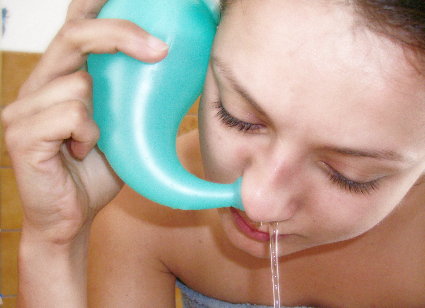 Efficacy and safety
Nasal irrigation device commonly available at pharmacies
Nasal irrigation is used to treat a wide range of chronic sinus and nasal symptoms; for chronic rhinosinusitis it is an effective adjunctive therapy. It is also an effective measure against chronic sinus symptoms induced by work-place exposure to sawdust.[5] Further evidence suggests that nasal irrigation causes relief for both hay-fever and the common cold. The neti pot used with a saline solution has been shown to be an effective treatment for hay fever,[6] sinusitis, and other nasal conditions.
SNI could also be an effective treatment for allergic rhinitis[6] and chronic sinusitis.[7] A conference abstract presented in November 2009 indicated that frequent nasal irrigation led to higher rates of sinus infections. Short term use of up to a week was not thought by the authors to pose a problem.[8]
Daily nasal irrigation with salt water solution (a mixture of 0.9% non-iodized sodium chloride and either purified or filtered water warmed to around 98 degrees F/ 37 degrees C, with or without inclusion of a buffering agent such as sodium bicarbonate) is recommended as both an adjunctive[9] and primary treatment[10] in such cases and is preferable to the use of corticosteroids except in the most serious cases of acute bacterial sinusitis which should be immediately referred to an otolaryngologist.[11] Irrigation should be used with caution in infants, as nasal drops are not widely tolerated.[12]
Flushing the nasal cavity with salt water has been claimed to promote mucociliary clearance by moisturizing the nasal cavity and by removing encrusted material, although there is no clear evidence to support this.[10] In proper proportion, nasal salt water solution with slight acidic pH functions as an anti-bacterial irrigant. The flow of salt water through the nasal passage flushes the dirt, airborne allergens (dust and pollen), pollutants and bacteria-filled mucus.
Salt water flushing also loosens and thins the mucus, making it easier to expel. Without this build up of mucus, the tiny cilia, or hairs in the nasal passage are able to function more efficiently, pushing excess mucus either to the back of the throat or to the nose to be expelled.
Potential allergens (such as iodine) or contaminants (algae, etc.) are to be avoided in the sodium chloride, water, or buffering ingredients.[13] Premanufactured dosages of salt water flushing solutions can be purchased, or the user can mix non-iodized 'kosher' salt, with or without a buffering agent such as sodium bicarbonate or baking soda (table salt frequently is iodized, while sea salt may contain algae or other contaminants). Treatment guidelines in both Canada and the United States now advocate use of nasal irrigation for all causes of rhinosinusitis and for postoperative cleaning of the nasal cavity.[14]
A conference abstract presented in 2009 indicated that long-term nasal irrigation led to higher rates of sinus infections, which the principal researcher theorized was due to alterations in nasal immunological chemistry brought on by flushing out the protective elements of the mucous membrane of the nose.[15] Note that this study has not been published in any peer-reviewed journal, and that the results may have been affected by the method of selection of test subjects and by the neti pot methods followed by the subjects. No such results were observed for short term use. However, it is of note that efficacy studies in general have not been conducted on groups utilizing this specific treatment, and that claims regarding the efficacy of the technique rely largely on anecdotal evidence.[8]
[edit]Neti pot use warning
While nasal irrigation is generally well-tolerated, at least two deaths from Naegleria fowleri have been reported from use of a neti pot. Naegleria fowleri present in unboiled or otherwise unsterilized water causes the fatal brain infection primary amoebic meningoencephalitis (PAM).[16][17][18][19]
The probability of death from this Naegleria infection is as high as 98%, but the parasite can be killed by boiling water before use. According to Louisiana State Epidemiologist Raoult Ratard, "if you are irrigating, flushing, or rinsing your sinuses, for example, by using a neti pot, use distilled, sterile or previously boiled water to make up the irrigation solution."[17]
In Pakistan, on October 15, 2010, a 54-year-old male Ghulam Mustafa Khalid was admitted to a Karachi hospital, suffering from typical signs of meningitis.[20] It was quickly diagnosed as PAM and attempts to administer Amphotericin B, initially via IV then by intrathecal injection, had no effect. Cranial decompression of the patient likewise yielded no results, and the patient died on October 22, 2010.[21] He was in perfect health, had no history of swimming, however, he had a habit of deep nasal cleansing with tap water while doing wudu, which could possibly be the reason of this infection. Laboratory tests confirmed the presence of N. fowleri.
In the United States, in June, 2011, a young Louisiana man died after flushing his sinuses with infected tap water.[22]
In the United States, in December 2011, a 51 year-old woman in Louisiana died after flushing her sinuses with infected tap water.[23]
[edit]Methods
Ceramic neti pot
A simple method, which requires no specialized equipment, is to snort water from cupped hands, but this clears little more than the nostrils. The application of commercially available saline nasal spray is another simple alternative, but it is relatively inefficient for washing away debris although it may suffice for simple rehydration of mucous and tissues.[24][25]
A simple yet effective technique is to pour salt water solution into one nostril and let it run out through the other while the mouth is kept open to breathe, using gravity as an aid. Jala-neti, which means to cleanse the nose with water,[26] is an old yogic technique. The container used to administer the saline is called a "neti pot". Neti is Sanskrit for "nasal cleansing". A second neti technique known as sutra neti uses a piece of string instead of water.
Neti pots are typically made of metal, glass, ceramic or plastic. They rely on gravity, along with head positioning and repeated practice in order to rinse the outer sinus cavities. Typically it has a spout attached near the bottom, sometimes with a handle on the opposite side.[27] Some users are able to use neti pots without problems, while the sideways positioning of the head can induce vertigo in others. A more advanced variation of the technique (known in yoga as Vyutkrama Kapalaneti) involves pouring the same salt water solution into one nostril while the other is held closed, so that the solution runs out of the mouth. It is more challenging than the basic version (care must be taken to keep the saline solution out of the throat and to suppress possible vomiting reflex), but it can allow more thorough irrigation of the nasal cavity and the sinuses. Yet another technique (known in yoga as Seethkrama Kapalaneti) is to take the saline into the mouth and - leaning forward - force it out of the nostrils. This is not recommended for beginners.
The second method of nasal irrigation is to introduce some form of positive pressure to the water introduced into the sinuses and nasal cavities in order to provide a more complete rinsing without resorting to special techniques, such as holding the head to one side (which is usually only difficult with a neck condition). Some products available from pharmacist supply retailers are essentially bottles made of flexible plastic with special tips to fit the nostril. These bottles, when filled with warm salt water solution, can be squeezed to exert positive pressure of the water flowing through the sinuses while the mouth is kept open at all times in order to breathe and prevent snorting the liquid down the throat. Even ordinary plastic water bottles can and have been used, as long as the nozzle will adequately fit a person's nostril. However, neither squeeze bottles nor bulb syringes provide the user with any genuine control over the pressure/volume of solution introduced. You need to make sure the pressure cannot be too high to prevent ear pressure or ear infection. The diameter of the hole in the center of the nostril fitting cannot be larger than 3 mm. If too large, a big wave of liquid can be forced to enter anywhere, such as middle ear, to cause ear pain or even ear infection.
Irrigation machines that utilize electric motor-driven pumps are also available. These irrigation devices pump salt water solution through a tube, in connection with a nasal adapter tip designed to seal against the nostril. Some of these machines allow adjustment of water volume/speed by use of an adjustment dial which regulates pump speed and volume per minute. Most of these motorized machines use a pulsatile or pulsating water pumping action at a relatively low, predetermined fixed pulse cyclic rate, designed to match the normal wave rate of healthy, unobstructed nasal cilia.[28] This matched pulse rate is claimed to stimulate the nasal cilia hairs and promote better sinus health, while reducing the severity of allergic reactions.[29] More sophisticated motorized irrigators have two or more pulse cycle settings that adjust the actual pulse cycle (as opposed to a simple volume/speed control, which does not alter the pulse cyclic rate). This design affords the user the option of using a higher pulse cyclic rate when suffering from partially closed sinuses, as in a typical case of acute sinusitis. The efficacy of all motorized pump irrigators has not yet been tested compared to simpler non-motorized mechanical pressure nasal irrigation methods.[30]
Some nasal irrigation systems that apply pressure have an anti-backwash valve to prevent used saltwater solution from flowing back into the nasal cavity. This is particularly important for those people with bacterial or viral infections, such as the common cold or flu. This type of irrigator should be held upright, as in brushing one's teeth, because if the head is tilted sideways liquid could enter the ear on the lower side and cause an ear infection. This refers to an irrigator that applies pressure, but not to the neti pot, which only utilizes gravity in its application. Neti pots do not allow used solution to flow back into the nasal cavity.
[edit]Solutions used for nasal irrigation
While nasal irrigation can be carried out using ordinary tap water, this is not safe and additionally can be uncomfortable because it irritates the mucous membranes. Therefore an isotonic or hypertonic salt water solution is normally used, i.e. water with enough salt to match the tonicity of the body cells and blood. For the same reason, lukewarm water is preferred over cold water, which in addition to irritating nasal membranes can also exaggerate the gag reflex during irrigation. Use of distilled, sterile or previously boiled and cooled water over ordinary tap water is advised. Tap water safe for drinking is not necessarily safe for nasal irrigation due to risk of rare but fatal brain infection. A small amount of baking soda is sometimes employed as a buffering agent to adjust the pH of the irrigating solution to that of the body.
Many pharmacies stock pre-manufactured sachets of pharmaceutical grade salt and baking soda designed to be used with the volume of water their corresponding device uses. Sometimes manufactured solutions such as a lactated Ringer's solution is used.[citation needed]
Optional additives include xylitol which is claimed to draw water into the sinus regions and helps displace bacteria.[31] Xylitol is commonly used to prevent acute otitis media in Europe and dental caries in the United States,[32] but research into xylitol use in the sinus cavities is lacking. Another nasal irrigation additive is aloe extract, which helps to prevent nasal dryness.[citation needed] Sodium citrate and citric acid help not only to balance the pH, also helps to improve the sense of smell.[citation needed] As noted above, in December 2011, the Louisiana state health department reported 2 deaths from Naegleria fowleri in which the use of contaminated tap water for nasal irrigation was strongly implicated.[33]
[edit]Mechanism of action
The precise reasons for the efficacy of nasal irrigation are not well understood, although it is clear that the removal of mucus plays an important role.[10] Damage to the mucociliary transport system is an important factor in the development of sinonasal diseases, leading to a stasis of mucus.[30] The numerous proteins found in nasal mucus include inflammatory mediators, defensins and many whose function is not understood.[10] Thus hypotheses include that nasal irrigation may decrease inflammation through the removal of mucus, that it may improve mucociliary clearance, and that it may remove thickened mucus that cannot be handled by the cilia.[10][30]
Sinusitis
Efficacy and safety
Nasal irrigation device commonly available at pharmacies
Nasal irrigation is used to treat a wide range of chronic sinus and nasal symptoms; for chronic rhinosinusitis it is an effective adjunctive therapy. It is also an effective measure against chronic sinus symptoms induced by work-place exposure to sawdust.[5] Further evidence suggests that nasal irrigation causes relief for both hay-fever and the common cold. The neti pot used with a saline solution has been shown to be an effective treatment for hay fever,[6] sinusitis, and other nasal conditions.
SNI could also be an effective treatment for allergic rhinitis[6] and chronic sinusitis.[7] A conference abstract presented in November 2009 indicated that frequent nasal irrigation led to higher rates of sinus infections. Short term use of up to a week was not thought by the authors to pose a problem.[8]
Daily nasal irrigation with salt water solution (a mixture of 0.9% non-iodized sodium chloride and either purified or filtered water warmed to around 98 degrees F/ 37 degrees C, with or without inclusion of a buffering agent such as sodium bicarbonate) is recommended as both an adjunctive[9] and primary treatment[10] in such cases and is preferable to the use of corticosteroids except in the most serious cases of acute bacterial sinusitis which should be immediately referred to an otolaryngologist.[11] Irrigation should be used with caution in infants, as nasal drops are not widely tolerated.[12]
Flushing the nasal cavity with salt water has been claimed to promote mucociliary clearance by moisturizing the nasal cavity and by removing encrusted material, although there is no clear evidence to support this.[10] In proper proportion, nasal salt water solution with slight acidic pH functions as an anti-bacterial irrigant. The flow of salt water through the nasal passage flushes the dirt, airborne allergens (dust and pollen), pollutants and bacteria-filled mucus.
Salt water flushing also loosens and thins the mucus, making it easier to expel. Without this build up of mucus, the tiny cilia, or hairs in the nasal passage are able to function more efficiently, pushing excess mucus either to the back of the throat or to the nose to be expelled.
Potential allergens (such as iodine) or contaminants (algae, etc.) are to be avoided in the sodium chloride, water, or buffering ingredients.[13] Premanufactured dosages of salt water flushing solutions can be purchased, or the user can mix non-iodized 'kosher' salt, with or without a buffering agent such as sodium bicarbonate or baking soda (table salt frequently is iodized, while sea salt may contain algae or other contaminants). Treatment guidelines in both Canada and the United States now advocate use of nasal irrigation for all causes of rhinosinusitis and for postoperative cleaning of the nasal cavity.[14]
A conference abstract presented in 2009 indicated that long-term nasal irrigation led to higher rates of sinus infections, which the principal researcher theorized was due to alterations in nasal immunological chemistry brought on by flushing out the protective elements of the mucous membrane of the nose.[15] Note that this study has not been published in any peer-reviewed journal, and that the results may have been affected by the method of selection of test subjects and by the neti pot methods followed by the subjects. No such results were observed for short term use. However, it is of note that efficacy studies in general have not been conducted on groups utilizing this specific treatment, and that claims regarding the efficacy of the technique rely largely on anecdotal evidence.[8]
[edit]Neti pot use warning
While nasal irrigation is generally well-tolerated, at least two deaths from Naegleria fowleri have been reported from use of a neti pot. Naegleria fowleri present in unboiled or otherwise unsterilized water causes the fatal brain infection primary amoebic meningoencephalitis (PAM).[16][17][18][19]
The probability of death from this Naegleria infection is as high as 98%, but the parasite can be killed by boiling water before use. According to Louisiana State Epidemiologist Raoult Ratard, "if you are irrigating, flushing, or rinsing your sinuses, for example, by using a neti pot, use distilled, sterile or previously boiled water to make up the irrigation solution."[17]
In Pakistan, on October 15, 2010, a 54-year-old male Ghulam Mustafa Khalid was admitted to a Karachi hospital, suffering from typical signs of meningitis.[20] It was quickly diagnosed as PAM and attempts to administer Amphotericin B, initially via IV then by intrathecal injection, had no effect. Cranial decompression of the patient likewise yielded no results, and the patient died on October 22, 2010.[21] He was in perfect health, had no history of swimming, however, he had a habit of deep nasal cleansing with tap water while doing wudu, which could possibly be the reason of this infection. Laboratory tests confirmed the presence of N. fowleri.
In the United States, in June, 2011, a young Louisiana man died after flushing his sinuses with infected tap water.[22]
In the United States, in December 2011, a 51 year-old woman in Louisiana died after flushing her sinuses with infected tap water.[23]
[edit]Methods
Ceramic neti pot
A simple method, which requires no specialized equipment, is to snort water from cupped hands, but this clears little more than the nostrils. The application of commercially available saline nasal spray is another simple alternative, but it is relatively inefficient for washing away debris although it may suffice for simple rehydration of mucous and tissues.[24][25]
A simple yet effective technique is to pour salt water solution into one nostril and let it run out through the other while the mouth is kept open to breathe, using gravity as an aid. Jala-neti, which means to cleanse the nose with water,[26] is an old yogic technique. The container used to administer the saline is called a "neti pot". Neti is Sanskrit for "nasal cleansing". A second neti technique known as sutra neti uses a piece of string instead of water.
Neti pots are typically made of metal, glass, ceramic or plastic. They rely on gravity, along with head positioning and repeated practice in order to rinse the outer sinus cavities. Typically it has a spout attached near the bottom, sometimes with a handle on the opposite side.[27] Some users are able to use neti pots without problems, while the sideways positioning of the head can induce vertigo in others. A more advanced variation of the technique (known in yoga as Vyutkrama Kapalaneti) involves pouring the same salt water solution into one nostril while the other is held closed, so that the solution runs out of the mouth. It is more challenging than the basic version (care must be taken to keep the saline solution out of the throat and to suppress possible vomiting reflex), but it can allow more thorough irrigation of the nasal cavity and the sinuses. Yet another technique (known in yoga as Seethkrama Kapalaneti) is to take the saline into the mouth and - leaning forward - force it out of the nostrils. This is not recommended for beginners.
The second method of nasal irrigation is to introduce some form of positive pressure to the water introduced into the sinuses and nasal cavities in order to provide a more complete rinsing without resorting to special techniques, such as holding the head to one side (which is usually only difficult with a neck condition). Some products available from pharmacist supply retailers are essentially bottles made of flexible plastic with special tips to fit the nostril. These bottles, when filled with warm salt water solution, can be squeezed to exert positive pressure of the water flowing through the sinuses while the mouth is kept open at all times in order to breathe and prevent snorting the liquid down the throat. Even ordinary plastic water bottles can and have been used, as long as the nozzle will adequately fit a person's nostril. However, neither squeeze bottles nor bulb syringes provide the user with any genuine control over the pressure/volume of solution introduced. You need to make sure the pressure cannot be too high to prevent ear pressure or ear infection. The diameter of the hole in the center of the nostril fitting cannot be larger than 3 mm. If too large, a big wave of liquid can be forced to enter anywhere, such as middle ear, to cause ear pain or even ear infection.
Irrigation machines that utilize electric motor-driven pumps are also available. These irrigation devices pump salt water solution through a tube, in connection with a nasal adapter tip designed to seal against the nostril. Some of these machines allow adjustment of water volume/speed by use of an adjustment dial which regulates pump speed and volume per minute. Most of these motorized machines use a pulsatile or pulsating water pumping action at a relatively low, predetermined fixed pulse cyclic rate, designed to match the normal wave rate of healthy, unobstructed nasal cilia.[28] This matched pulse rate is claimed to stimulate the nasal cilia hairs and promote better sinus health, while reducing the severity of allergic reactions.[29] More sophisticated motorized irrigators have two or more pulse cycle settings that adjust the actual pulse cycle (as opposed to a simple volume/speed control, which does not alter the pulse cyclic rate). This design affords the user the option of using a higher pulse cyclic rate when suffering from partially closed sinuses, as in a typical case of acute sinusitis. The efficacy of all motorized pump irrigators has not yet been tested compared to simpler non-motorized mechanical pressure nasal irrigation methods.[30]
Some nasal irrigation systems that apply pressure have an anti-backwash valve to prevent used saltwater solution from flowing back into the nasal cavity. This is particularly important for those people with bacterial or viral infections, such as the common cold or flu. This type of irrigator should be held upright, as in brushing one's teeth, because if the head is tilted sideways liquid could enter the ear on the lower side and cause an ear infection. This refers to an irrigator that applies pressure, but not to the neti pot, which only utilizes gravity in its application. Neti pots do not allow used solution to flow back into the nasal cavity.
[edit]Solutions used for nasal irrigation
While nasal irrigation can be carried out using ordinary tap water, this is not safe and additionally can be uncomfortable because it irritates the mucous membranes. Therefore an isotonic or hypertonic salt water solution is normally used, i.e. water with enough salt to match the tonicity of the body cells and blood. For the same reason, lukewarm water is preferred over cold water, which in addition to irritating nasal membranes can also exaggerate the gag reflex during irrigation. Use of distilled, sterile or previously boiled and cooled water over ordinary tap water is advised. Tap water safe for drinking is not necessarily safe for nasal irrigation due to risk of rare but fatal brain infection. A small amount of baking soda is sometimes employed as a buffering agent to adjust the pH of the irrigating solution to that of the body.
Many pharmacies stock pre-manufactured sachets of pharmaceutical grade salt and baking soda designed to be used with the volume of water their corresponding device uses. Sometimes manufactured solutions such as a lactated Ringer's solution is used.[citation needed]
Optional additives include xylitol which is claimed to draw water into the sinus regions and helps displace bacteria.[31] Xylitol is commonly used to prevent acute otitis media in Europe and dental caries in the United States,[32] but research into xylitol use in the sinus cavities is lacking. Another nasal irrigation additive is aloe extract, which helps to prevent nasal dryness.[citation needed] Sodium citrate and citric acid help not only to balance the pH, also helps to improve the sense of smell.[citation needed] As noted above, in December 2011, the Louisiana state health department reported 2 deaths from Naegleria fowleri in which the use of contaminated tap water for nasal irrigation was strongly implicated.[33]
[edit]Mechanism of action
The precise reasons for the efficacy of nasal irrigation are not well understood, although it is clear that the removal of mucus plays an important role.[10] Damage to the mucociliary transport system is an important factor in the development of sinonasal diseases, leading to a stasis of mucus.[30] The numerous proteins found in nasal mucus include inflammatory mediators, defensins and many whose function is not understood.[10] Thus hypotheses include that nasal irrigation may decrease inflammation through the removal of mucus, that it may improve mucociliary clearance, and that it may remove thickened mucus that cannot be handled by the cilia.[10][30]
Sinusitis
Saturday, June 23, 2012
What should you do when u get bored
Are you getting bored lately? Watchout!
Let see what it mean
Boredom is an emotional state experienced when an individual is not interested in their surroundings or available activities. The first recorded use of the word boredom is in the novel Bleak House by Charles Dickens, written in 1852,[1] in which it appears six times, although the expression to be a bore had been used in the sense of "to be tiresome or dull" since 1768.[2] The French term for boredom, ennui, is sometimes used in English as well.
Contents [hide]
1 Psychology
2 Philosophy
3 Causes and effects
4 Popular culture
5 See also
6 References
Psychology
 Mental state in terms of challenge level and skill level, according to Csikszentmihalyi's flow model.[3] (Click on a fragment of the image to go to the appropriate article)
Boredom has been defined by C. D. Fisher in terms of its central psychological processes: “an unpleasant, transient affective state in which the individual feels a pervasive lack of interest in and difficulty concentrating on the current activity.”[4] M. R. Leary and others describe boredom as “an affective experience associated with cognitive attentional processes.”[5] In positive psychology, boredom is described as a response to a moderate challenge for which the subject has more than enough skill.[3]
There are three types of boredom, all of which involve problems of engagement of attention. These include times when we are prevented from engaging in some wanted activity, when we are forced to engage in some unwanted activity, or when we are simply unable, for no apparent reason, to maintain engagement in any activity or spectacle.[6] Boredom proneness is a tendency to experience boredom of all types. This is typically assessed by the Boredom Proneness Scale.[7] Consistent with the definition provided above, recent research has found that boredom proneness is clearly and consistently associated with failures of attention.[8] Boredom and boredom proneness are both theoretically and empirically linked to depression and depressive symptoms.[9][10][11] Nonetheless, boredom proneness has been found to be as strongly correlated with attentional lapses as with depression.[9] Although boredom is often viewed as a trivial and mild irritant, proneness to boredom has been linked to a very diverse range of possible psychological, physical, educational, and social problems.
Philosophy
Boredom is a condition characterized by perception of one's environment as dull, tedious, and lacking in stimulation. This can result from leisure and a lack of aesthetic interests. Labor, however, and even art may be alienated and passive, or immersed in tedium. There is an inherent anxiety in boredom; people will expend considerable effort to prevent or remedy it, yet in many circumstances, it is accepted as suffering to be endured. Common passive ways to escape boredom are to sleep or to think creative thoughts (daydream). Typical active solutions consist in an intentional activity of some sort, often something new, as familiarity and repetition lead to the tedious.
1916 Rea Irvin illustration depicting a bore putting her audience to sleep
Boredom also plays a role in existentialist thought. In contexts where one is confined, spatially or otherwise, boredom may be met with various religious activities, not because religion would want to associate itself with tedium, but rather, partly because boredom may be taken as the essential human condition, to which God, wisdom, or morality are the ultimate answers. Boredom is in fact taken in this sense by virtually all existentialist philosophers as well as by Schopenhauer.
Heidegger wrote about boredom in two texts available in English, in the 1929/30 semester lecture course The Fundamental Concepts of Metaphysics, and again in the essay What is Metaphysics? published in the same year. In the lecture, Heidegger included about 100 pages on boredom, probably the most extensive philosophical treatment ever of the subject. He focused on waiting at train stations in particular as a major context of boredom.[12] In Kierkegaard's remark in Either/Or, that "patience cannot be depicted" visually, since there is a sense that any immediate moment of life may be fundamentally tedious.
Blaise Pascal in the Pensées discusses the human condition in saying "we seek rest in a struggle against some obstacles. And when we have overcome these, rest proves unbearable because of the boredom it produces", and later states that "only an infinite and immutable object – that is, God himself – can fill this infinite abyss."[13]
Without stimulus or focus, the individual is confronted with nothingness, the meaninglessness of existence, and experiences existential anxiety. Heidegger states this idea nicely: "Profound boredom, drifting here and there in the abysses of our existence like a muffling fog, removes all things and men and oneself along with it into a remarkable indifference. This boredom reveals being as a whole."[14] Arthur Schopenhauer used the existence of boredom in an attempt to prove the vanity of human existence, stating, "...for if life, in the desire for which our essence and existence consists, possessed in itself a positive value and real content, there would be no such thing as boredom: mere existence would fulfil and satisfy us."[15]
Erich Fromm and other thinkers of critical theory speak of boredom as a common psychological response to industrial society, where people are required to engage in alienated labor. According to Fromm, boredom is "perhaps the most important source of aggression and destructiveness today." For Fromm, the search for thrills and novelty that characterizes consumer culture are not solutions to boredom, but mere distractions from boredom which, he argues, continues unconsciously.[16] Above and beyond taste and character, the universal case of boredom consists in any instance of waiting, as Heidegger noted, such as in line, for someone else to arrive or finish a task, or while one is travelling somewhere. The automobile requires fast reflexes, making its operator busy and hence, perhaps for other reasons as well, making the ride more tedious despite being over sooner.
Indian thinker, Domenic Marbaniang, defines boredom as "the metaphysical turbulent emotion that arises out of the paradox of the rational sense of immutability and the empirical sense of mutation." He explains "Reason anticipates permanence, changelessness, and immutability as the quality of ultimate reality; however, for experience immutability is an impossibility. Nothing immutable is empirically conceivable; for if something doesn’t move in space, it at least moves in time. The tension between the immutable and the mutable produces the emotion of ennui, the sense of tediousness and vexation associated with the absence of immutable or lasting purpose in the cosmic phenomena of change."[17]
Causes and effects
The Princess Who Never Smiled by Viktor Vasnetsov
Although it has not been widely studied, research on boredom suggests that boredom is a major factor impacting diverse areas of a person's life. People ranked low on a boredom-proneness scale were found to have better performance in a wide variety of aspects of their lives, including career, education, and autonomy.[18] Boredom can be a symptom of clinical depression. Boredom can be a form of learned helplessness, a phenomenon closely related to depression. Some philosophies of parenting propose that if children are raised in an environment devoid of stimuli, and are not allowed or encouraged to interact with their environment, they will fail to develop the mental capacities to do so.
In a learning environment, a common cause of boredom is lack of understanding; for instance, if one is not following or connecting to the material in a class or lecture, it will usually seem boring. However, the opposite can also be true; something that is too easily understood, simple or transparent, can also be boring. Boredom is often inversely related to learning, and in school it may be a sign that a student is not challenged enough, or too challenged. An activity that is predictable to the students is likely to bore them.[19]
A 1989 study indicated that an individual's impression of boredom may be influenced by the individual's degree of attention, as a higher acoustic level of distraction from the environment correlated with higher reportings of boredom.[20]
Boredom has been studied as being related to drug abuse among teens.[21] Boredom has been proposed as a cause of pathological gambling behavior. A study found results consistent with the hypothesis that pathological gamblers seek stimulation to avoid states of boredom and depression.[22] Boredom is also associated with earlier death[23] and with anxiety, eating disorders, hostility, anger, poor social skills, bad grades, and low work performance.[24] Civil servants who reported being very bored were 2.5 times more likely to die of a heart problem than those who hadn't reported being bored.[25]
Boredom has sometimes been associated with suicide. Patients with a history of failed suicide attempts report feeling more boredom than those without such histories.[26] Teens and senior citizens are more likely than other groups to complain of boredom and also represent the groups that commit the most suicides. Thomas J. Young notes that while drugs, sexual promiscuity, and television are commonly turned to in an attempt to fill the existential void, they are sources of simple stimuli that provide only temporary relief; "Without activating stimuli, feelings of boredom and meaningless may reach the point of an existential crisis which may cause the adolescent to become suicidal."[27] Prisoner suicides have been hypothesized to be linked in some cases to deprivation of liberty producing boredom and related attacks on personality and self-esteem.[28]
George Sanders' suicide note stated, "Dear World, I am leaving because I am bored."[29] Boredom was blamed by the Fair Labor Association for suicides at Apple computer factories.[30] Henrik Ibsen supposedly wrote Hedda Gabler after reading a news item about a woman who killed herself out of sheer boredom.[31] Peter Toohey questions the association, arguing that "There is no death-producing pain involved in an intellectual perception of the meaninglessness of life, unless that perception is the product of painful depression . . . Hedda's unfortunate death, typical of so many literary suicides, does nothing but demean. It's as if her and others' existential boredom becomes a strikingly more important condition if it can be seen to provoke its sufferers into taking their own lives, rather than leaving them smelly, solitary, and rather insufferable."[32]
Popular culture
In Chapter 18 of the novel The Picture of Dorian Gray by Oscar Wilde (1854–1900), the character Lord Henry Wotton says to a young Dorian Gray: "The only horrible thing in the world is ennui, Dorian. That is the one sin for which there is no forgiveness." John Sebastian, Iggy Pop, the Deftones, Buzzcocks, and Blink-182 have all written songs with boredom mentioned in the title. Other songs about boredom and activities people turn to when bored include Green Day's song "Longview", System of a Down's "Lonely Day", and Bloodhound Gang's "Mope". Douglas Adams depicted a robot named Marvin the Paranoid Android whose boredom appeared to be the defining trait of his existence in The Hitchhiker's Guide to the Galaxy.
I'm sure that bored is not a disease, just try to find some intersting to do!
Mental state in terms of challenge level and skill level, according to Csikszentmihalyi's flow model.[3] (Click on a fragment of the image to go to the appropriate article)
Boredom has been defined by C. D. Fisher in terms of its central psychological processes: “an unpleasant, transient affective state in which the individual feels a pervasive lack of interest in and difficulty concentrating on the current activity.”[4] M. R. Leary and others describe boredom as “an affective experience associated with cognitive attentional processes.”[5] In positive psychology, boredom is described as a response to a moderate challenge for which the subject has more than enough skill.[3]
There are three types of boredom, all of which involve problems of engagement of attention. These include times when we are prevented from engaging in some wanted activity, when we are forced to engage in some unwanted activity, or when we are simply unable, for no apparent reason, to maintain engagement in any activity or spectacle.[6] Boredom proneness is a tendency to experience boredom of all types. This is typically assessed by the Boredom Proneness Scale.[7] Consistent with the definition provided above, recent research has found that boredom proneness is clearly and consistently associated with failures of attention.[8] Boredom and boredom proneness are both theoretically and empirically linked to depression and depressive symptoms.[9][10][11] Nonetheless, boredom proneness has been found to be as strongly correlated with attentional lapses as with depression.[9] Although boredom is often viewed as a trivial and mild irritant, proneness to boredom has been linked to a very diverse range of possible psychological, physical, educational, and social problems.
Philosophy
Boredom is a condition characterized by perception of one's environment as dull, tedious, and lacking in stimulation. This can result from leisure and a lack of aesthetic interests. Labor, however, and even art may be alienated and passive, or immersed in tedium. There is an inherent anxiety in boredom; people will expend considerable effort to prevent or remedy it, yet in many circumstances, it is accepted as suffering to be endured. Common passive ways to escape boredom are to sleep or to think creative thoughts (daydream). Typical active solutions consist in an intentional activity of some sort, often something new, as familiarity and repetition lead to the tedious.
1916 Rea Irvin illustration depicting a bore putting her audience to sleep
Boredom also plays a role in existentialist thought. In contexts where one is confined, spatially or otherwise, boredom may be met with various religious activities, not because religion would want to associate itself with tedium, but rather, partly because boredom may be taken as the essential human condition, to which God, wisdom, or morality are the ultimate answers. Boredom is in fact taken in this sense by virtually all existentialist philosophers as well as by Schopenhauer.
Heidegger wrote about boredom in two texts available in English, in the 1929/30 semester lecture course The Fundamental Concepts of Metaphysics, and again in the essay What is Metaphysics? published in the same year. In the lecture, Heidegger included about 100 pages on boredom, probably the most extensive philosophical treatment ever of the subject. He focused on waiting at train stations in particular as a major context of boredom.[12] In Kierkegaard's remark in Either/Or, that "patience cannot be depicted" visually, since there is a sense that any immediate moment of life may be fundamentally tedious.
Blaise Pascal in the Pensées discusses the human condition in saying "we seek rest in a struggle against some obstacles. And when we have overcome these, rest proves unbearable because of the boredom it produces", and later states that "only an infinite and immutable object – that is, God himself – can fill this infinite abyss."[13]
Without stimulus or focus, the individual is confronted with nothingness, the meaninglessness of existence, and experiences existential anxiety. Heidegger states this idea nicely: "Profound boredom, drifting here and there in the abysses of our existence like a muffling fog, removes all things and men and oneself along with it into a remarkable indifference. This boredom reveals being as a whole."[14] Arthur Schopenhauer used the existence of boredom in an attempt to prove the vanity of human existence, stating, "...for if life, in the desire for which our essence and existence consists, possessed in itself a positive value and real content, there would be no such thing as boredom: mere existence would fulfil and satisfy us."[15]
Erich Fromm and other thinkers of critical theory speak of boredom as a common psychological response to industrial society, where people are required to engage in alienated labor. According to Fromm, boredom is "perhaps the most important source of aggression and destructiveness today." For Fromm, the search for thrills and novelty that characterizes consumer culture are not solutions to boredom, but mere distractions from boredom which, he argues, continues unconsciously.[16] Above and beyond taste and character, the universal case of boredom consists in any instance of waiting, as Heidegger noted, such as in line, for someone else to arrive or finish a task, or while one is travelling somewhere. The automobile requires fast reflexes, making its operator busy and hence, perhaps for other reasons as well, making the ride more tedious despite being over sooner.
Indian thinker, Domenic Marbaniang, defines boredom as "the metaphysical turbulent emotion that arises out of the paradox of the rational sense of immutability and the empirical sense of mutation." He explains "Reason anticipates permanence, changelessness, and immutability as the quality of ultimate reality; however, for experience immutability is an impossibility. Nothing immutable is empirically conceivable; for if something doesn’t move in space, it at least moves in time. The tension between the immutable and the mutable produces the emotion of ennui, the sense of tediousness and vexation associated with the absence of immutable or lasting purpose in the cosmic phenomena of change."[17]
Causes and effects
The Princess Who Never Smiled by Viktor Vasnetsov
Although it has not been widely studied, research on boredom suggests that boredom is a major factor impacting diverse areas of a person's life. People ranked low on a boredom-proneness scale were found to have better performance in a wide variety of aspects of their lives, including career, education, and autonomy.[18] Boredom can be a symptom of clinical depression. Boredom can be a form of learned helplessness, a phenomenon closely related to depression. Some philosophies of parenting propose that if children are raised in an environment devoid of stimuli, and are not allowed or encouraged to interact with their environment, they will fail to develop the mental capacities to do so.
In a learning environment, a common cause of boredom is lack of understanding; for instance, if one is not following or connecting to the material in a class or lecture, it will usually seem boring. However, the opposite can also be true; something that is too easily understood, simple or transparent, can also be boring. Boredom is often inversely related to learning, and in school it may be a sign that a student is not challenged enough, or too challenged. An activity that is predictable to the students is likely to bore them.[19]
A 1989 study indicated that an individual's impression of boredom may be influenced by the individual's degree of attention, as a higher acoustic level of distraction from the environment correlated with higher reportings of boredom.[20]
Boredom has been studied as being related to drug abuse among teens.[21] Boredom has been proposed as a cause of pathological gambling behavior. A study found results consistent with the hypothesis that pathological gamblers seek stimulation to avoid states of boredom and depression.[22] Boredom is also associated with earlier death[23] and with anxiety, eating disorders, hostility, anger, poor social skills, bad grades, and low work performance.[24] Civil servants who reported being very bored were 2.5 times more likely to die of a heart problem than those who hadn't reported being bored.[25]
Boredom has sometimes been associated with suicide. Patients with a history of failed suicide attempts report feeling more boredom than those without such histories.[26] Teens and senior citizens are more likely than other groups to complain of boredom and also represent the groups that commit the most suicides. Thomas J. Young notes that while drugs, sexual promiscuity, and television are commonly turned to in an attempt to fill the existential void, they are sources of simple stimuli that provide only temporary relief; "Without activating stimuli, feelings of boredom and meaningless may reach the point of an existential crisis which may cause the adolescent to become suicidal."[27] Prisoner suicides have been hypothesized to be linked in some cases to deprivation of liberty producing boredom and related attacks on personality and self-esteem.[28]
George Sanders' suicide note stated, "Dear World, I am leaving because I am bored."[29] Boredom was blamed by the Fair Labor Association for suicides at Apple computer factories.[30] Henrik Ibsen supposedly wrote Hedda Gabler after reading a news item about a woman who killed herself out of sheer boredom.[31] Peter Toohey questions the association, arguing that "There is no death-producing pain involved in an intellectual perception of the meaninglessness of life, unless that perception is the product of painful depression . . . Hedda's unfortunate death, typical of so many literary suicides, does nothing but demean. It's as if her and others' existential boredom becomes a strikingly more important condition if it can be seen to provoke its sufferers into taking their own lives, rather than leaving them smelly, solitary, and rather insufferable."[32]
Popular culture
In Chapter 18 of the novel The Picture of Dorian Gray by Oscar Wilde (1854–1900), the character Lord Henry Wotton says to a young Dorian Gray: "The only horrible thing in the world is ennui, Dorian. That is the one sin for which there is no forgiveness." John Sebastian, Iggy Pop, the Deftones, Buzzcocks, and Blink-182 have all written songs with boredom mentioned in the title. Other songs about boredom and activities people turn to when bored include Green Day's song "Longview", System of a Down's "Lonely Day", and Bloodhound Gang's "Mope". Douglas Adams depicted a robot named Marvin the Paranoid Android whose boredom appeared to be the defining trait of his existence in The Hitchhiker's Guide to the Galaxy.
I'm sure that bored is not a disease, just try to find some intersting to do!
 Mental state in terms of challenge level and skill level, according to Csikszentmihalyi's flow model.[3] (Click on a fragment of the image to go to the appropriate article)
Boredom has been defined by C. D. Fisher in terms of its central psychological processes: “an unpleasant, transient affective state in which the individual feels a pervasive lack of interest in and difficulty concentrating on the current activity.”[4] M. R. Leary and others describe boredom as “an affective experience associated with cognitive attentional processes.”[5] In positive psychology, boredom is described as a response to a moderate challenge for which the subject has more than enough skill.[3]
There are three types of boredom, all of which involve problems of engagement of attention. These include times when we are prevented from engaging in some wanted activity, when we are forced to engage in some unwanted activity, or when we are simply unable, for no apparent reason, to maintain engagement in any activity or spectacle.[6] Boredom proneness is a tendency to experience boredom of all types. This is typically assessed by the Boredom Proneness Scale.[7] Consistent with the definition provided above, recent research has found that boredom proneness is clearly and consistently associated with failures of attention.[8] Boredom and boredom proneness are both theoretically and empirically linked to depression and depressive symptoms.[9][10][11] Nonetheless, boredom proneness has been found to be as strongly correlated with attentional lapses as with depression.[9] Although boredom is often viewed as a trivial and mild irritant, proneness to boredom has been linked to a very diverse range of possible psychological, physical, educational, and social problems.
Philosophy
Boredom is a condition characterized by perception of one's environment as dull, tedious, and lacking in stimulation. This can result from leisure and a lack of aesthetic interests. Labor, however, and even art may be alienated and passive, or immersed in tedium. There is an inherent anxiety in boredom; people will expend considerable effort to prevent or remedy it, yet in many circumstances, it is accepted as suffering to be endured. Common passive ways to escape boredom are to sleep or to think creative thoughts (daydream). Typical active solutions consist in an intentional activity of some sort, often something new, as familiarity and repetition lead to the tedious.
1916 Rea Irvin illustration depicting a bore putting her audience to sleep
Boredom also plays a role in existentialist thought. In contexts where one is confined, spatially or otherwise, boredom may be met with various religious activities, not because religion would want to associate itself with tedium, but rather, partly because boredom may be taken as the essential human condition, to which God, wisdom, or morality are the ultimate answers. Boredom is in fact taken in this sense by virtually all existentialist philosophers as well as by Schopenhauer.
Heidegger wrote about boredom in two texts available in English, in the 1929/30 semester lecture course The Fundamental Concepts of Metaphysics, and again in the essay What is Metaphysics? published in the same year. In the lecture, Heidegger included about 100 pages on boredom, probably the most extensive philosophical treatment ever of the subject. He focused on waiting at train stations in particular as a major context of boredom.[12] In Kierkegaard's remark in Either/Or, that "patience cannot be depicted" visually, since there is a sense that any immediate moment of life may be fundamentally tedious.
Blaise Pascal in the Pensées discusses the human condition in saying "we seek rest in a struggle against some obstacles. And when we have overcome these, rest proves unbearable because of the boredom it produces", and later states that "only an infinite and immutable object – that is, God himself – can fill this infinite abyss."[13]
Without stimulus or focus, the individual is confronted with nothingness, the meaninglessness of existence, and experiences existential anxiety. Heidegger states this idea nicely: "Profound boredom, drifting here and there in the abysses of our existence like a muffling fog, removes all things and men and oneself along with it into a remarkable indifference. This boredom reveals being as a whole."[14] Arthur Schopenhauer used the existence of boredom in an attempt to prove the vanity of human existence, stating, "...for if life, in the desire for which our essence and existence consists, possessed in itself a positive value and real content, there would be no such thing as boredom: mere existence would fulfil and satisfy us."[15]
Erich Fromm and other thinkers of critical theory speak of boredom as a common psychological response to industrial society, where people are required to engage in alienated labor. According to Fromm, boredom is "perhaps the most important source of aggression and destructiveness today." For Fromm, the search for thrills and novelty that characterizes consumer culture are not solutions to boredom, but mere distractions from boredom which, he argues, continues unconsciously.[16] Above and beyond taste and character, the universal case of boredom consists in any instance of waiting, as Heidegger noted, such as in line, for someone else to arrive or finish a task, or while one is travelling somewhere. The automobile requires fast reflexes, making its operator busy and hence, perhaps for other reasons as well, making the ride more tedious despite being over sooner.
Indian thinker, Domenic Marbaniang, defines boredom as "the metaphysical turbulent emotion that arises out of the paradox of the rational sense of immutability and the empirical sense of mutation." He explains "Reason anticipates permanence, changelessness, and immutability as the quality of ultimate reality; however, for experience immutability is an impossibility. Nothing immutable is empirically conceivable; for if something doesn’t move in space, it at least moves in time. The tension between the immutable and the mutable produces the emotion of ennui, the sense of tediousness and vexation associated with the absence of immutable or lasting purpose in the cosmic phenomena of change."[17]
Causes and effects
The Princess Who Never Smiled by Viktor Vasnetsov
Although it has not been widely studied, research on boredom suggests that boredom is a major factor impacting diverse areas of a person's life. People ranked low on a boredom-proneness scale were found to have better performance in a wide variety of aspects of their lives, including career, education, and autonomy.[18] Boredom can be a symptom of clinical depression. Boredom can be a form of learned helplessness, a phenomenon closely related to depression. Some philosophies of parenting propose that if children are raised in an environment devoid of stimuli, and are not allowed or encouraged to interact with their environment, they will fail to develop the mental capacities to do so.
In a learning environment, a common cause of boredom is lack of understanding; for instance, if one is not following or connecting to the material in a class or lecture, it will usually seem boring. However, the opposite can also be true; something that is too easily understood, simple or transparent, can also be boring. Boredom is often inversely related to learning, and in school it may be a sign that a student is not challenged enough, or too challenged. An activity that is predictable to the students is likely to bore them.[19]
A 1989 study indicated that an individual's impression of boredom may be influenced by the individual's degree of attention, as a higher acoustic level of distraction from the environment correlated with higher reportings of boredom.[20]
Boredom has been studied as being related to drug abuse among teens.[21] Boredom has been proposed as a cause of pathological gambling behavior. A study found results consistent with the hypothesis that pathological gamblers seek stimulation to avoid states of boredom and depression.[22] Boredom is also associated with earlier death[23] and with anxiety, eating disorders, hostility, anger, poor social skills, bad grades, and low work performance.[24] Civil servants who reported being very bored were 2.5 times more likely to die of a heart problem than those who hadn't reported being bored.[25]
Boredom has sometimes been associated with suicide. Patients with a history of failed suicide attempts report feeling more boredom than those without such histories.[26] Teens and senior citizens are more likely than other groups to complain of boredom and also represent the groups that commit the most suicides. Thomas J. Young notes that while drugs, sexual promiscuity, and television are commonly turned to in an attempt to fill the existential void, they are sources of simple stimuli that provide only temporary relief; "Without activating stimuli, feelings of boredom and meaningless may reach the point of an existential crisis which may cause the adolescent to become suicidal."[27] Prisoner suicides have been hypothesized to be linked in some cases to deprivation of liberty producing boredom and related attacks on personality and self-esteem.[28]
George Sanders' suicide note stated, "Dear World, I am leaving because I am bored."[29] Boredom was blamed by the Fair Labor Association for suicides at Apple computer factories.[30] Henrik Ibsen supposedly wrote Hedda Gabler after reading a news item about a woman who killed herself out of sheer boredom.[31] Peter Toohey questions the association, arguing that "There is no death-producing pain involved in an intellectual perception of the meaninglessness of life, unless that perception is the product of painful depression . . . Hedda's unfortunate death, typical of so many literary suicides, does nothing but demean. It's as if her and others' existential boredom becomes a strikingly more important condition if it can be seen to provoke its sufferers into taking their own lives, rather than leaving them smelly, solitary, and rather insufferable."[32]
Popular culture
In Chapter 18 of the novel The Picture of Dorian Gray by Oscar Wilde (1854–1900), the character Lord Henry Wotton says to a young Dorian Gray: "The only horrible thing in the world is ennui, Dorian. That is the one sin for which there is no forgiveness." John Sebastian, Iggy Pop, the Deftones, Buzzcocks, and Blink-182 have all written songs with boredom mentioned in the title. Other songs about boredom and activities people turn to when bored include Green Day's song "Longview", System of a Down's "Lonely Day", and Bloodhound Gang's "Mope". Douglas Adams depicted a robot named Marvin the Paranoid Android whose boredom appeared to be the defining trait of his existence in The Hitchhiker's Guide to the Galaxy.
I'm sure that bored is not a disease, just try to find some intersting to do!
Mental state in terms of challenge level and skill level, according to Csikszentmihalyi's flow model.[3] (Click on a fragment of the image to go to the appropriate article)
Boredom has been defined by C. D. Fisher in terms of its central psychological processes: “an unpleasant, transient affective state in which the individual feels a pervasive lack of interest in and difficulty concentrating on the current activity.”[4] M. R. Leary and others describe boredom as “an affective experience associated with cognitive attentional processes.”[5] In positive psychology, boredom is described as a response to a moderate challenge for which the subject has more than enough skill.[3]
There are three types of boredom, all of which involve problems of engagement of attention. These include times when we are prevented from engaging in some wanted activity, when we are forced to engage in some unwanted activity, or when we are simply unable, for no apparent reason, to maintain engagement in any activity or spectacle.[6] Boredom proneness is a tendency to experience boredom of all types. This is typically assessed by the Boredom Proneness Scale.[7] Consistent with the definition provided above, recent research has found that boredom proneness is clearly and consistently associated with failures of attention.[8] Boredom and boredom proneness are both theoretically and empirically linked to depression and depressive symptoms.[9][10][11] Nonetheless, boredom proneness has been found to be as strongly correlated with attentional lapses as with depression.[9] Although boredom is often viewed as a trivial and mild irritant, proneness to boredom has been linked to a very diverse range of possible psychological, physical, educational, and social problems.
Philosophy
Boredom is a condition characterized by perception of one's environment as dull, tedious, and lacking in stimulation. This can result from leisure and a lack of aesthetic interests. Labor, however, and even art may be alienated and passive, or immersed in tedium. There is an inherent anxiety in boredom; people will expend considerable effort to prevent or remedy it, yet in many circumstances, it is accepted as suffering to be endured. Common passive ways to escape boredom are to sleep or to think creative thoughts (daydream). Typical active solutions consist in an intentional activity of some sort, often something new, as familiarity and repetition lead to the tedious.
1916 Rea Irvin illustration depicting a bore putting her audience to sleep
Boredom also plays a role in existentialist thought. In contexts where one is confined, spatially or otherwise, boredom may be met with various religious activities, not because religion would want to associate itself with tedium, but rather, partly because boredom may be taken as the essential human condition, to which God, wisdom, or morality are the ultimate answers. Boredom is in fact taken in this sense by virtually all existentialist philosophers as well as by Schopenhauer.
Heidegger wrote about boredom in two texts available in English, in the 1929/30 semester lecture course The Fundamental Concepts of Metaphysics, and again in the essay What is Metaphysics? published in the same year. In the lecture, Heidegger included about 100 pages on boredom, probably the most extensive philosophical treatment ever of the subject. He focused on waiting at train stations in particular as a major context of boredom.[12] In Kierkegaard's remark in Either/Or, that "patience cannot be depicted" visually, since there is a sense that any immediate moment of life may be fundamentally tedious.
Blaise Pascal in the Pensées discusses the human condition in saying "we seek rest in a struggle against some obstacles. And when we have overcome these, rest proves unbearable because of the boredom it produces", and later states that "only an infinite and immutable object – that is, God himself – can fill this infinite abyss."[13]
Without stimulus or focus, the individual is confronted with nothingness, the meaninglessness of existence, and experiences existential anxiety. Heidegger states this idea nicely: "Profound boredom, drifting here and there in the abysses of our existence like a muffling fog, removes all things and men and oneself along with it into a remarkable indifference. This boredom reveals being as a whole."[14] Arthur Schopenhauer used the existence of boredom in an attempt to prove the vanity of human existence, stating, "...for if life, in the desire for which our essence and existence consists, possessed in itself a positive value and real content, there would be no such thing as boredom: mere existence would fulfil and satisfy us."[15]
Erich Fromm and other thinkers of critical theory speak of boredom as a common psychological response to industrial society, where people are required to engage in alienated labor. According to Fromm, boredom is "perhaps the most important source of aggression and destructiveness today." For Fromm, the search for thrills and novelty that characterizes consumer culture are not solutions to boredom, but mere distractions from boredom which, he argues, continues unconsciously.[16] Above and beyond taste and character, the universal case of boredom consists in any instance of waiting, as Heidegger noted, such as in line, for someone else to arrive or finish a task, or while one is travelling somewhere. The automobile requires fast reflexes, making its operator busy and hence, perhaps for other reasons as well, making the ride more tedious despite being over sooner.
Indian thinker, Domenic Marbaniang, defines boredom as "the metaphysical turbulent emotion that arises out of the paradox of the rational sense of immutability and the empirical sense of mutation." He explains "Reason anticipates permanence, changelessness, and immutability as the quality of ultimate reality; however, for experience immutability is an impossibility. Nothing immutable is empirically conceivable; for if something doesn’t move in space, it at least moves in time. The tension between the immutable and the mutable produces the emotion of ennui, the sense of tediousness and vexation associated with the absence of immutable or lasting purpose in the cosmic phenomena of change."[17]
Causes and effects
The Princess Who Never Smiled by Viktor Vasnetsov
Although it has not been widely studied, research on boredom suggests that boredom is a major factor impacting diverse areas of a person's life. People ranked low on a boredom-proneness scale were found to have better performance in a wide variety of aspects of their lives, including career, education, and autonomy.[18] Boredom can be a symptom of clinical depression. Boredom can be a form of learned helplessness, a phenomenon closely related to depression. Some philosophies of parenting propose that if children are raised in an environment devoid of stimuli, and are not allowed or encouraged to interact with their environment, they will fail to develop the mental capacities to do so.
In a learning environment, a common cause of boredom is lack of understanding; for instance, if one is not following or connecting to the material in a class or lecture, it will usually seem boring. However, the opposite can also be true; something that is too easily understood, simple or transparent, can also be boring. Boredom is often inversely related to learning, and in school it may be a sign that a student is not challenged enough, or too challenged. An activity that is predictable to the students is likely to bore them.[19]
A 1989 study indicated that an individual's impression of boredom may be influenced by the individual's degree of attention, as a higher acoustic level of distraction from the environment correlated with higher reportings of boredom.[20]
Boredom has been studied as being related to drug abuse among teens.[21] Boredom has been proposed as a cause of pathological gambling behavior. A study found results consistent with the hypothesis that pathological gamblers seek stimulation to avoid states of boredom and depression.[22] Boredom is also associated with earlier death[23] and with anxiety, eating disorders, hostility, anger, poor social skills, bad grades, and low work performance.[24] Civil servants who reported being very bored were 2.5 times more likely to die of a heart problem than those who hadn't reported being bored.[25]
Boredom has sometimes been associated with suicide. Patients with a history of failed suicide attempts report feeling more boredom than those without such histories.[26] Teens and senior citizens are more likely than other groups to complain of boredom and also represent the groups that commit the most suicides. Thomas J. Young notes that while drugs, sexual promiscuity, and television are commonly turned to in an attempt to fill the existential void, they are sources of simple stimuli that provide only temporary relief; "Without activating stimuli, feelings of boredom and meaningless may reach the point of an existential crisis which may cause the adolescent to become suicidal."[27] Prisoner suicides have been hypothesized to be linked in some cases to deprivation of liberty producing boredom and related attacks on personality and self-esteem.[28]
George Sanders' suicide note stated, "Dear World, I am leaving because I am bored."[29] Boredom was blamed by the Fair Labor Association for suicides at Apple computer factories.[30] Henrik Ibsen supposedly wrote Hedda Gabler after reading a news item about a woman who killed herself out of sheer boredom.[31] Peter Toohey questions the association, arguing that "There is no death-producing pain involved in an intellectual perception of the meaninglessness of life, unless that perception is the product of painful depression . . . Hedda's unfortunate death, typical of so many literary suicides, does nothing but demean. It's as if her and others' existential boredom becomes a strikingly more important condition if it can be seen to provoke its sufferers into taking their own lives, rather than leaving them smelly, solitary, and rather insufferable."[32]
Popular culture
In Chapter 18 of the novel The Picture of Dorian Gray by Oscar Wilde (1854–1900), the character Lord Henry Wotton says to a young Dorian Gray: "The only horrible thing in the world is ennui, Dorian. That is the one sin for which there is no forgiveness." John Sebastian, Iggy Pop, the Deftones, Buzzcocks, and Blink-182 have all written songs with boredom mentioned in the title. Other songs about boredom and activities people turn to when bored include Green Day's song "Longview", System of a Down's "Lonely Day", and Bloodhound Gang's "Mope". Douglas Adams depicted a robot named Marvin the Paranoid Android whose boredom appeared to be the defining trait of his existence in The Hitchhiker's Guide to the Galaxy.
I'm sure that bored is not a disease, just try to find some intersting to do!
Circumcision
I done this today, and it was my first time. Wow! Wow! Just wow. The feeling that you love surgery and you do it for free is so priceless.
Well circumcision is not a diseas, it's a procedure. Lets we disscuss about it.
Male circumcision is the surgical removal of some or all of the foreskin (prepuce) from the penis.[1] Early depictions of circumcision are found in cave paintings and Ancient Egyptian tombs, though some pictures are open to interpretation.[2][3][4] Circumcision is often performed for religious reasons. In Judaism, it is considered a commandment from God;[5][6] in Islam, it is widely practiced and often considered to be sunnah, even though it is not mentioned in the Qur'an.[7] It is also customary in some Christian churches in Africa.[8]
Estimates by the World Health Organization (WHO) suggest that 30 percent of males worldwide are circumcised.[9] The prevalence of circumcision varies mostly with religious affiliation, and sometimes culture. The timing of circumcision similarly varies, though it is commonly practiced between infancy and the early twenties.[9]
Circumcisions are commonly performed for religious, cultural, social, or prophylactic reasons.[10] In addition, circumcision is used therapeutically, as one of the treatment options for a number of penile conditions.[11][12] Summaries of the views of professional associations of physicians state that none currently recommend routine (i.e. universal) circumcision,[13][14] and that none recommend prohibiting the practice.[14]
A Cochrane meta-analysis of studies done on sexually active men in Africa found that circumcision reduces the infection rate of HIV among heterosexual men by 38%-66% over a period of 24 months,[15] and studies have concluded it is cost effective in sub-Saharan Africa.[16] The WHO currently recommends circumcision be part of a comprehensive program for prevention of HIV transmission in areas with high endemic rates of HIV.[17]
There is controversy regarding circumcision.[18] Areas of controversy have included the health benefits and risks of the procedure,[18][19] ethical[20][21] and legal considerations,[18] and the application of human rights principles to the practice.[22]
Contents [hide]
1 Modern procedure
2 Medical aspects
2.1 Pain
2.2 Sexual effects
2.3 Psychological effects
2.4 Complications
2.5 Sexually transmitted diseases
2.6 Hygiene, infection, chronic and skin conditions
2.7 Cancers
3 Prevalence
4 History
4.1 Non-religious circumcision
4.2 Etymology
5 Society and culture
5.1 Ethical issues
5.2 Legal issues
5.3 Cultures and religions
6 Positions of medical associations
6.1 Australasia
6.2 Canada
6.3 Finland
6.4 International
6.5 Netherlands
6.6 United Kingdom
6.7 United States
7 See also
8 Notes
9 Further reading
10 External links
[edit]Modern procedure
 If anesthesia is to be used, there are several options: local anesthetic cream (EMLA cream) can be applied to the end of the penis 60–90 minutes prior to the procedure; local anesthetic can be injected at the base of the penis to block the dorsal penile nerve; local anesthetic can be injected in a ring around the middle of the penis in what is called a subcutaneous ring block.[23] It is also possible to use general anesthetics in the case of adult surgery, though not the standard practice.
For infant circumcision, devices such as the Gomco clamp, Plastibell, and Mogen clamp are commonly used,[24] together with a restraining device.[25]
With all these devices, the same basic procedure is followed. First, the amount of foreskin to be removed is estimated. The foreskin is opened via the preputial orifice to reveal the glans underneath and ensure it is normal. The inner lining of the foreskin (preputial epithelium) is bluntly separated from its attachment to the glans. The device is placed (this sometimes requires a dorsal slit) and remains there until blood flow has stopped. Finally, the foreskin is amputated.[23] Sometimes, the frenulum band may need to be broken or crushed and cut from the corona near the urethra to ensure that the glans can be freely and completely exposed.[26]
Plastibell circumcision day 6 post operation
With the Plastibell, once the glans is freed, the Plastibell is placed over the glans, and the foreskin is placed over the Plastibell. A ligature is then tied firmly around the foreskin and tightened into a groove in the Plastibell to achieve hemostasis. Foreskin distal to the ligature is excised and the handle is snapped off the Plastibell device. The Plastibell falls from the penis after the wound has healed, typically in four to six days.[27]
With a Gomco clamp, a section of skin is dorsally crushed with a hemostat and then slit with scissors. The foreskin is drawn over the bell shaped portion of the clamp and inserted through a hole in the base of the clamp. The clamp is tightened, "crushing the foreskin between the bell and the base plate." The crushed blood vessels provide hemostasis. The flared bottom of the bell fits tightly against the hole of the base plate, so the foreskin may be cut away with a scalpel from above the base plate.[28]
With a Mogen clamp, the foreskin is pulled dorsally with a straight hemostat, and lifted. The Mogen clamp is then slid between the glans and hemostat, following the angle of the corona to "avoid removing excess skin ventrally and to obtain a superior cosmetic result" to Gomco or Plastibell circumcisions. The clamp is locked, and a scalpel is used to cut the skin from the flat (upper) side of the clamp.[29][30]
Adult circumcisions are often performed without clamps and require four to six weeks of abstinence from masturbation or intercourse after the operation to allow the wound to heal.[31] In some African countries, male circumcision is often performed by non-medical personnel under unsterile conditions.[32] After hospital circumcision, the foreskin may be used in biomedical research,[33] consumer skin-care products,[34] skin grafts,[35][36][37] or β-interferon-based drugs.[38] In parts of Africa, the foreskin may be dipped in brandy and eaten by the patient, eaten by the circumciser, or fed to animals.[39] According to Jewish law, the foreskin should be buried after a brit milah.[40]
[edit]Medical aspects
Main article: Medical analysis of circumcision
Studies comparing healthcare cost to benefits of circumcision have reached varying conclusions. Some found a small net benefit of circumcision,[41][18] some found a small net decrement,[42][43] and one found that the benefits and risks balanced each other out and suggested that the decision could "most reasonably be made on nonmedical factors."[44]
[edit]Pain
Injection of lignocaine at 10 o'clock and 2 o'clock
According to the American Academy of Pediatrics' 1999 Circumcision Policy Statement, "There is considerable evidence that newborns who are circumcised without analgesia experience pain and physiologic stress."[23] One of the supporting studies found a correlation between circumcision and intensity of pain response during vaccination months later.[45] While acknowledging that there may be other factors than circumcision to account for different levels of pain response, they stated that they did not find evidence of such. They therefore recommended to use pain relief for circumcision.[45] Other medical associations also cite evidence that circumcision without anesthetic is painful.[46][47]
Stang, 1998, found 45% of physicians responding to a survey who circumcise used anaesthesia – most commonly a dorsal penile nerve block – for infant circumcisions. The obstetricians in the sample used anaesthesia less often (25%) than the family practitioners (56%) or pediatricians (71%).[48] Howard et al. (1998) surveyed US medical doctor residency programs and directors, and found that 26% of the programs that taught the circumcision procedure "failed to provide instruction in anesthesia/analgesia for the procedure" and recommended that "residency training in neonatal circumcision should include instruction in pain relief techniques".[49] A 2006 follow-up study revealed that the percentage of programs that taught circumcision and also taught administration of topical or local anesthetic had increased to 97%.[50] However, the authors of the follow-up study also noted that only 84% of these programs used anesthetic "frequently or always" when the procedure was conducted.[50]
Glass, 1999, stated that Jewish ritual circumcision is so quick that "most mohelim do not routinely use any anaesthesia as they feel there is probably no need in the neonate." Glass continued, "However, there is no Talmudic objection and should the parents wish for local anaesthetic cream to be applied there is no reason why this cannot be done." Glass also stated that for older children and adults, a penile block is used.[51] In 2001 the Swedish government passed a law requiring all boys undergoing a bris to be given anaesthetic administered by a medical professional.[52]
Comparisons of the dorsal penile nerve block and EMLA (lidocaine/prilocaine) topical cream methods of pain control have revealed that while both are safe, the dorsal nerve block controls pain more effectively than topical treatments. Neither method eliminates pain completely.[53] The ring block may provide more effective pain control than either of these treatments.[54] The use of sucrose pacifiers and comfortable, padded chairs may also help.[54]
[edit]Sexual effects
Main article: Sexual effects of circumcision
The effect of circumcision on sexual function is poorly determined, with studies reporting mixed effects.[55] The American Academy of Pediatrics points to a survey (self-report) finding circumcised adult men had less sexual dysfunction and more varied sexual practices, but also noted anecdotal reports that penile sensation and sexual satisfaction are decreased for circumcised males.[23] A 2002 review stated that "the genitally intact male has thousands of fine touch receptors and other highly erogenous nerve endings—many of which are lost to circumcision, with an inevitable reduction in sexual sensation experienced by circumcised males." The authors concluded, "intercourse is less satisfying for both partners when the man is circumcised".[56] Hirji et al. (2005) state that "Reports of [. . .] psychological trauma are not borne out in studies but remain as an anecdotal cause for concern."[57]
In January 2007, the American Academy of Family Physicians (AAFP) stated "The effect of circumcision on penile sensation or sexual satisfaction is unknown. Because the epithelium of a circumcised glans becomes cornified, and because some feel nerve over-stimulation leads to desensitization, many believe that the glans of a circumcised penis is less sensitive. [. . .] No valid evidence to date, however, supports the notion that being circumcised affects sexual sensation or satisfaction."[46] A 2010 review reported that "despite conflicting results in some of the historical observational studies, most recent articles do not show evidence of adverse effects on sexual function."[58] A review which analysed the data from eight clinical trials concluded that the "evidence suggests that adult circumcision does not affect sexual satisfaction and function."[10]
[edit]Psychological effects
The British Medical Association (BMA) states that "it is now widely accepted, including by the BMA, that this surgical procedure has medical and psychological risks."[59] Milos and Macris (1992) argue that circumcision encodes the perinatal brain with violence and negatively affects infant-maternal bonding and trust.[60] Goldman discussed the possible trauma of circumcision on children and parents, anxieties over the circumcised state, a tendency to repeat the trauma, and suggested a need on the part of circumcised doctors to find medical justifications for the procedure.[61] Furthermore, Schultheiss (1998) reports males attempting to undo the effects of circumcision through the practice of foreskin restoration.[62] Moses et al. (1998) state that "scientific evidence is lacking" for psychological and emotional harm, citing a longitudinal study which did not find a difference "in relation to a number of developmental and behavioural indices."[63] A literature review by Gerharz and Haarmann (2000) reached a similar conclusion.[64] Boyle et al. (2002) state that circumcision may result in psychological harm, including post-traumatic stress disorder (PTSD), citing a study reporting high rates of PTSD among Filipino boys after either ritual or medical circumcision.[56]
[edit]Complications
Complication rates ranging from 0.06% to 55% have been cited;[65] more specific estimates have included 2–10%[66] and 0.2–0.6%.[23][67] The authors of a systematic review found a median complication rate of 1.5% among neonates, with a range of 0 to 16%. In older boys, rates varied from 2-14%, with a median of 6%. The median risk of serious complications was 0% in both cases.[68]
According to the American Medical Association (AMA), blood loss and infection are the most common complications, but most bleeding is minor and can be stopped by applying pressure.[67] A survey of circumcision complications by Kaplan in 1983 revealed that the rate of bleeding complications was between 0.1% and 35%.[69]
Meatal stenosis (a narrowing of the urethral opening) may be a longer-term complication of circumcision. It is thought that because the foreskin no longer protects the meatus, ammonia formed from urine in wet diapers irritates and inflames the exposed urethral opening. Meatal stenosis can lead to discomfort with urination, incontinence, bleeding after urination and urinary tract infections.[70][verification needed]
Circumcisions may remove too much or too little skin.[66][71] If insufficient skin is removed, the child may still develop phimosis in later life.[66] Other complications include concealed penis, urinary fistulas, chordee, cysts, lymphedema, ulceration of the glans, necrosis of all or part of the penis, hypospadias, epispadias and impotence.[69] Kaplan stated "Virtually all of these complications are preventable with only a modicum of care" and "most such complications occur at the hands of inexperienced operators who are neither urologists nor surgeons."[69] Another complication of infant circumcision is skin bridge formation, whereby a remaining part of the foreskin fuses to other parts of the penis (often the glans) upon healing. This can result in pain during erections and minor bleeding can occur if the shaft skin is forcibly retracted.[citation needed]
Although deaths have been reported,[69] the American Academy of Family Physicians states that death is rare, and cites an estimated death rate of 1 infant in 500,000 from circumcision.[46] The penis is thought to be lost in 1 in 1,000,000 circumcisions.[72]
[edit]Sexually transmitted diseases
There is strong evidence that circumcision reduces the risk of HIV infection in heterosexual men in populations that are at high risk.[73][74] Evidence among heterosexual men in sub-Saharan Africa shows a decreased risk of between 38 percent and 66 percent over two years[15] and in this population studies rate it cost effective.[75] Whether it protects against male-to-female transmission is disputed[76][77] and whether it is of benefit in developed countries and among men who have sex with men is undetermined.[78][79][80]
[edit]Human immunodeficiency virus
Main article: Circumcision and HIV
Over forty observational studies have been conducted to investigate the relationship between circumcision and HIV infection.[81] Reviews of these studies have reached differing conclusions about whether circumcision could be used as a prevention method against HIV.[82][83][84][85]
Experimental evidence was needed to establish a causal relationship between lack of circumcision and HIV, so three randomized controlled trials were commissioned as a means to reduce the effect of any confounding factors.[85] Trials took place in South Africa, Kenya and Uganda.[15] All three trials were stopped early by their monitoring boards on ethical grounds, because those in the circumcised group had a lower rate of HIV contraction than the control group.[15] The results showed that circumcision reduced vaginal-to-penile transmission of HIV by 60%, 53%, and 51%, respectively.[15] A meta-analysis of the African randomised controlled trials found that the risk in circumcised males was 0.44 times that in uncircumcised males, and that 72 circumcisions would need to be performed to prevent one HIV infection. The authors also stated that using circumcision as a means to reduce HIV infection would, on a national level, require consistently safe sexual practices to maintain the protective benefit.[86]
As a result of these findings, the WHO and the Joint United Nations Programme on HIV/AIDS (UNAIDS) stated that male circumcision is an efficacious intervention for HIV prevention but should be carried out by well trained medical professionals and under conditions of informed consent.[9][87][17] Both the WHO and CDC indicate that circumcision may not reduce HIV transmission from men to women, and that data are lacking for the transmission rate of men who engage in anal sex with a female partner.[87][88] The joint WHO/UNAIDS recommendation also notes that circumcision only provides partial protection from HIV and should never replace known methods of HIV prevention. The Male Circumcision Clearinghouse website was formed by WHO, UNAIDS, FHI and AVAC to provide current evidence-based guidance, information and resources to support the delivery of safe male circumcision services in countries that choose to scale up male circumcision as one component of comprehensive HIV prevention services. [89][90]
Circumcision has been judged to be a cost-effective method to reduce the spread of HIV in a population,[9][91] though not necessarily more cost-effective than condoms.[9][92] Some have challenged the validity of the African randomized controlled trials, prompting a number of researchers to question the effectiveness of circumcision as an HIV prevention strategy.[93][94]
In addition to the studies which provided information about female-to-male transmission, some studies have addressed other transmission routes. A randomised controlled trial in Uganda found that male circumcision did not reduce male to female transmission of HIV. The authors could not rule out the possibility of higher risk of transmission from men who did not wait for the wound to fully heal before engaging in intercourse.[95] A meta-analysis of data from fifteen observational studies of men who have sex with men found "insufficient evidence that male circumcision protects against HIV infection or other STIs."[96]
[edit]Human papilloma virus
A 2007 meta-analysis of eight observational studies found no protective effect against human papillomavirus (HPV);[97] critics reported that reanalysis of the same data showed a protective effect.[98] A later analysis of 14 studies, by Bosch et al, found a protective effect.[99] In 2011, a meta-analysis of 23 studies (including both randomised controlled trials and observational studies) found reduced risk of prevalent HPV and (though the evidence was less strong) some evidence of reduced risk of new HPV infections.[100] In another analysis, in which 21 studies were included, there was a statistically significant reduction in prevalence of HPV, but no statistically significant association with new acquisitions was observed.[101]
A 2009 meta-analysis of multiple studies found a significant association between genital warts and HPV and the presence of a foreskin, as well as HPV alone. While circumcision was associated with a lesser risk of genital warts alone, the association did not reach statistical significance.[99] However, later analyses found no association between circumcision and penile warts.[100][101]
[edit]Other sexually transmitted infections
Studies evaluating the effect of circumcision on the incidence of other sexually transmitted infections have reached conflicting conclusions. A 2006 meta-analysis of observational data from twenty-six studies found that circumcision was associated with lower rates of syphilis, chancroid and possibly genital herpes.[102] More recently, a 2010 review of clinical trial data found that circumcision reduced the incidence of HSV-2 (herpes simplex virus, type 2) infections by 28%. The researchers found mixed results for protection against Trichomonas vaginalis and Chlamydia trachomatis, and no evidence of protection against gonorrhoea or syphilis.[103] Among men who have sex with men, reviews have found insufficient evidence of an effect against sexually transmitted infections other than HIV,[104][105] with the possible exception of syphilis.[105]
[edit]Hygiene, infection, chronic and skin conditions
The American Academy of Pediatrics (1999) stated: "Circumcision has been suggested as an effective method of maintaining penile hygiene since the time of the Egyptian dynasties, but there is little evidence to affirm the association between circumcision status and optimal penile hygiene."[23] Circumcision is used therapeutically, as one of the treatment options for balanitis xerotica obliterans, phimosis, balanitis, posthitis and balanoposthitis.[11][12]
An inflammation of the glans penis and foreskin is called balanoposthitis; that affecting the glans alone is called balanitis. Both conditions are usually treated with topical antibiotics (metronidazole cream) and antifungals (clotrimazole cream) or low-potency steroid creams. Although not as necessary as in the past, circumcision may be considered for recurrent or resistant cases.[106][107] Most cases of these conditions occur in uncircumcised males,[108][109] and affect 4 to 11% of uncircumcised boys.[110] The moist, warm space underneath the foreskin is thought to facilitate the growth of pathogens, particularly when hygiene is poor. Yeasts, especially Candida albicans, are the most common penile infection, and are rarely identified in samples taken from circumcised males.[109]
Phimosis is the inability to retract the foreskin over the glans penis; authors frequently distinguish between "physiologic" phimosis (or developmental non-retractility) and "pathological" phimosis.[110] The latter is most commonly caused by balanitis xerotica obliterans, for which circumcision is the preferred treatment.[111] The American Medical Association states that circumcision, properly performed, protects against the development of phimosis.[67] Rickwood and other authors have argued that many infant circumcisions are performed unnecessarily for developmental non-retractability of the prepuce rather than for pathological phimosis.[112][113] Metcalfe et al. stated that "Gairdner and Oster made a strong case for leaving boys uncircumcised, allowing the natural separation of the foreskin from the glans to take place gradually, and instructing boys in proper hygiene. This obviates the need for 'preventive' circumcision."[114] In a study to determine the most cost-effective treatment for phimosis, Van Howe concluded that using cream was 75% more cost-effective than circumcision at treating pathological phimosis.[115]
[edit]Urinary tract infections
Circumcision is associated with a reduced risk of urinary tract infections (UTIs) however the magnitude of this benefit is likely to outweigh the risk only in those at high risk of UTIs.[116]
Some UTI studies have been criticized for not taking into account a high rate of UTI's among premature infants, who are usually not circumcised because of their fragile health status.[23] The AMA stated that "depending on the model employed, approximately 100 to 200 circumcisions would need to be performed to prevent 1 UTI," and noted one decision analysis model that concluded that circumcision was not justified as a preventative measure against UTI.[67]
[edit]Cancers
The American Academy of Pediatrics (1999) stated that studies suggest that neonatal circumcision confers some protection from penile cancer, but circumcision at a later age does not seem to confer the same level of protection. Further, because penile cancer is a rare disease, the risk of penile cancer developing in an uncircumcised man, although increased compared with a circumcised man, remains low.[23]
Micali et al (2006) describe penile cancer as an "emerging problem", noting that "public health measures, such as prophylactic use of circumcision, have proven successful".[117] The American Cancer Society (2009) stated, "Most experts agree that circumcision should not be recommended solely as a way to prevent penile cancer."[118]
A 2011 meta-analysis concluded that childhood or adolescent circumcision substantially reduces the risk of invasive penile cancer. It was suggested that this may be due, in part, to reduced risk of phimosis, a predisposing factor for penile cancers.[119] While the same study found "some evidence" of an association between adult circumcision and an increased risk of invasive penile cancer, the authors suggested this may have been due to adult circumcisions being used as a treatment for penile cancer or a condition that is itself a precursor to cancer, rather than a direct result of the procedure itself. With respect to the quality of the studies included in the meta-analysis, the overall risk of bias was evaluated as "high", leading to a possibility that the protective effect of circumcision was underestimated.[119]
In 2012, Morris et al. reported that there is some evidence, albeit mixed, that circumcision may protect against prostate cancer; they called for more extensive research into the matter.[120]
There are mixed interpretations regarding cervical cancer in female partners. Rivet (2002) summarising a meta-analysis by Bosch et al. in which seven studies were included, notes a "moderate but nonsignificant decrease in risk of cervical cancer", with a statistically significant reduction in partners of men at high-risk of HPV.[121] In contrast, Van Howe (2009) stated that only one of sixteen studies found a statistically significant association remarking that "a positive association in 1 study out of 16 studies is what would be expected by chance alone."[122]
[edit]Prevalence
Prevalence of circumcision by country
Main article: Prevalence of circumcision
Estimates of the proportion of males that are circumcised worldwide vary from one-sixth[66] to a third.[123] The WHO has estimated that 664,500,000 males aged 15 and over are circumcised (30% global prevalence), with almost 70% of these being Muslim.[9] Circumcision is most prevalent in the Muslim world, parts of Southeast Asia, Africa, the United States, the Philippines, Israel, and South Korea. It is relatively rare in Europe, Latin America, parts of Southern Africa, and most of Asia and Oceania. Prevalence is near-universal in the Middle East and Central Asia.[9] The WHO states that "there is generally little non-religious circumcision in Asia, with the exceptions of the Republic of Korea and the Philippines".[9] The WHO presents a map of estimated prevalence in which the level is generally low (< 20%) across Europe,[9] and Klavs et al. report findings that "support the notion that the prevalence is low in Europe".[124] In Latin America, prevalence is universally low.[125] Estimates for individual countries include Spain,[126] Colombia[126] and Denmark[127] less than 2%, Finland 0.006%[128] and 7%,[129] Brazil[126] 7%, Taiwan[130] 9%, Thailand[126] 13% and Australia[131] 58.7%.
The WHO estimates prevalence in the United States and Canada at 75% and 30%, respectively.[9] Prevalence in Africa varies from less than 20% in some southern African countries to near universal in North and West Africa.[125]
[edit]History
Circumcision in Ancient Egypt
Main article: History of male circumcision
The origin of male circumcision is not known with certainty. Various theories have been proposed as to how it began, including:
As a religious sacrifice
As a rite of passage marking a boy's entrance into adulthood
As a form of sympathetic magic to ensure virility or fertility
As a means of enhancing sexual pleasure
As an aid to hygiene where regular bathing was impractical
As a means of marking those of higher social status
As a means of humiliating enemies and slaves by symbolic castration
As a means of differentiating a circumcising group from their non-circumcising neighbors
As a means of discouraging masturbation or other socially proscribed sexual behaviors
As a means of removing "excess" pleasure
As a means of increasing a man's attractiveness to women
As a demonstration of one's ability to endure pain
As a male counterpart to menstruation or the breaking of the hymen
To copy the rare natural occurrence of a missing foreskin of an important leader
It has been suggested that the custom of circumcision gave advantages to tribes that practiced it and thus led to its spread.[132][133] Darby describes these theories as "conflicting", and states that "the only point of agreement among proponents of the various theories is that promoting good health had nothing to do with it."[133] Immerman et al. suggest that circumcision causes lowered sexual arousal of pubescent males, and hypothesize that this was a competitive advantage to tribes practising circumcision, leading to its spread.[132] Wilson suggests that circumcision reduces insemination efficiency, reducing a man's capacity for extra-pair fertilizations by impairing sperm competition. Thus, men who display this signal of sexual obedience, may gain social benefits, if married men are selected to offer social trust and investment preferentially to peers who are less threatening to their paternity.[134] It is possible that circumcision arose independently in different cultures for different reasons.
The oldest documentary evidence for circumcision comes from ancient Egypt[135] and Greek historian Herodotus states that "the Egyptians and those who have learned it from them are the only people who practise circumcision".[136] Circumcision was common, although not universal, among ancient Semitic peoples.[137] In the aftermath of the conquests of Alexander the Great, however, Greek dislike of circumcision (they regarded a man as truly "naked" only if his prepuce was retracted) led to a decline in its incidence among many peoples that had previously practiced it.[138]
Circumcision has ancient roots among several ethnic groups in sub-equatorial Africa, and is still performed on adolescent boys to symbolize their transition to warrior status or adulthood.[139]
[edit]Non-religious circumcision
Infant circumcision was taken up in the United States, Australia and the English-speaking parts of Canada, South Africa, New Zealand and to a lesser extent in the United Kingdom. There are several hypotheses to explain why infant circumcision was accepted in the United States about the year 1900. The germ theory of disease elicited an image of the human body as a conveyance for many dangerous germs, making the public "germ phobic" and suspicious of dirt and bodily secretions. The penis became "dirty" by association with its function, and from this premise circumcision was seen as preventative medicine to be practised universally.[140] In the view of many practitioners at the time, circumcision was a method of treating and preventing masturbation.[140] Aggleton wrote that John Harvey Kellogg viewed male circumcision in this way, and further "advocated an unashamedly punitive approach."[141] Circumcision was also said to protect against syphilis,[142] phimosis, paraphimosis, balanitis, and "excessive venery" (which was believed to produce paralysis).[140] Gollaher states that physicians advocating circumcision in the late nineteenth century expected public skepticism, and refined their arguments to overcome it.[140]
Although it is difficult to determine historical circumcision rates, one estimate of infant circumcision rates in the United States holds that 32% of newborn American boys were being circumcised in 1933.[143] Laumann et al. reported that the prevalence of circumcision among US-born males was approximately 70%, 80%, 85%, and 77% for those born in 1945, 1955, 1965, and 1971 respectively.[143] Xu et al. reported that the prevalence of circumcision among US-born males was 91% for males born in the 1970s and 84% for those born in the 1980s.[144] Between 1981 and 1999, National Hospital Discharge Survey data from the National Center for Health Statistics demonstrated that the infant circumcision rate remained relatively stable within the 60% range, with a minimum of 60.7% in 1988 and a maximum of 67.8% in 1995.[145] A 1987 study found that the most prominent reasons US parents choose circumcision were "concerns about the attitudes of peers and their sons' self concept in the future," rather than medical concerns.[146] However, a later study speculated that an increased recognition of the potential benefits of neonatal circumcision may have been responsible for the observed increase in the US rate between 1988 and 2000.[147] A report by the Agency for Healthcare Research and Quality placed the 2005 national circumcision rate at 56%.[148] Most recently, the Centers for Disease control used the Charge Data Master [CDM] from SDIHealth to estimate that 54.7% of American newborn males were circumcised in 2010 .[149]
In 1949, the United Kingdom's newly formed National Health Service removed infant circumcision from its list of covered services, and circumcision has since been an out-of-pocket cost to parents. Among men (aged 15 years or older) who are neither Jews nor Muslims, the overall prevalence of circumcision in the UK is 6% according to the WHO's estimates.[9] When "data from targeted oversampling of black Caribbean, black African, Indian, and Pakistani groups (the Natsal ethnic minority boost) were combined with the main [Natsal II] survey data", it was found that the prevalence of circumcision in the UK is age-graded, with 11.7% of those aged 16–19 years circumcised and 19.6% of those aged 40–44 years.[150] There is a clear ethnic division: "With the exception of black Caribbeans, men from all ethnic minority backgrounds were significantly [(3.02 times)] more likely to report being circumcised compared to men who described their ethnicity as white". These particular findings "confirm that the prevalence of male circumcision among British men appears to be declining. This is despite an increase in the proportion of the British population describing their ethnicity as nonwhite"; indeed, the proportion of newborns circumcised in England and Wales has fallen to less than one percent.
The circumcision rate has declined sharply in Australia since the 1970s, leading to an age-graded fall in prevalence, with a 2000–1 survey finding 32% of those aged 16–19 years circumcised, 50% for 20–29 years and 64% for those aged 30–39 years.[131][151]
In Canada, Ontario health services delisted circumcision in 1994.[152]
[edit]Etymology
The word "circumcision" comes from Latin circumcisione. "Circumcisione" comes from circum (meaning "around") and cædere (meaning "to cut").
[edit]Society and culture
A protest against infant circumcision.
Main article: Circumcision controversies
Circumcision is controversial; Alanis and Lucidi (2004) even describe neonatal circumcision as "the world's oldest and most controversial operation."[18][78]
[edit]Ethical issues
Ethical questions have been raised over removing healthy, functioning genital tissue from a minor. Opponents of circumcision state that infant circumcision infringes upon individual autonomy and represents a human rights violation.[153][154][155] Rennie et al. note that using circumcision as a way of preventing HIV in high prevalence, low-income countries in sub-Saharan Africa, is controversial, but argue that "it would be unethical to not seriously consider one of the most promising [. . .] new approaches to HIV-prevention in the 25-year history of the epidemic".[21]
[edit]Consent
Main article: Ethics of circumcision
Views differ on whether limits should be placed on caregivers having a child circumcised.
Some medical associations take the position that the parents should determine what is in the best interest of the infant or child,[67][23][156] but the Royal Australasian College of Physicians (RACP) and the British Medical Association (BMA) observe that controversy exists on this issue.[59][20] The BMA state that in general, "the parents should determine how best to promote their children's interests, and it is for society to decide what limits should be imposed on parental choices." They state that because the parents' interests and the child's interests sometimes differ, there are "limits on parents' rights to choose and parents are not entitled to demand medical procedures contrary to their child's best interests." They state that competent children may decide for themselves.[59] UNAIDS states that "[m]ale circumcision is a voluntary surgical procedure and health care providers must ensure that men and young boys are given all the necessary information to enable them to make free and informed choices either for or against getting circumcised."[157]
Some argue that the medical problems that have their risk reduced by circumcision are already rare, can be avoided, and, if they occur, can usually be treated in less invasive ways than circumcision. Somerville states that the removal of healthy genital tissue from a minor should not be subject to parental discretion and that physicians who perform the procedure are not acting in accordance with their ethical duties to the patient.[153] Denniston states that circumcision is harmful and asserts that in the absence of the individual's consent, non-therapeutic child circumcision violates several ethical principles that govern medicine.[158]
Others believe neonatal circumcision is permissible, if parents should so choose. Viens argues that, in a cultural or religious context, circumcision is of significant enough importance that parental consent is sufficient and that there is "an absence of sufficient evidence or persuasive argumentation" to support changing the present policy.[159] Benatar and Benatar argue that circumcision can be beneficial to a male before he would be able to otherwise provide consent, that "it is far from obvious that circumcision reduces sexual pleasure," and that "it is far from clear that non-circumcision leaves open a future person's options in every regard."[160]
[edit]Acknowledgment of pain
Williams (2003) argued that human attitudes toward the pain that animals (including humans) experience may not be based on speciesism, developing an analogy between attitudes toward the pain pigs endure while having their tails docked, and "our culture's indifference to the pain that male human infants experience while being circumcised."[161]
[edit]Legal issues
Main article: Circumcision and law
In 2001, Sweden passed a law allowing only persons certified by the National Board of Health to circumcise infants, requiring a medical doctor or an anesthesia nurse to accompany the circumciser and for anaesthetic to be applied beforehand. Jews and Muslims in Sweden objected to the law,[162] and in 2001, the World Jewish Congress stated that it was "the first legal restriction on Jewish religious practice in Europe since the Nazi era."[163] In 2005, the Swedish National Board of Health and Welfare reviewed the law and recommended that it be maintained. In 2006, the U.S. State Department's report on Sweden stated that most Jewish mohels had been certified under the law and 3000 Muslim and 40–50 Jewish boys were circumcised each year.[164] According to the Swedish National Board of Health and Welfare, the law "did not work" and most circumcisions are still made illegally.[165]
In 2006, a Finnish court found that a parent's actions in having her 4-year-old son circumcised was illegal.[166] However, no punishment was assigned by the court, and in 2008 the Finnish Supreme Court ruled that the mother's actions did not constitute a criminal offense and that circumcision of a child for religious reasons, when performed properly, is not a crime.[167] In 2008, the Finnish government was reported to be considering a new law to legalize ritual circumcision if the practitioner is a doctor, "according to the parents' wishes, and with the child's consent", as reported.[168] In December 2011, Helsinki District Court said that the Supreme Court's decision does not mean that circumcision is legal for any non-medical reasons.[169] The court referred to the Convention on Human rights and Biomedicine of the Council of Europe, which was ratified in Finland in 2010.[169]
As of 2007, all Australian states had stopped the practice of non-therapeutic male circumcision in public hospitals, but did not forbid the procedure from being performed in private hospitals.[170] [171]
[edit]Cultures and religions
Jewish ritual circumcision
Family circumcision set and trunk, ca. eighteenth century Wooden box covered in cow hide with silver implements: silver trays, clip, pointer, silver flask, spice vessel.
Illustrated account of the circumcision ceremony of Sultan Ahmed III's three sons
See also: Brit milah, Religious male circumcision, and Khitan (circumcision)
In some cultures, males must be circumcised shortly after birth, during childhood, or around puberty as part of a rite of passage. Circumcision is commonly practised in the Jewish and Islamic faiths.
Jewish law states that circumcision is a mitzva aseh ("positive commandment" to perform an act) and is obligatory for Jewish-born males and for non-circumcised Jewish male converts. It is only postponed or abrogated in the case of threat to the life or health of the child.[51] It is usually performed by a mohel on the eighth day of life in a ceremony called a Brit milah (or Bris milah, colloquially simply bris), which means "Covenant of circumcision" in Hebrew. It is considered of such importance that in Orthodox communities, the body of an uncircumcised Jewish male will sometimes be circumcised before burial.[172] Although 19th century Reform leaders described it as "barbaric", the practice of circumcision "remained a central rite"[173] and the Union for Reform Judaism has, since 1984, trained and certified over 300 practicing mohels under its "Berit Mila Program".[174]Humanistic Judaism argues that "circumcision is not required for Jewish identity."[175]
The Igbos of Nigeria also traditionally practice circumcision of infants on the 8th day.[176] This tradition in particular has historically been cited as evidence of a link between the Igbos and the Jews.
In Islam, circumcision is mentioned in some hadith (it is referred as Khitan), but not in the Qur'an. Some Fiqh scholars state that circumcision is recommended (Sunnah); others that it is obligatory.[177] Some have quoted the hadith to argue that the requirement of circumcision is based on the covenant with Abraham.[178] While endorsing circumcision for males, Islamic scholars note that it is not a requirement for converting to Islam.[179]
The Roman Catholic Church formally condemned the ritual observance of circumcision and ordered against its practice in the Ecumenical Council of Basel-Florence in 1442.[180] The Church presently maintains a neutral stance on circumcision as a medical practice.[181]
Circumcision is customary among the Coptic, Ethiopian, and Eritrean Orthodox Churches, and also some other African churches.[8] Some Christian churches in South Africa oppose circumcision, viewing it as a pagan ritual, while others, including the Nomiya church in Kenya,[8][182] require circumcision for membership. Some Christian churches celebrate the Circumcision of Christ.[183][184] The vast majority of Christians do not practise circumcision as a religious requirement.
Circumcision in South Korea is largely the result of American cultural and military influence following the Korean War. In West Africa infant circumcision may have had tribal significance as a rite of passage or otherwise in the past; today in some non-Muslim Nigerian societies it is medicalised and is simply a cultural norm.[185] Circumcision is part of initiation rites in some African, Pacific Islander, and Australian aboriginal traditions in areas such as Arnhem Land,[186] where the practice was introduced by Makassan traders from Sulawesi in the Indonesian Archipelago.[187] Circumcision ceremonies among certain Australian aboriginal societies are noted for their painful nature: subincision is practised amongst some aboriginal peoples in the Western Desert.[188]
In the Pacific, circumcision or superincision is nearly universal among the Melanesians of Fiji and Vanuatu,[189] while participation in the traditional land diving on Pentecost Island is reserved for those who have been circumcised.[190] Circumcision or superincision is also commonly practiced in the Polynesian islands of Samoa, Tonga, Niue, and Tikopia, where the custom is recorded as a pre-Christian/colonial practice. In Samoa it is accompanied by a celebration.
Among some West African groups, such as the Dogon and Dowayo, circumcision is taken to represent a removal of "feminine" aspects of the male, turning boys into fully masculine males.[191] Among the Urhobo of southern Nigeria it is symbolic of a boy entering into manhood. The ritual expression, Omo te Oshare ("the boy is now man"), constitutes a rite of passage from one age set to another.[192] For Nilotic peoples, such as the Kalenjin and Maasai, circumcision is a rite of passage observed collectively by a number of boys every few years, and boys circumcised at the same time are taken to be members of a single age set.[193]
[edit]Positions of medical associations
[edit]Australasia
As of 2010, the Royal Australasian College of Physicians state: "After reviewing the currently available evidence, the RACP believes that the frequency of diseases modifiable by circumcision, the level of protection offered by circumcision and the complication rates of circumcision do not warrant routine infant circumcision in Australia and New Zealand. However it is reasonable for parents to weigh the benefits and risks of circumcision and to make the decision whether or not to circumcise their sons."[20]
[edit]Canada
The Fetus and Newborn Committee of the Canadian Paediatric Society posted "Neonatal circumcision revisited" in 1996 and "Circumcision: Information for Parents" in November 2004. The 1996 position statement says that "circumcision of newborns should not be routinely performed",[156] and the 2004 information to parents says: 'Circumcision is a "non-therapeutic" procedure, which means it is not medically necessary. Parents who decide to circumcise their newborns often do so for religious, social, or cultural reasons. [. . .] After reviewing the scientific evidence for and against circumcision, the CPS does not recommend routine circumcision for newborn boys. Many paediatricians no longer perform circumcisions.'[47]
[edit]Finland
Finnish Medical Association opposes circumcision of infants for non-medical reasons, arguing that circumcision does not bring about any medical benefits and it may risk the health of the infant as well as his right to physical integrity, because he is not able to make the decision himself. The association emphasizes that according to Finnish constitution, the parents' freedom of religion and conscience does not produce the right to violate other people's (children's) right to physical integrity.[194]
[edit]International
The World Health Organization and UNAIDS currently recommend circumcision as part of a comprehensive program for prevention of HIV transmission in areas with high endemic rates of HIV.[17]
[edit]Netherlands
In the Netherlands, the Royal Dutch Medical Association (KNMG) stated in 2010 that non-therapeutic male circumcision "conflicts with the child's right to autonomy and physical integrity." They called on doctors to inform caregivers seeking the intervention of the (in their assessment) medical and psychological risks and lack of convincing medical benefits. They stated that there are as good reasons for legal prohibition of male circumcision as exist for female genital mutilation (FGM).[13]
[edit]United Kingdom
There is a spectrum of views within the British Medical Association's (BMA) membership about whether non-therapeutic male circumcision is a beneficial, neutral or harmful procedure or whether it is superfluous, and whether it should ever be done on a child who is not capable of deciding for himself. Moreover, the Association states that “there is significant disagreement about whether circumcision is overall a beneficial, neutral or harmful procedure. At present, the medical literature on the health, including sexual health, implications of circumcision is contradictory, and often subject to claims of bias in research.”[59] As a general rule, the BMA believe that "parents should be entitled to make choices about how best to promote their children’s interests, and it is for society to decide what limits should be imposed on parental choices." They also state that "both parents [...] must give consent for non-therapeutic circumcision", and that parents and children should be provided with up-to-date written information about the risks involved.[59]
The BMA state that parents should be informed about the lack of consensus within the medical profession with regard to the potential health benefits of non-therapeutic circumcision, adding that they consider the evidence for such benefits to be insufficient as the sole reason for carrying out a circumcision.[59]
[edit]United States
The American Academy of Pediatrics (1999) stated: "Existing scientific evidence demonstrates potential medical benefits of newborn male circumcision; however, these data are not sufficient to recommend routine neonatal circumcision. In the case of circumcision, in which there are potential benefits and risks, yet the procedure is not essential to the child's current well-being, parents should determine what is in the best interest of the child."[23] The AAP recommends that if parents choose to circumcise, analgesia should be used to reduce pain associated with circumcision. It states that circumcision should only be performed on newborns who are stable and healthy.[23]
The American Medical Association supports the AAP's 1999 circumcision policy statement with regard to non-therapeutic circumcision, which they define as the non-religious, non-ritualistic, not medically necessary, elective circumcision of male newborns. They state that "policy statements issued by professional societies representing Australian, Canadian, and American pediatricians do not recommend routine circumcision of male newborns."[67]
The American Academy of Family Physicians (2007) recognizes the controversy surrounding circumcision and recommends that physicians "discuss the potential harms and benefits of circumcision with all parents or legal guardians considering this procedure for their newborn son."[195]
The American Urological Association (2007) stated that neonatal circumcision has potential medical benefits and advantages as well as disadvantages and risks, stating that "while the results of studies in African nations may not necessarily be extrapolated to men in the United States at risk for HIV infection, the American Urological Association recommends that circumcision should be presented as an option for health benefits. Circumcision should not be offered as the only strategy for HIV risk reduction. Other methods of HIV risk reduction, including safe sexual practices, should be emphasized."[196]
[edit]
If anesthesia is to be used, there are several options: local anesthetic cream (EMLA cream) can be applied to the end of the penis 60–90 minutes prior to the procedure; local anesthetic can be injected at the base of the penis to block the dorsal penile nerve; local anesthetic can be injected in a ring around the middle of the penis in what is called a subcutaneous ring block.[23] It is also possible to use general anesthetics in the case of adult surgery, though not the standard practice.
For infant circumcision, devices such as the Gomco clamp, Plastibell, and Mogen clamp are commonly used,[24] together with a restraining device.[25]
With all these devices, the same basic procedure is followed. First, the amount of foreskin to be removed is estimated. The foreskin is opened via the preputial orifice to reveal the glans underneath and ensure it is normal. The inner lining of the foreskin (preputial epithelium) is bluntly separated from its attachment to the glans. The device is placed (this sometimes requires a dorsal slit) and remains there until blood flow has stopped. Finally, the foreskin is amputated.[23] Sometimes, the frenulum band may need to be broken or crushed and cut from the corona near the urethra to ensure that the glans can be freely and completely exposed.[26]
Plastibell circumcision day 6 post operation
With the Plastibell, once the glans is freed, the Plastibell is placed over the glans, and the foreskin is placed over the Plastibell. A ligature is then tied firmly around the foreskin and tightened into a groove in the Plastibell to achieve hemostasis. Foreskin distal to the ligature is excised and the handle is snapped off the Plastibell device. The Plastibell falls from the penis after the wound has healed, typically in four to six days.[27]
With a Gomco clamp, a section of skin is dorsally crushed with a hemostat and then slit with scissors. The foreskin is drawn over the bell shaped portion of the clamp and inserted through a hole in the base of the clamp. The clamp is tightened, "crushing the foreskin between the bell and the base plate." The crushed blood vessels provide hemostasis. The flared bottom of the bell fits tightly against the hole of the base plate, so the foreskin may be cut away with a scalpel from above the base plate.[28]
With a Mogen clamp, the foreskin is pulled dorsally with a straight hemostat, and lifted. The Mogen clamp is then slid between the glans and hemostat, following the angle of the corona to "avoid removing excess skin ventrally and to obtain a superior cosmetic result" to Gomco or Plastibell circumcisions. The clamp is locked, and a scalpel is used to cut the skin from the flat (upper) side of the clamp.[29][30]
Adult circumcisions are often performed without clamps and require four to six weeks of abstinence from masturbation or intercourse after the operation to allow the wound to heal.[31] In some African countries, male circumcision is often performed by non-medical personnel under unsterile conditions.[32] After hospital circumcision, the foreskin may be used in biomedical research,[33] consumer skin-care products,[34] skin grafts,[35][36][37] or β-interferon-based drugs.[38] In parts of Africa, the foreskin may be dipped in brandy and eaten by the patient, eaten by the circumciser, or fed to animals.[39] According to Jewish law, the foreskin should be buried after a brit milah.[40]
[edit]Medical aspects
Main article: Medical analysis of circumcision
Studies comparing healthcare cost to benefits of circumcision have reached varying conclusions. Some found a small net benefit of circumcision,[41][18] some found a small net decrement,[42][43] and one found that the benefits and risks balanced each other out and suggested that the decision could "most reasonably be made on nonmedical factors."[44]
[edit]Pain
Injection of lignocaine at 10 o'clock and 2 o'clock
According to the American Academy of Pediatrics' 1999 Circumcision Policy Statement, "There is considerable evidence that newborns who are circumcised without analgesia experience pain and physiologic stress."[23] One of the supporting studies found a correlation between circumcision and intensity of pain response during vaccination months later.[45] While acknowledging that there may be other factors than circumcision to account for different levels of pain response, they stated that they did not find evidence of such. They therefore recommended to use pain relief for circumcision.[45] Other medical associations also cite evidence that circumcision without anesthetic is painful.[46][47]
Stang, 1998, found 45% of physicians responding to a survey who circumcise used anaesthesia – most commonly a dorsal penile nerve block – for infant circumcisions. The obstetricians in the sample used anaesthesia less often (25%) than the family practitioners (56%) or pediatricians (71%).[48] Howard et al. (1998) surveyed US medical doctor residency programs and directors, and found that 26% of the programs that taught the circumcision procedure "failed to provide instruction in anesthesia/analgesia for the procedure" and recommended that "residency training in neonatal circumcision should include instruction in pain relief techniques".[49] A 2006 follow-up study revealed that the percentage of programs that taught circumcision and also taught administration of topical or local anesthetic had increased to 97%.[50] However, the authors of the follow-up study also noted that only 84% of these programs used anesthetic "frequently or always" when the procedure was conducted.[50]
Glass, 1999, stated that Jewish ritual circumcision is so quick that "most mohelim do not routinely use any anaesthesia as they feel there is probably no need in the neonate." Glass continued, "However, there is no Talmudic objection and should the parents wish for local anaesthetic cream to be applied there is no reason why this cannot be done." Glass also stated that for older children and adults, a penile block is used.[51] In 2001 the Swedish government passed a law requiring all boys undergoing a bris to be given anaesthetic administered by a medical professional.[52]
Comparisons of the dorsal penile nerve block and EMLA (lidocaine/prilocaine) topical cream methods of pain control have revealed that while both are safe, the dorsal nerve block controls pain more effectively than topical treatments. Neither method eliminates pain completely.[53] The ring block may provide more effective pain control than either of these treatments.[54] The use of sucrose pacifiers and comfortable, padded chairs may also help.[54]
[edit]Sexual effects
Main article: Sexual effects of circumcision
The effect of circumcision on sexual function is poorly determined, with studies reporting mixed effects.[55] The American Academy of Pediatrics points to a survey (self-report) finding circumcised adult men had less sexual dysfunction and more varied sexual practices, but also noted anecdotal reports that penile sensation and sexual satisfaction are decreased for circumcised males.[23] A 2002 review stated that "the genitally intact male has thousands of fine touch receptors and other highly erogenous nerve endings—many of which are lost to circumcision, with an inevitable reduction in sexual sensation experienced by circumcised males." The authors concluded, "intercourse is less satisfying for both partners when the man is circumcised".[56] Hirji et al. (2005) state that "Reports of [. . .] psychological trauma are not borne out in studies but remain as an anecdotal cause for concern."[57]
In January 2007, the American Academy of Family Physicians (AAFP) stated "The effect of circumcision on penile sensation or sexual satisfaction is unknown. Because the epithelium of a circumcised glans becomes cornified, and because some feel nerve over-stimulation leads to desensitization, many believe that the glans of a circumcised penis is less sensitive. [. . .] No valid evidence to date, however, supports the notion that being circumcised affects sexual sensation or satisfaction."[46] A 2010 review reported that "despite conflicting results in some of the historical observational studies, most recent articles do not show evidence of adverse effects on sexual function."[58] A review which analysed the data from eight clinical trials concluded that the "evidence suggests that adult circumcision does not affect sexual satisfaction and function."[10]
[edit]Psychological effects
The British Medical Association (BMA) states that "it is now widely accepted, including by the BMA, that this surgical procedure has medical and psychological risks."[59] Milos and Macris (1992) argue that circumcision encodes the perinatal brain with violence and negatively affects infant-maternal bonding and trust.[60] Goldman discussed the possible trauma of circumcision on children and parents, anxieties over the circumcised state, a tendency to repeat the trauma, and suggested a need on the part of circumcised doctors to find medical justifications for the procedure.[61] Furthermore, Schultheiss (1998) reports males attempting to undo the effects of circumcision through the practice of foreskin restoration.[62] Moses et al. (1998) state that "scientific evidence is lacking" for psychological and emotional harm, citing a longitudinal study which did not find a difference "in relation to a number of developmental and behavioural indices."[63] A literature review by Gerharz and Haarmann (2000) reached a similar conclusion.[64] Boyle et al. (2002) state that circumcision may result in psychological harm, including post-traumatic stress disorder (PTSD), citing a study reporting high rates of PTSD among Filipino boys after either ritual or medical circumcision.[56]
[edit]Complications
Complication rates ranging from 0.06% to 55% have been cited;[65] more specific estimates have included 2–10%[66] and 0.2–0.6%.[23][67] The authors of a systematic review found a median complication rate of 1.5% among neonates, with a range of 0 to 16%. In older boys, rates varied from 2-14%, with a median of 6%. The median risk of serious complications was 0% in both cases.[68]
According to the American Medical Association (AMA), blood loss and infection are the most common complications, but most bleeding is minor and can be stopped by applying pressure.[67] A survey of circumcision complications by Kaplan in 1983 revealed that the rate of bleeding complications was between 0.1% and 35%.[69]
Meatal stenosis (a narrowing of the urethral opening) may be a longer-term complication of circumcision. It is thought that because the foreskin no longer protects the meatus, ammonia formed from urine in wet diapers irritates and inflames the exposed urethral opening. Meatal stenosis can lead to discomfort with urination, incontinence, bleeding after urination and urinary tract infections.[70][verification needed]
Circumcisions may remove too much or too little skin.[66][71] If insufficient skin is removed, the child may still develop phimosis in later life.[66] Other complications include concealed penis, urinary fistulas, chordee, cysts, lymphedema, ulceration of the glans, necrosis of all or part of the penis, hypospadias, epispadias and impotence.[69] Kaplan stated "Virtually all of these complications are preventable with only a modicum of care" and "most such complications occur at the hands of inexperienced operators who are neither urologists nor surgeons."[69] Another complication of infant circumcision is skin bridge formation, whereby a remaining part of the foreskin fuses to other parts of the penis (often the glans) upon healing. This can result in pain during erections and minor bleeding can occur if the shaft skin is forcibly retracted.[citation needed]
Although deaths have been reported,[69] the American Academy of Family Physicians states that death is rare, and cites an estimated death rate of 1 infant in 500,000 from circumcision.[46] The penis is thought to be lost in 1 in 1,000,000 circumcisions.[72]
[edit]Sexually transmitted diseases
There is strong evidence that circumcision reduces the risk of HIV infection in heterosexual men in populations that are at high risk.[73][74] Evidence among heterosexual men in sub-Saharan Africa shows a decreased risk of between 38 percent and 66 percent over two years[15] and in this population studies rate it cost effective.[75] Whether it protects against male-to-female transmission is disputed[76][77] and whether it is of benefit in developed countries and among men who have sex with men is undetermined.[78][79][80]
[edit]Human immunodeficiency virus
Main article: Circumcision and HIV
Over forty observational studies have been conducted to investigate the relationship between circumcision and HIV infection.[81] Reviews of these studies have reached differing conclusions about whether circumcision could be used as a prevention method against HIV.[82][83][84][85]
Experimental evidence was needed to establish a causal relationship between lack of circumcision and HIV, so three randomized controlled trials were commissioned as a means to reduce the effect of any confounding factors.[85] Trials took place in South Africa, Kenya and Uganda.[15] All three trials were stopped early by their monitoring boards on ethical grounds, because those in the circumcised group had a lower rate of HIV contraction than the control group.[15] The results showed that circumcision reduced vaginal-to-penile transmission of HIV by 60%, 53%, and 51%, respectively.[15] A meta-analysis of the African randomised controlled trials found that the risk in circumcised males was 0.44 times that in uncircumcised males, and that 72 circumcisions would need to be performed to prevent one HIV infection. The authors also stated that using circumcision as a means to reduce HIV infection would, on a national level, require consistently safe sexual practices to maintain the protective benefit.[86]
As a result of these findings, the WHO and the Joint United Nations Programme on HIV/AIDS (UNAIDS) stated that male circumcision is an efficacious intervention for HIV prevention but should be carried out by well trained medical professionals and under conditions of informed consent.[9][87][17] Both the WHO and CDC indicate that circumcision may not reduce HIV transmission from men to women, and that data are lacking for the transmission rate of men who engage in anal sex with a female partner.[87][88] The joint WHO/UNAIDS recommendation also notes that circumcision only provides partial protection from HIV and should never replace known methods of HIV prevention. The Male Circumcision Clearinghouse website was formed by WHO, UNAIDS, FHI and AVAC to provide current evidence-based guidance, information and resources to support the delivery of safe male circumcision services in countries that choose to scale up male circumcision as one component of comprehensive HIV prevention services. [89][90]
Circumcision has been judged to be a cost-effective method to reduce the spread of HIV in a population,[9][91] though not necessarily more cost-effective than condoms.[9][92] Some have challenged the validity of the African randomized controlled trials, prompting a number of researchers to question the effectiveness of circumcision as an HIV prevention strategy.[93][94]
In addition to the studies which provided information about female-to-male transmission, some studies have addressed other transmission routes. A randomised controlled trial in Uganda found that male circumcision did not reduce male to female transmission of HIV. The authors could not rule out the possibility of higher risk of transmission from men who did not wait for the wound to fully heal before engaging in intercourse.[95] A meta-analysis of data from fifteen observational studies of men who have sex with men found "insufficient evidence that male circumcision protects against HIV infection or other STIs."[96]
[edit]Human papilloma virus
A 2007 meta-analysis of eight observational studies found no protective effect against human papillomavirus (HPV);[97] critics reported that reanalysis of the same data showed a protective effect.[98] A later analysis of 14 studies, by Bosch et al, found a protective effect.[99] In 2011, a meta-analysis of 23 studies (including both randomised controlled trials and observational studies) found reduced risk of prevalent HPV and (though the evidence was less strong) some evidence of reduced risk of new HPV infections.[100] In another analysis, in which 21 studies were included, there was a statistically significant reduction in prevalence of HPV, but no statistically significant association with new acquisitions was observed.[101]
A 2009 meta-analysis of multiple studies found a significant association between genital warts and HPV and the presence of a foreskin, as well as HPV alone. While circumcision was associated with a lesser risk of genital warts alone, the association did not reach statistical significance.[99] However, later analyses found no association between circumcision and penile warts.[100][101]
[edit]Other sexually transmitted infections
Studies evaluating the effect of circumcision on the incidence of other sexually transmitted infections have reached conflicting conclusions. A 2006 meta-analysis of observational data from twenty-six studies found that circumcision was associated with lower rates of syphilis, chancroid and possibly genital herpes.[102] More recently, a 2010 review of clinical trial data found that circumcision reduced the incidence of HSV-2 (herpes simplex virus, type 2) infections by 28%. The researchers found mixed results for protection against Trichomonas vaginalis and Chlamydia trachomatis, and no evidence of protection against gonorrhoea or syphilis.[103] Among men who have sex with men, reviews have found insufficient evidence of an effect against sexually transmitted infections other than HIV,[104][105] with the possible exception of syphilis.[105]
[edit]Hygiene, infection, chronic and skin conditions
The American Academy of Pediatrics (1999) stated: "Circumcision has been suggested as an effective method of maintaining penile hygiene since the time of the Egyptian dynasties, but there is little evidence to affirm the association between circumcision status and optimal penile hygiene."[23] Circumcision is used therapeutically, as one of the treatment options for balanitis xerotica obliterans, phimosis, balanitis, posthitis and balanoposthitis.[11][12]
An inflammation of the glans penis and foreskin is called balanoposthitis; that affecting the glans alone is called balanitis. Both conditions are usually treated with topical antibiotics (metronidazole cream) and antifungals (clotrimazole cream) or low-potency steroid creams. Although not as necessary as in the past, circumcision may be considered for recurrent or resistant cases.[106][107] Most cases of these conditions occur in uncircumcised males,[108][109] and affect 4 to 11% of uncircumcised boys.[110] The moist, warm space underneath the foreskin is thought to facilitate the growth of pathogens, particularly when hygiene is poor. Yeasts, especially Candida albicans, are the most common penile infection, and are rarely identified in samples taken from circumcised males.[109]
Phimosis is the inability to retract the foreskin over the glans penis; authors frequently distinguish between "physiologic" phimosis (or developmental non-retractility) and "pathological" phimosis.[110] The latter is most commonly caused by balanitis xerotica obliterans, for which circumcision is the preferred treatment.[111] The American Medical Association states that circumcision, properly performed, protects against the development of phimosis.[67] Rickwood and other authors have argued that many infant circumcisions are performed unnecessarily for developmental non-retractability of the prepuce rather than for pathological phimosis.[112][113] Metcalfe et al. stated that "Gairdner and Oster made a strong case for leaving boys uncircumcised, allowing the natural separation of the foreskin from the glans to take place gradually, and instructing boys in proper hygiene. This obviates the need for 'preventive' circumcision."[114] In a study to determine the most cost-effective treatment for phimosis, Van Howe concluded that using cream was 75% more cost-effective than circumcision at treating pathological phimosis.[115]
[edit]Urinary tract infections
Circumcision is associated with a reduced risk of urinary tract infections (UTIs) however the magnitude of this benefit is likely to outweigh the risk only in those at high risk of UTIs.[116]
Some UTI studies have been criticized for not taking into account a high rate of UTI's among premature infants, who are usually not circumcised because of their fragile health status.[23] The AMA stated that "depending on the model employed, approximately 100 to 200 circumcisions would need to be performed to prevent 1 UTI," and noted one decision analysis model that concluded that circumcision was not justified as a preventative measure against UTI.[67]
[edit]Cancers
The American Academy of Pediatrics (1999) stated that studies suggest that neonatal circumcision confers some protection from penile cancer, but circumcision at a later age does not seem to confer the same level of protection. Further, because penile cancer is a rare disease, the risk of penile cancer developing in an uncircumcised man, although increased compared with a circumcised man, remains low.[23]
Micali et al (2006) describe penile cancer as an "emerging problem", noting that "public health measures, such as prophylactic use of circumcision, have proven successful".[117] The American Cancer Society (2009) stated, "Most experts agree that circumcision should not be recommended solely as a way to prevent penile cancer."[118]
A 2011 meta-analysis concluded that childhood or adolescent circumcision substantially reduces the risk of invasive penile cancer. It was suggested that this may be due, in part, to reduced risk of phimosis, a predisposing factor for penile cancers.[119] While the same study found "some evidence" of an association between adult circumcision and an increased risk of invasive penile cancer, the authors suggested this may have been due to adult circumcisions being used as a treatment for penile cancer or a condition that is itself a precursor to cancer, rather than a direct result of the procedure itself. With respect to the quality of the studies included in the meta-analysis, the overall risk of bias was evaluated as "high", leading to a possibility that the protective effect of circumcision was underestimated.[119]
In 2012, Morris et al. reported that there is some evidence, albeit mixed, that circumcision may protect against prostate cancer; they called for more extensive research into the matter.[120]
There are mixed interpretations regarding cervical cancer in female partners. Rivet (2002) summarising a meta-analysis by Bosch et al. in which seven studies were included, notes a "moderate but nonsignificant decrease in risk of cervical cancer", with a statistically significant reduction in partners of men at high-risk of HPV.[121] In contrast, Van Howe (2009) stated that only one of sixteen studies found a statistically significant association remarking that "a positive association in 1 study out of 16 studies is what would be expected by chance alone."[122]
[edit]Prevalence
Prevalence of circumcision by country
Main article: Prevalence of circumcision
Estimates of the proportion of males that are circumcised worldwide vary from one-sixth[66] to a third.[123] The WHO has estimated that 664,500,000 males aged 15 and over are circumcised (30% global prevalence), with almost 70% of these being Muslim.[9] Circumcision is most prevalent in the Muslim world, parts of Southeast Asia, Africa, the United States, the Philippines, Israel, and South Korea. It is relatively rare in Europe, Latin America, parts of Southern Africa, and most of Asia and Oceania. Prevalence is near-universal in the Middle East and Central Asia.[9] The WHO states that "there is generally little non-religious circumcision in Asia, with the exceptions of the Republic of Korea and the Philippines".[9] The WHO presents a map of estimated prevalence in which the level is generally low (< 20%) across Europe,[9] and Klavs et al. report findings that "support the notion that the prevalence is low in Europe".[124] In Latin America, prevalence is universally low.[125] Estimates for individual countries include Spain,[126] Colombia[126] and Denmark[127] less than 2%, Finland 0.006%[128] and 7%,[129] Brazil[126] 7%, Taiwan[130] 9%, Thailand[126] 13% and Australia[131] 58.7%.
The WHO estimates prevalence in the United States and Canada at 75% and 30%, respectively.[9] Prevalence in Africa varies from less than 20% in some southern African countries to near universal in North and West Africa.[125]
[edit]History
Circumcision in Ancient Egypt
Main article: History of male circumcision
The origin of male circumcision is not known with certainty. Various theories have been proposed as to how it began, including:
As a religious sacrifice
As a rite of passage marking a boy's entrance into adulthood
As a form of sympathetic magic to ensure virility or fertility
As a means of enhancing sexual pleasure
As an aid to hygiene where regular bathing was impractical
As a means of marking those of higher social status
As a means of humiliating enemies and slaves by symbolic castration
As a means of differentiating a circumcising group from their non-circumcising neighbors
As a means of discouraging masturbation or other socially proscribed sexual behaviors
As a means of removing "excess" pleasure
As a means of increasing a man's attractiveness to women
As a demonstration of one's ability to endure pain
As a male counterpart to menstruation or the breaking of the hymen
To copy the rare natural occurrence of a missing foreskin of an important leader
It has been suggested that the custom of circumcision gave advantages to tribes that practiced it and thus led to its spread.[132][133] Darby describes these theories as "conflicting", and states that "the only point of agreement among proponents of the various theories is that promoting good health had nothing to do with it."[133] Immerman et al. suggest that circumcision causes lowered sexual arousal of pubescent males, and hypothesize that this was a competitive advantage to tribes practising circumcision, leading to its spread.[132] Wilson suggests that circumcision reduces insemination efficiency, reducing a man's capacity for extra-pair fertilizations by impairing sperm competition. Thus, men who display this signal of sexual obedience, may gain social benefits, if married men are selected to offer social trust and investment preferentially to peers who are less threatening to their paternity.[134] It is possible that circumcision arose independently in different cultures for different reasons.
The oldest documentary evidence for circumcision comes from ancient Egypt[135] and Greek historian Herodotus states that "the Egyptians and those who have learned it from them are the only people who practise circumcision".[136] Circumcision was common, although not universal, among ancient Semitic peoples.[137] In the aftermath of the conquests of Alexander the Great, however, Greek dislike of circumcision (they regarded a man as truly "naked" only if his prepuce was retracted) led to a decline in its incidence among many peoples that had previously practiced it.[138]
Circumcision has ancient roots among several ethnic groups in sub-equatorial Africa, and is still performed on adolescent boys to symbolize their transition to warrior status or adulthood.[139]
[edit]Non-religious circumcision
Infant circumcision was taken up in the United States, Australia and the English-speaking parts of Canada, South Africa, New Zealand and to a lesser extent in the United Kingdom. There are several hypotheses to explain why infant circumcision was accepted in the United States about the year 1900. The germ theory of disease elicited an image of the human body as a conveyance for many dangerous germs, making the public "germ phobic" and suspicious of dirt and bodily secretions. The penis became "dirty" by association with its function, and from this premise circumcision was seen as preventative medicine to be practised universally.[140] In the view of many practitioners at the time, circumcision was a method of treating and preventing masturbation.[140] Aggleton wrote that John Harvey Kellogg viewed male circumcision in this way, and further "advocated an unashamedly punitive approach."[141] Circumcision was also said to protect against syphilis,[142] phimosis, paraphimosis, balanitis, and "excessive venery" (which was believed to produce paralysis).[140] Gollaher states that physicians advocating circumcision in the late nineteenth century expected public skepticism, and refined their arguments to overcome it.[140]
Although it is difficult to determine historical circumcision rates, one estimate of infant circumcision rates in the United States holds that 32% of newborn American boys were being circumcised in 1933.[143] Laumann et al. reported that the prevalence of circumcision among US-born males was approximately 70%, 80%, 85%, and 77% for those born in 1945, 1955, 1965, and 1971 respectively.[143] Xu et al. reported that the prevalence of circumcision among US-born males was 91% for males born in the 1970s and 84% for those born in the 1980s.[144] Between 1981 and 1999, National Hospital Discharge Survey data from the National Center for Health Statistics demonstrated that the infant circumcision rate remained relatively stable within the 60% range, with a minimum of 60.7% in 1988 and a maximum of 67.8% in 1995.[145] A 1987 study found that the most prominent reasons US parents choose circumcision were "concerns about the attitudes of peers and their sons' self concept in the future," rather than medical concerns.[146] However, a later study speculated that an increased recognition of the potential benefits of neonatal circumcision may have been responsible for the observed increase in the US rate between 1988 and 2000.[147] A report by the Agency for Healthcare Research and Quality placed the 2005 national circumcision rate at 56%.[148] Most recently, the Centers for Disease control used the Charge Data Master [CDM] from SDIHealth to estimate that 54.7% of American newborn males were circumcised in 2010 .[149]
In 1949, the United Kingdom's newly formed National Health Service removed infant circumcision from its list of covered services, and circumcision has since been an out-of-pocket cost to parents. Among men (aged 15 years or older) who are neither Jews nor Muslims, the overall prevalence of circumcision in the UK is 6% according to the WHO's estimates.[9] When "data from targeted oversampling of black Caribbean, black African, Indian, and Pakistani groups (the Natsal ethnic minority boost) were combined with the main [Natsal II] survey data", it was found that the prevalence of circumcision in the UK is age-graded, with 11.7% of those aged 16–19 years circumcised and 19.6% of those aged 40–44 years.[150] There is a clear ethnic division: "With the exception of black Caribbeans, men from all ethnic minority backgrounds were significantly [(3.02 times)] more likely to report being circumcised compared to men who described their ethnicity as white". These particular findings "confirm that the prevalence of male circumcision among British men appears to be declining. This is despite an increase in the proportion of the British population describing their ethnicity as nonwhite"; indeed, the proportion of newborns circumcised in England and Wales has fallen to less than one percent.
The circumcision rate has declined sharply in Australia since the 1970s, leading to an age-graded fall in prevalence, with a 2000–1 survey finding 32% of those aged 16–19 years circumcised, 50% for 20–29 years and 64% for those aged 30–39 years.[131][151]
In Canada, Ontario health services delisted circumcision in 1994.[152]
[edit]Etymology
The word "circumcision" comes from Latin circumcisione. "Circumcisione" comes from circum (meaning "around") and cædere (meaning "to cut").
[edit]Society and culture
A protest against infant circumcision.
Main article: Circumcision controversies
Circumcision is controversial; Alanis and Lucidi (2004) even describe neonatal circumcision as "the world's oldest and most controversial operation."[18][78]
[edit]Ethical issues
Ethical questions have been raised over removing healthy, functioning genital tissue from a minor. Opponents of circumcision state that infant circumcision infringes upon individual autonomy and represents a human rights violation.[153][154][155] Rennie et al. note that using circumcision as a way of preventing HIV in high prevalence, low-income countries in sub-Saharan Africa, is controversial, but argue that "it would be unethical to not seriously consider one of the most promising [. . .] new approaches to HIV-prevention in the 25-year history of the epidemic".[21]
[edit]Consent
Main article: Ethics of circumcision
Views differ on whether limits should be placed on caregivers having a child circumcised.
Some medical associations take the position that the parents should determine what is in the best interest of the infant or child,[67][23][156] but the Royal Australasian College of Physicians (RACP) and the British Medical Association (BMA) observe that controversy exists on this issue.[59][20] The BMA state that in general, "the parents should determine how best to promote their children's interests, and it is for society to decide what limits should be imposed on parental choices." They state that because the parents' interests and the child's interests sometimes differ, there are "limits on parents' rights to choose and parents are not entitled to demand medical procedures contrary to their child's best interests." They state that competent children may decide for themselves.[59] UNAIDS states that "[m]ale circumcision is a voluntary surgical procedure and health care providers must ensure that men and young boys are given all the necessary information to enable them to make free and informed choices either for or against getting circumcised."[157]
Some argue that the medical problems that have their risk reduced by circumcision are already rare, can be avoided, and, if they occur, can usually be treated in less invasive ways than circumcision. Somerville states that the removal of healthy genital tissue from a minor should not be subject to parental discretion and that physicians who perform the procedure are not acting in accordance with their ethical duties to the patient.[153] Denniston states that circumcision is harmful and asserts that in the absence of the individual's consent, non-therapeutic child circumcision violates several ethical principles that govern medicine.[158]
Others believe neonatal circumcision is permissible, if parents should so choose. Viens argues that, in a cultural or religious context, circumcision is of significant enough importance that parental consent is sufficient and that there is "an absence of sufficient evidence or persuasive argumentation" to support changing the present policy.[159] Benatar and Benatar argue that circumcision can be beneficial to a male before he would be able to otherwise provide consent, that "it is far from obvious that circumcision reduces sexual pleasure," and that "it is far from clear that non-circumcision leaves open a future person's options in every regard."[160]
[edit]Acknowledgment of pain
Williams (2003) argued that human attitudes toward the pain that animals (including humans) experience may not be based on speciesism, developing an analogy between attitudes toward the pain pigs endure while having their tails docked, and "our culture's indifference to the pain that male human infants experience while being circumcised."[161]
[edit]Legal issues
Main article: Circumcision and law
In 2001, Sweden passed a law allowing only persons certified by the National Board of Health to circumcise infants, requiring a medical doctor or an anesthesia nurse to accompany the circumciser and for anaesthetic to be applied beforehand. Jews and Muslims in Sweden objected to the law,[162] and in 2001, the World Jewish Congress stated that it was "the first legal restriction on Jewish religious practice in Europe since the Nazi era."[163] In 2005, the Swedish National Board of Health and Welfare reviewed the law and recommended that it be maintained. In 2006, the U.S. State Department's report on Sweden stated that most Jewish mohels had been certified under the law and 3000 Muslim and 40–50 Jewish boys were circumcised each year.[164] According to the Swedish National Board of Health and Welfare, the law "did not work" and most circumcisions are still made illegally.[165]
In 2006, a Finnish court found that a parent's actions in having her 4-year-old son circumcised was illegal.[166] However, no punishment was assigned by the court, and in 2008 the Finnish Supreme Court ruled that the mother's actions did not constitute a criminal offense and that circumcision of a child for religious reasons, when performed properly, is not a crime.[167] In 2008, the Finnish government was reported to be considering a new law to legalize ritual circumcision if the practitioner is a doctor, "according to the parents' wishes, and with the child's consent", as reported.[168] In December 2011, Helsinki District Court said that the Supreme Court's decision does not mean that circumcision is legal for any non-medical reasons.[169] The court referred to the Convention on Human rights and Biomedicine of the Council of Europe, which was ratified in Finland in 2010.[169]
As of 2007, all Australian states had stopped the practice of non-therapeutic male circumcision in public hospitals, but did not forbid the procedure from being performed in private hospitals.[170] [171]
[edit]Cultures and religions
Jewish ritual circumcision
Family circumcision set and trunk, ca. eighteenth century Wooden box covered in cow hide with silver implements: silver trays, clip, pointer, silver flask, spice vessel.
Illustrated account of the circumcision ceremony of Sultan Ahmed III's three sons
See also: Brit milah, Religious male circumcision, and Khitan (circumcision)
In some cultures, males must be circumcised shortly after birth, during childhood, or around puberty as part of a rite of passage. Circumcision is commonly practised in the Jewish and Islamic faiths.
Jewish law states that circumcision is a mitzva aseh ("positive commandment" to perform an act) and is obligatory for Jewish-born males and for non-circumcised Jewish male converts. It is only postponed or abrogated in the case of threat to the life or health of the child.[51] It is usually performed by a mohel on the eighth day of life in a ceremony called a Brit milah (or Bris milah, colloquially simply bris), which means "Covenant of circumcision" in Hebrew. It is considered of such importance that in Orthodox communities, the body of an uncircumcised Jewish male will sometimes be circumcised before burial.[172] Although 19th century Reform leaders described it as "barbaric", the practice of circumcision "remained a central rite"[173] and the Union for Reform Judaism has, since 1984, trained and certified over 300 practicing mohels under its "Berit Mila Program".[174]Humanistic Judaism argues that "circumcision is not required for Jewish identity."[175]
The Igbos of Nigeria also traditionally practice circumcision of infants on the 8th day.[176] This tradition in particular has historically been cited as evidence of a link between the Igbos and the Jews.
In Islam, circumcision is mentioned in some hadith (it is referred as Khitan), but not in the Qur'an. Some Fiqh scholars state that circumcision is recommended (Sunnah); others that it is obligatory.[177] Some have quoted the hadith to argue that the requirement of circumcision is based on the covenant with Abraham.[178] While endorsing circumcision for males, Islamic scholars note that it is not a requirement for converting to Islam.[179]
The Roman Catholic Church formally condemned the ritual observance of circumcision and ordered against its practice in the Ecumenical Council of Basel-Florence in 1442.[180] The Church presently maintains a neutral stance on circumcision as a medical practice.[181]
Circumcision is customary among the Coptic, Ethiopian, and Eritrean Orthodox Churches, and also some other African churches.[8] Some Christian churches in South Africa oppose circumcision, viewing it as a pagan ritual, while others, including the Nomiya church in Kenya,[8][182] require circumcision for membership. Some Christian churches celebrate the Circumcision of Christ.[183][184] The vast majority of Christians do not practise circumcision as a religious requirement.
Circumcision in South Korea is largely the result of American cultural and military influence following the Korean War. In West Africa infant circumcision may have had tribal significance as a rite of passage or otherwise in the past; today in some non-Muslim Nigerian societies it is medicalised and is simply a cultural norm.[185] Circumcision is part of initiation rites in some African, Pacific Islander, and Australian aboriginal traditions in areas such as Arnhem Land,[186] where the practice was introduced by Makassan traders from Sulawesi in the Indonesian Archipelago.[187] Circumcision ceremonies among certain Australian aboriginal societies are noted for their painful nature: subincision is practised amongst some aboriginal peoples in the Western Desert.[188]
In the Pacific, circumcision or superincision is nearly universal among the Melanesians of Fiji and Vanuatu,[189] while participation in the traditional land diving on Pentecost Island is reserved for those who have been circumcised.[190] Circumcision or superincision is also commonly practiced in the Polynesian islands of Samoa, Tonga, Niue, and Tikopia, where the custom is recorded as a pre-Christian/colonial practice. In Samoa it is accompanied by a celebration.
Among some West African groups, such as the Dogon and Dowayo, circumcision is taken to represent a removal of "feminine" aspects of the male, turning boys into fully masculine males.[191] Among the Urhobo of southern Nigeria it is symbolic of a boy entering into manhood. The ritual expression, Omo te Oshare ("the boy is now man"), constitutes a rite of passage from one age set to another.[192] For Nilotic peoples, such as the Kalenjin and Maasai, circumcision is a rite of passage observed collectively by a number of boys every few years, and boys circumcised at the same time are taken to be members of a single age set.[193]
[edit]Positions of medical associations
[edit]Australasia
As of 2010, the Royal Australasian College of Physicians state: "After reviewing the currently available evidence, the RACP believes that the frequency of diseases modifiable by circumcision, the level of protection offered by circumcision and the complication rates of circumcision do not warrant routine infant circumcision in Australia and New Zealand. However it is reasonable for parents to weigh the benefits and risks of circumcision and to make the decision whether or not to circumcise their sons."[20]
[edit]Canada
The Fetus and Newborn Committee of the Canadian Paediatric Society posted "Neonatal circumcision revisited" in 1996 and "Circumcision: Information for Parents" in November 2004. The 1996 position statement says that "circumcision of newborns should not be routinely performed",[156] and the 2004 information to parents says: 'Circumcision is a "non-therapeutic" procedure, which means it is not medically necessary. Parents who decide to circumcise their newborns often do so for religious, social, or cultural reasons. [. . .] After reviewing the scientific evidence for and against circumcision, the CPS does not recommend routine circumcision for newborn boys. Many paediatricians no longer perform circumcisions.'[47]
[edit]Finland
Finnish Medical Association opposes circumcision of infants for non-medical reasons, arguing that circumcision does not bring about any medical benefits and it may risk the health of the infant as well as his right to physical integrity, because he is not able to make the decision himself. The association emphasizes that according to Finnish constitution, the parents' freedom of religion and conscience does not produce the right to violate other people's (children's) right to physical integrity.[194]
[edit]International
The World Health Organization and UNAIDS currently recommend circumcision as part of a comprehensive program for prevention of HIV transmission in areas with high endemic rates of HIV.[17]
[edit]Netherlands
In the Netherlands, the Royal Dutch Medical Association (KNMG) stated in 2010 that non-therapeutic male circumcision "conflicts with the child's right to autonomy and physical integrity." They called on doctors to inform caregivers seeking the intervention of the (in their assessment) medical and psychological risks and lack of convincing medical benefits. They stated that there are as good reasons for legal prohibition of male circumcision as exist for female genital mutilation (FGM).[13]
[edit]United Kingdom
There is a spectrum of views within the British Medical Association's (BMA) membership about whether non-therapeutic male circumcision is a beneficial, neutral or harmful procedure or whether it is superfluous, and whether it should ever be done on a child who is not capable of deciding for himself. Moreover, the Association states that “there is significant disagreement about whether circumcision is overall a beneficial, neutral or harmful procedure. At present, the medical literature on the health, including sexual health, implications of circumcision is contradictory, and often subject to claims of bias in research.”[59] As a general rule, the BMA believe that "parents should be entitled to make choices about how best to promote their children’s interests, and it is for society to decide what limits should be imposed on parental choices." They also state that "both parents [...] must give consent for non-therapeutic circumcision", and that parents and children should be provided with up-to-date written information about the risks involved.[59]
The BMA state that parents should be informed about the lack of consensus within the medical profession with regard to the potential health benefits of non-therapeutic circumcision, adding that they consider the evidence for such benefits to be insufficient as the sole reason for carrying out a circumcision.[59]
[edit]United States
The American Academy of Pediatrics (1999) stated: "Existing scientific evidence demonstrates potential medical benefits of newborn male circumcision; however, these data are not sufficient to recommend routine neonatal circumcision. In the case of circumcision, in which there are potential benefits and risks, yet the procedure is not essential to the child's current well-being, parents should determine what is in the best interest of the child."[23] The AAP recommends that if parents choose to circumcise, analgesia should be used to reduce pain associated with circumcision. It states that circumcision should only be performed on newborns who are stable and healthy.[23]
The American Medical Association supports the AAP's 1999 circumcision policy statement with regard to non-therapeutic circumcision, which they define as the non-religious, non-ritualistic, not medically necessary, elective circumcision of male newborns. They state that "policy statements issued by professional societies representing Australian, Canadian, and American pediatricians do not recommend routine circumcision of male newborns."[67]
The American Academy of Family Physicians (2007) recognizes the controversy surrounding circumcision and recommends that physicians "discuss the potential harms and benefits of circumcision with all parents or legal guardians considering this procedure for their newborn son."[195]
The American Urological Association (2007) stated that neonatal circumcision has potential medical benefits and advantages as well as disadvantages and risks, stating that "while the results of studies in African nations may not necessarily be extrapolated to men in the United States at risk for HIV infection, the American Urological Association recommends that circumcision should be presented as an option for health benefits. Circumcision should not be offered as the only strategy for HIV risk reduction. Other methods of HIV risk reduction, including safe sexual practices, should be emphasized."[196]
[edit]
 If anesthesia is to be used, there are several options: local anesthetic cream (EMLA cream) can be applied to the end of the penis 60–90 minutes prior to the procedure; local anesthetic can be injected at the base of the penis to block the dorsal penile nerve; local anesthetic can be injected in a ring around the middle of the penis in what is called a subcutaneous ring block.[23] It is also possible to use general anesthetics in the case of adult surgery, though not the standard practice.
For infant circumcision, devices such as the Gomco clamp, Plastibell, and Mogen clamp are commonly used,[24] together with a restraining device.[25]
With all these devices, the same basic procedure is followed. First, the amount of foreskin to be removed is estimated. The foreskin is opened via the preputial orifice to reveal the glans underneath and ensure it is normal. The inner lining of the foreskin (preputial epithelium) is bluntly separated from its attachment to the glans. The device is placed (this sometimes requires a dorsal slit) and remains there until blood flow has stopped. Finally, the foreskin is amputated.[23] Sometimes, the frenulum band may need to be broken or crushed and cut from the corona near the urethra to ensure that the glans can be freely and completely exposed.[26]
Plastibell circumcision day 6 post operation
With the Plastibell, once the glans is freed, the Plastibell is placed over the glans, and the foreskin is placed over the Plastibell. A ligature is then tied firmly around the foreskin and tightened into a groove in the Plastibell to achieve hemostasis. Foreskin distal to the ligature is excised and the handle is snapped off the Plastibell device. The Plastibell falls from the penis after the wound has healed, typically in four to six days.[27]
With a Gomco clamp, a section of skin is dorsally crushed with a hemostat and then slit with scissors. The foreskin is drawn over the bell shaped portion of the clamp and inserted through a hole in the base of the clamp. The clamp is tightened, "crushing the foreskin between the bell and the base plate." The crushed blood vessels provide hemostasis. The flared bottom of the bell fits tightly against the hole of the base plate, so the foreskin may be cut away with a scalpel from above the base plate.[28]
With a Mogen clamp, the foreskin is pulled dorsally with a straight hemostat, and lifted. The Mogen clamp is then slid between the glans and hemostat, following the angle of the corona to "avoid removing excess skin ventrally and to obtain a superior cosmetic result" to Gomco or Plastibell circumcisions. The clamp is locked, and a scalpel is used to cut the skin from the flat (upper) side of the clamp.[29][30]
Adult circumcisions are often performed without clamps and require four to six weeks of abstinence from masturbation or intercourse after the operation to allow the wound to heal.[31] In some African countries, male circumcision is often performed by non-medical personnel under unsterile conditions.[32] After hospital circumcision, the foreskin may be used in biomedical research,[33] consumer skin-care products,[34] skin grafts,[35][36][37] or β-interferon-based drugs.[38] In parts of Africa, the foreskin may be dipped in brandy and eaten by the patient, eaten by the circumciser, or fed to animals.[39] According to Jewish law, the foreskin should be buried after a brit milah.[40]
[edit]Medical aspects
Main article: Medical analysis of circumcision
Studies comparing healthcare cost to benefits of circumcision have reached varying conclusions. Some found a small net benefit of circumcision,[41][18] some found a small net decrement,[42][43] and one found that the benefits and risks balanced each other out and suggested that the decision could "most reasonably be made on nonmedical factors."[44]
[edit]Pain
Injection of lignocaine at 10 o'clock and 2 o'clock
According to the American Academy of Pediatrics' 1999 Circumcision Policy Statement, "There is considerable evidence that newborns who are circumcised without analgesia experience pain and physiologic stress."[23] One of the supporting studies found a correlation between circumcision and intensity of pain response during vaccination months later.[45] While acknowledging that there may be other factors than circumcision to account for different levels of pain response, they stated that they did not find evidence of such. They therefore recommended to use pain relief for circumcision.[45] Other medical associations also cite evidence that circumcision without anesthetic is painful.[46][47]
Stang, 1998, found 45% of physicians responding to a survey who circumcise used anaesthesia – most commonly a dorsal penile nerve block – for infant circumcisions. The obstetricians in the sample used anaesthesia less often (25%) than the family practitioners (56%) or pediatricians (71%).[48] Howard et al. (1998) surveyed US medical doctor residency programs and directors, and found that 26% of the programs that taught the circumcision procedure "failed to provide instruction in anesthesia/analgesia for the procedure" and recommended that "residency training in neonatal circumcision should include instruction in pain relief techniques".[49] A 2006 follow-up study revealed that the percentage of programs that taught circumcision and also taught administration of topical or local anesthetic had increased to 97%.[50] However, the authors of the follow-up study also noted that only 84% of these programs used anesthetic "frequently or always" when the procedure was conducted.[50]
Glass, 1999, stated that Jewish ritual circumcision is so quick that "most mohelim do not routinely use any anaesthesia as they feel there is probably no need in the neonate." Glass continued, "However, there is no Talmudic objection and should the parents wish for local anaesthetic cream to be applied there is no reason why this cannot be done." Glass also stated that for older children and adults, a penile block is used.[51] In 2001 the Swedish government passed a law requiring all boys undergoing a bris to be given anaesthetic administered by a medical professional.[52]
Comparisons of the dorsal penile nerve block and EMLA (lidocaine/prilocaine) topical cream methods of pain control have revealed that while both are safe, the dorsal nerve block controls pain more effectively than topical treatments. Neither method eliminates pain completely.[53] The ring block may provide more effective pain control than either of these treatments.[54] The use of sucrose pacifiers and comfortable, padded chairs may also help.[54]
[edit]Sexual effects
Main article: Sexual effects of circumcision
The effect of circumcision on sexual function is poorly determined, with studies reporting mixed effects.[55] The American Academy of Pediatrics points to a survey (self-report) finding circumcised adult men had less sexual dysfunction and more varied sexual practices, but also noted anecdotal reports that penile sensation and sexual satisfaction are decreased for circumcised males.[23] A 2002 review stated that "the genitally intact male has thousands of fine touch receptors and other highly erogenous nerve endings—many of which are lost to circumcision, with an inevitable reduction in sexual sensation experienced by circumcised males." The authors concluded, "intercourse is less satisfying for both partners when the man is circumcised".[56] Hirji et al. (2005) state that "Reports of [. . .] psychological trauma are not borne out in studies but remain as an anecdotal cause for concern."[57]
In January 2007, the American Academy of Family Physicians (AAFP) stated "The effect of circumcision on penile sensation or sexual satisfaction is unknown. Because the epithelium of a circumcised glans becomes cornified, and because some feel nerve over-stimulation leads to desensitization, many believe that the glans of a circumcised penis is less sensitive. [. . .] No valid evidence to date, however, supports the notion that being circumcised affects sexual sensation or satisfaction."[46] A 2010 review reported that "despite conflicting results in some of the historical observational studies, most recent articles do not show evidence of adverse effects on sexual function."[58] A review which analysed the data from eight clinical trials concluded that the "evidence suggests that adult circumcision does not affect sexual satisfaction and function."[10]
[edit]Psychological effects
The British Medical Association (BMA) states that "it is now widely accepted, including by the BMA, that this surgical procedure has medical and psychological risks."[59] Milos and Macris (1992) argue that circumcision encodes the perinatal brain with violence and negatively affects infant-maternal bonding and trust.[60] Goldman discussed the possible trauma of circumcision on children and parents, anxieties over the circumcised state, a tendency to repeat the trauma, and suggested a need on the part of circumcised doctors to find medical justifications for the procedure.[61] Furthermore, Schultheiss (1998) reports males attempting to undo the effects of circumcision through the practice of foreskin restoration.[62] Moses et al. (1998) state that "scientific evidence is lacking" for psychological and emotional harm, citing a longitudinal study which did not find a difference "in relation to a number of developmental and behavioural indices."[63] A literature review by Gerharz and Haarmann (2000) reached a similar conclusion.[64] Boyle et al. (2002) state that circumcision may result in psychological harm, including post-traumatic stress disorder (PTSD), citing a study reporting high rates of PTSD among Filipino boys after either ritual or medical circumcision.[56]
[edit]Complications
Complication rates ranging from 0.06% to 55% have been cited;[65] more specific estimates have included 2–10%[66] and 0.2–0.6%.[23][67] The authors of a systematic review found a median complication rate of 1.5% among neonates, with a range of 0 to 16%. In older boys, rates varied from 2-14%, with a median of 6%. The median risk of serious complications was 0% in both cases.[68]
According to the American Medical Association (AMA), blood loss and infection are the most common complications, but most bleeding is minor and can be stopped by applying pressure.[67] A survey of circumcision complications by Kaplan in 1983 revealed that the rate of bleeding complications was between 0.1% and 35%.[69]
Meatal stenosis (a narrowing of the urethral opening) may be a longer-term complication of circumcision. It is thought that because the foreskin no longer protects the meatus, ammonia formed from urine in wet diapers irritates and inflames the exposed urethral opening. Meatal stenosis can lead to discomfort with urination, incontinence, bleeding after urination and urinary tract infections.[70][verification needed]
Circumcisions may remove too much or too little skin.[66][71] If insufficient skin is removed, the child may still develop phimosis in later life.[66] Other complications include concealed penis, urinary fistulas, chordee, cysts, lymphedema, ulceration of the glans, necrosis of all or part of the penis, hypospadias, epispadias and impotence.[69] Kaplan stated "Virtually all of these complications are preventable with only a modicum of care" and "most such complications occur at the hands of inexperienced operators who are neither urologists nor surgeons."[69] Another complication of infant circumcision is skin bridge formation, whereby a remaining part of the foreskin fuses to other parts of the penis (often the glans) upon healing. This can result in pain during erections and minor bleeding can occur if the shaft skin is forcibly retracted.[citation needed]
Although deaths have been reported,[69] the American Academy of Family Physicians states that death is rare, and cites an estimated death rate of 1 infant in 500,000 from circumcision.[46] The penis is thought to be lost in 1 in 1,000,000 circumcisions.[72]
[edit]Sexually transmitted diseases
There is strong evidence that circumcision reduces the risk of HIV infection in heterosexual men in populations that are at high risk.[73][74] Evidence among heterosexual men in sub-Saharan Africa shows a decreased risk of between 38 percent and 66 percent over two years[15] and in this population studies rate it cost effective.[75] Whether it protects against male-to-female transmission is disputed[76][77] and whether it is of benefit in developed countries and among men who have sex with men is undetermined.[78][79][80]
[edit]Human immunodeficiency virus
Main article: Circumcision and HIV
Over forty observational studies have been conducted to investigate the relationship between circumcision and HIV infection.[81] Reviews of these studies have reached differing conclusions about whether circumcision could be used as a prevention method against HIV.[82][83][84][85]
Experimental evidence was needed to establish a causal relationship between lack of circumcision and HIV, so three randomized controlled trials were commissioned as a means to reduce the effect of any confounding factors.[85] Trials took place in South Africa, Kenya and Uganda.[15] All three trials were stopped early by their monitoring boards on ethical grounds, because those in the circumcised group had a lower rate of HIV contraction than the control group.[15] The results showed that circumcision reduced vaginal-to-penile transmission of HIV by 60%, 53%, and 51%, respectively.[15] A meta-analysis of the African randomised controlled trials found that the risk in circumcised males was 0.44 times that in uncircumcised males, and that 72 circumcisions would need to be performed to prevent one HIV infection. The authors also stated that using circumcision as a means to reduce HIV infection would, on a national level, require consistently safe sexual practices to maintain the protective benefit.[86]
As a result of these findings, the WHO and the Joint United Nations Programme on HIV/AIDS (UNAIDS) stated that male circumcision is an efficacious intervention for HIV prevention but should be carried out by well trained medical professionals and under conditions of informed consent.[9][87][17] Both the WHO and CDC indicate that circumcision may not reduce HIV transmission from men to women, and that data are lacking for the transmission rate of men who engage in anal sex with a female partner.[87][88] The joint WHO/UNAIDS recommendation also notes that circumcision only provides partial protection from HIV and should never replace known methods of HIV prevention. The Male Circumcision Clearinghouse website was formed by WHO, UNAIDS, FHI and AVAC to provide current evidence-based guidance, information and resources to support the delivery of safe male circumcision services in countries that choose to scale up male circumcision as one component of comprehensive HIV prevention services. [89][90]
Circumcision has been judged to be a cost-effective method to reduce the spread of HIV in a population,[9][91] though not necessarily more cost-effective than condoms.[9][92] Some have challenged the validity of the African randomized controlled trials, prompting a number of researchers to question the effectiveness of circumcision as an HIV prevention strategy.[93][94]
In addition to the studies which provided information about female-to-male transmission, some studies have addressed other transmission routes. A randomised controlled trial in Uganda found that male circumcision did not reduce male to female transmission of HIV. The authors could not rule out the possibility of higher risk of transmission from men who did not wait for the wound to fully heal before engaging in intercourse.[95] A meta-analysis of data from fifteen observational studies of men who have sex with men found "insufficient evidence that male circumcision protects against HIV infection or other STIs."[96]
[edit]Human papilloma virus
A 2007 meta-analysis of eight observational studies found no protective effect against human papillomavirus (HPV);[97] critics reported that reanalysis of the same data showed a protective effect.[98] A later analysis of 14 studies, by Bosch et al, found a protective effect.[99] In 2011, a meta-analysis of 23 studies (including both randomised controlled trials and observational studies) found reduced risk of prevalent HPV and (though the evidence was less strong) some evidence of reduced risk of new HPV infections.[100] In another analysis, in which 21 studies were included, there was a statistically significant reduction in prevalence of HPV, but no statistically significant association with new acquisitions was observed.[101]
A 2009 meta-analysis of multiple studies found a significant association between genital warts and HPV and the presence of a foreskin, as well as HPV alone. While circumcision was associated with a lesser risk of genital warts alone, the association did not reach statistical significance.[99] However, later analyses found no association between circumcision and penile warts.[100][101]
[edit]Other sexually transmitted infections
Studies evaluating the effect of circumcision on the incidence of other sexually transmitted infections have reached conflicting conclusions. A 2006 meta-analysis of observational data from twenty-six studies found that circumcision was associated with lower rates of syphilis, chancroid and possibly genital herpes.[102] More recently, a 2010 review of clinical trial data found that circumcision reduced the incidence of HSV-2 (herpes simplex virus, type 2) infections by 28%. The researchers found mixed results for protection against Trichomonas vaginalis and Chlamydia trachomatis, and no evidence of protection against gonorrhoea or syphilis.[103] Among men who have sex with men, reviews have found insufficient evidence of an effect against sexually transmitted infections other than HIV,[104][105] with the possible exception of syphilis.[105]
[edit]Hygiene, infection, chronic and skin conditions
The American Academy of Pediatrics (1999) stated: "Circumcision has been suggested as an effective method of maintaining penile hygiene since the time of the Egyptian dynasties, but there is little evidence to affirm the association between circumcision status and optimal penile hygiene."[23] Circumcision is used therapeutically, as one of the treatment options for balanitis xerotica obliterans, phimosis, balanitis, posthitis and balanoposthitis.[11][12]
An inflammation of the glans penis and foreskin is called balanoposthitis; that affecting the glans alone is called balanitis. Both conditions are usually treated with topical antibiotics (metronidazole cream) and antifungals (clotrimazole cream) or low-potency steroid creams. Although not as necessary as in the past, circumcision may be considered for recurrent or resistant cases.[106][107] Most cases of these conditions occur in uncircumcised males,[108][109] and affect 4 to 11% of uncircumcised boys.[110] The moist, warm space underneath the foreskin is thought to facilitate the growth of pathogens, particularly when hygiene is poor. Yeasts, especially Candida albicans, are the most common penile infection, and are rarely identified in samples taken from circumcised males.[109]
Phimosis is the inability to retract the foreskin over the glans penis; authors frequently distinguish between "physiologic" phimosis (or developmental non-retractility) and "pathological" phimosis.[110] The latter is most commonly caused by balanitis xerotica obliterans, for which circumcision is the preferred treatment.[111] The American Medical Association states that circumcision, properly performed, protects against the development of phimosis.[67] Rickwood and other authors have argued that many infant circumcisions are performed unnecessarily for developmental non-retractability of the prepuce rather than for pathological phimosis.[112][113] Metcalfe et al. stated that "Gairdner and Oster made a strong case for leaving boys uncircumcised, allowing the natural separation of the foreskin from the glans to take place gradually, and instructing boys in proper hygiene. This obviates the need for 'preventive' circumcision."[114] In a study to determine the most cost-effective treatment for phimosis, Van Howe concluded that using cream was 75% more cost-effective than circumcision at treating pathological phimosis.[115]
[edit]Urinary tract infections
Circumcision is associated with a reduced risk of urinary tract infections (UTIs) however the magnitude of this benefit is likely to outweigh the risk only in those at high risk of UTIs.[116]
Some UTI studies have been criticized for not taking into account a high rate of UTI's among premature infants, who are usually not circumcised because of their fragile health status.[23] The AMA stated that "depending on the model employed, approximately 100 to 200 circumcisions would need to be performed to prevent 1 UTI," and noted one decision analysis model that concluded that circumcision was not justified as a preventative measure against UTI.[67]
[edit]Cancers
The American Academy of Pediatrics (1999) stated that studies suggest that neonatal circumcision confers some protection from penile cancer, but circumcision at a later age does not seem to confer the same level of protection. Further, because penile cancer is a rare disease, the risk of penile cancer developing in an uncircumcised man, although increased compared with a circumcised man, remains low.[23]
Micali et al (2006) describe penile cancer as an "emerging problem", noting that "public health measures, such as prophylactic use of circumcision, have proven successful".[117] The American Cancer Society (2009) stated, "Most experts agree that circumcision should not be recommended solely as a way to prevent penile cancer."[118]
A 2011 meta-analysis concluded that childhood or adolescent circumcision substantially reduces the risk of invasive penile cancer. It was suggested that this may be due, in part, to reduced risk of phimosis, a predisposing factor for penile cancers.[119] While the same study found "some evidence" of an association between adult circumcision and an increased risk of invasive penile cancer, the authors suggested this may have been due to adult circumcisions being used as a treatment for penile cancer or a condition that is itself a precursor to cancer, rather than a direct result of the procedure itself. With respect to the quality of the studies included in the meta-analysis, the overall risk of bias was evaluated as "high", leading to a possibility that the protective effect of circumcision was underestimated.[119]
In 2012, Morris et al. reported that there is some evidence, albeit mixed, that circumcision may protect against prostate cancer; they called for more extensive research into the matter.[120]
There are mixed interpretations regarding cervical cancer in female partners. Rivet (2002) summarising a meta-analysis by Bosch et al. in which seven studies were included, notes a "moderate but nonsignificant decrease in risk of cervical cancer", with a statistically significant reduction in partners of men at high-risk of HPV.[121] In contrast, Van Howe (2009) stated that only one of sixteen studies found a statistically significant association remarking that "a positive association in 1 study out of 16 studies is what would be expected by chance alone."[122]
[edit]Prevalence
Prevalence of circumcision by country
Main article: Prevalence of circumcision
Estimates of the proportion of males that are circumcised worldwide vary from one-sixth[66] to a third.[123] The WHO has estimated that 664,500,000 males aged 15 and over are circumcised (30% global prevalence), with almost 70% of these being Muslim.[9] Circumcision is most prevalent in the Muslim world, parts of Southeast Asia, Africa, the United States, the Philippines, Israel, and South Korea. It is relatively rare in Europe, Latin America, parts of Southern Africa, and most of Asia and Oceania. Prevalence is near-universal in the Middle East and Central Asia.[9] The WHO states that "there is generally little non-religious circumcision in Asia, with the exceptions of the Republic of Korea and the Philippines".[9] The WHO presents a map of estimated prevalence in which the level is generally low (< 20%) across Europe,[9] and Klavs et al. report findings that "support the notion that the prevalence is low in Europe".[124] In Latin America, prevalence is universally low.[125] Estimates for individual countries include Spain,[126] Colombia[126] and Denmark[127] less than 2%, Finland 0.006%[128] and 7%,[129] Brazil[126] 7%, Taiwan[130] 9%, Thailand[126] 13% and Australia[131] 58.7%.
The WHO estimates prevalence in the United States and Canada at 75% and 30%, respectively.[9] Prevalence in Africa varies from less than 20% in some southern African countries to near universal in North and West Africa.[125]
[edit]History
Circumcision in Ancient Egypt
Main article: History of male circumcision
The origin of male circumcision is not known with certainty. Various theories have been proposed as to how it began, including:
As a religious sacrifice
As a rite of passage marking a boy's entrance into adulthood
As a form of sympathetic magic to ensure virility or fertility
As a means of enhancing sexual pleasure
As an aid to hygiene where regular bathing was impractical
As a means of marking those of higher social status
As a means of humiliating enemies and slaves by symbolic castration
As a means of differentiating a circumcising group from their non-circumcising neighbors
As a means of discouraging masturbation or other socially proscribed sexual behaviors
As a means of removing "excess" pleasure
As a means of increasing a man's attractiveness to women
As a demonstration of one's ability to endure pain
As a male counterpart to menstruation or the breaking of the hymen
To copy the rare natural occurrence of a missing foreskin of an important leader
It has been suggested that the custom of circumcision gave advantages to tribes that practiced it and thus led to its spread.[132][133] Darby describes these theories as "conflicting", and states that "the only point of agreement among proponents of the various theories is that promoting good health had nothing to do with it."[133] Immerman et al. suggest that circumcision causes lowered sexual arousal of pubescent males, and hypothesize that this was a competitive advantage to tribes practising circumcision, leading to its spread.[132] Wilson suggests that circumcision reduces insemination efficiency, reducing a man's capacity for extra-pair fertilizations by impairing sperm competition. Thus, men who display this signal of sexual obedience, may gain social benefits, if married men are selected to offer social trust and investment preferentially to peers who are less threatening to their paternity.[134] It is possible that circumcision arose independently in different cultures for different reasons.
The oldest documentary evidence for circumcision comes from ancient Egypt[135] and Greek historian Herodotus states that "the Egyptians and those who have learned it from them are the only people who practise circumcision".[136] Circumcision was common, although not universal, among ancient Semitic peoples.[137] In the aftermath of the conquests of Alexander the Great, however, Greek dislike of circumcision (they regarded a man as truly "naked" only if his prepuce was retracted) led to a decline in its incidence among many peoples that had previously practiced it.[138]
Circumcision has ancient roots among several ethnic groups in sub-equatorial Africa, and is still performed on adolescent boys to symbolize their transition to warrior status or adulthood.[139]
[edit]Non-religious circumcision
Infant circumcision was taken up in the United States, Australia and the English-speaking parts of Canada, South Africa, New Zealand and to a lesser extent in the United Kingdom. There are several hypotheses to explain why infant circumcision was accepted in the United States about the year 1900. The germ theory of disease elicited an image of the human body as a conveyance for many dangerous germs, making the public "germ phobic" and suspicious of dirt and bodily secretions. The penis became "dirty" by association with its function, and from this premise circumcision was seen as preventative medicine to be practised universally.[140] In the view of many practitioners at the time, circumcision was a method of treating and preventing masturbation.[140] Aggleton wrote that John Harvey Kellogg viewed male circumcision in this way, and further "advocated an unashamedly punitive approach."[141] Circumcision was also said to protect against syphilis,[142] phimosis, paraphimosis, balanitis, and "excessive venery" (which was believed to produce paralysis).[140] Gollaher states that physicians advocating circumcision in the late nineteenth century expected public skepticism, and refined their arguments to overcome it.[140]
Although it is difficult to determine historical circumcision rates, one estimate of infant circumcision rates in the United States holds that 32% of newborn American boys were being circumcised in 1933.[143] Laumann et al. reported that the prevalence of circumcision among US-born males was approximately 70%, 80%, 85%, and 77% for those born in 1945, 1955, 1965, and 1971 respectively.[143] Xu et al. reported that the prevalence of circumcision among US-born males was 91% for males born in the 1970s and 84% for those born in the 1980s.[144] Between 1981 and 1999, National Hospital Discharge Survey data from the National Center for Health Statistics demonstrated that the infant circumcision rate remained relatively stable within the 60% range, with a minimum of 60.7% in 1988 and a maximum of 67.8% in 1995.[145] A 1987 study found that the most prominent reasons US parents choose circumcision were "concerns about the attitudes of peers and their sons' self concept in the future," rather than medical concerns.[146] However, a later study speculated that an increased recognition of the potential benefits of neonatal circumcision may have been responsible for the observed increase in the US rate between 1988 and 2000.[147] A report by the Agency for Healthcare Research and Quality placed the 2005 national circumcision rate at 56%.[148] Most recently, the Centers for Disease control used the Charge Data Master [CDM] from SDIHealth to estimate that 54.7% of American newborn males were circumcised in 2010 .[149]
In 1949, the United Kingdom's newly formed National Health Service removed infant circumcision from its list of covered services, and circumcision has since been an out-of-pocket cost to parents. Among men (aged 15 years or older) who are neither Jews nor Muslims, the overall prevalence of circumcision in the UK is 6% according to the WHO's estimates.[9] When "data from targeted oversampling of black Caribbean, black African, Indian, and Pakistani groups (the Natsal ethnic minority boost) were combined with the main [Natsal II] survey data", it was found that the prevalence of circumcision in the UK is age-graded, with 11.7% of those aged 16–19 years circumcised and 19.6% of those aged 40–44 years.[150] There is a clear ethnic division: "With the exception of black Caribbeans, men from all ethnic minority backgrounds were significantly [(3.02 times)] more likely to report being circumcised compared to men who described their ethnicity as white". These particular findings "confirm that the prevalence of male circumcision among British men appears to be declining. This is despite an increase in the proportion of the British population describing their ethnicity as nonwhite"; indeed, the proportion of newborns circumcised in England and Wales has fallen to less than one percent.
The circumcision rate has declined sharply in Australia since the 1970s, leading to an age-graded fall in prevalence, with a 2000–1 survey finding 32% of those aged 16–19 years circumcised, 50% for 20–29 years and 64% for those aged 30–39 years.[131][151]
In Canada, Ontario health services delisted circumcision in 1994.[152]
[edit]Etymology
The word "circumcision" comes from Latin circumcisione. "Circumcisione" comes from circum (meaning "around") and cædere (meaning "to cut").
[edit]Society and culture
A protest against infant circumcision.
Main article: Circumcision controversies
Circumcision is controversial; Alanis and Lucidi (2004) even describe neonatal circumcision as "the world's oldest and most controversial operation."[18][78]
[edit]Ethical issues
Ethical questions have been raised over removing healthy, functioning genital tissue from a minor. Opponents of circumcision state that infant circumcision infringes upon individual autonomy and represents a human rights violation.[153][154][155] Rennie et al. note that using circumcision as a way of preventing HIV in high prevalence, low-income countries in sub-Saharan Africa, is controversial, but argue that "it would be unethical to not seriously consider one of the most promising [. . .] new approaches to HIV-prevention in the 25-year history of the epidemic".[21]
[edit]Consent
Main article: Ethics of circumcision
Views differ on whether limits should be placed on caregivers having a child circumcised.
Some medical associations take the position that the parents should determine what is in the best interest of the infant or child,[67][23][156] but the Royal Australasian College of Physicians (RACP) and the British Medical Association (BMA) observe that controversy exists on this issue.[59][20] The BMA state that in general, "the parents should determine how best to promote their children's interests, and it is for society to decide what limits should be imposed on parental choices." They state that because the parents' interests and the child's interests sometimes differ, there are "limits on parents' rights to choose and parents are not entitled to demand medical procedures contrary to their child's best interests." They state that competent children may decide for themselves.[59] UNAIDS states that "[m]ale circumcision is a voluntary surgical procedure and health care providers must ensure that men and young boys are given all the necessary information to enable them to make free and informed choices either for or against getting circumcised."[157]
Some argue that the medical problems that have their risk reduced by circumcision are already rare, can be avoided, and, if they occur, can usually be treated in less invasive ways than circumcision. Somerville states that the removal of healthy genital tissue from a minor should not be subject to parental discretion and that physicians who perform the procedure are not acting in accordance with their ethical duties to the patient.[153] Denniston states that circumcision is harmful and asserts that in the absence of the individual's consent, non-therapeutic child circumcision violates several ethical principles that govern medicine.[158]
Others believe neonatal circumcision is permissible, if parents should so choose. Viens argues that, in a cultural or religious context, circumcision is of significant enough importance that parental consent is sufficient and that there is "an absence of sufficient evidence or persuasive argumentation" to support changing the present policy.[159] Benatar and Benatar argue that circumcision can be beneficial to a male before he would be able to otherwise provide consent, that "it is far from obvious that circumcision reduces sexual pleasure," and that "it is far from clear that non-circumcision leaves open a future person's options in every regard."[160]
[edit]Acknowledgment of pain
Williams (2003) argued that human attitudes toward the pain that animals (including humans) experience may not be based on speciesism, developing an analogy between attitudes toward the pain pigs endure while having their tails docked, and "our culture's indifference to the pain that male human infants experience while being circumcised."[161]
[edit]Legal issues
Main article: Circumcision and law
In 2001, Sweden passed a law allowing only persons certified by the National Board of Health to circumcise infants, requiring a medical doctor or an anesthesia nurse to accompany the circumciser and for anaesthetic to be applied beforehand. Jews and Muslims in Sweden objected to the law,[162] and in 2001, the World Jewish Congress stated that it was "the first legal restriction on Jewish religious practice in Europe since the Nazi era."[163] In 2005, the Swedish National Board of Health and Welfare reviewed the law and recommended that it be maintained. In 2006, the U.S. State Department's report on Sweden stated that most Jewish mohels had been certified under the law and 3000 Muslim and 40–50 Jewish boys were circumcised each year.[164] According to the Swedish National Board of Health and Welfare, the law "did not work" and most circumcisions are still made illegally.[165]
In 2006, a Finnish court found that a parent's actions in having her 4-year-old son circumcised was illegal.[166] However, no punishment was assigned by the court, and in 2008 the Finnish Supreme Court ruled that the mother's actions did not constitute a criminal offense and that circumcision of a child for religious reasons, when performed properly, is not a crime.[167] In 2008, the Finnish government was reported to be considering a new law to legalize ritual circumcision if the practitioner is a doctor, "according to the parents' wishes, and with the child's consent", as reported.[168] In December 2011, Helsinki District Court said that the Supreme Court's decision does not mean that circumcision is legal for any non-medical reasons.[169] The court referred to the Convention on Human rights and Biomedicine of the Council of Europe, which was ratified in Finland in 2010.[169]
As of 2007, all Australian states had stopped the practice of non-therapeutic male circumcision in public hospitals, but did not forbid the procedure from being performed in private hospitals.[170] [171]
[edit]Cultures and religions
Jewish ritual circumcision
Family circumcision set and trunk, ca. eighteenth century Wooden box covered in cow hide with silver implements: silver trays, clip, pointer, silver flask, spice vessel.
Illustrated account of the circumcision ceremony of Sultan Ahmed III's three sons
See also: Brit milah, Religious male circumcision, and Khitan (circumcision)
In some cultures, males must be circumcised shortly after birth, during childhood, or around puberty as part of a rite of passage. Circumcision is commonly practised in the Jewish and Islamic faiths.
Jewish law states that circumcision is a mitzva aseh ("positive commandment" to perform an act) and is obligatory for Jewish-born males and for non-circumcised Jewish male converts. It is only postponed or abrogated in the case of threat to the life or health of the child.[51] It is usually performed by a mohel on the eighth day of life in a ceremony called a Brit milah (or Bris milah, colloquially simply bris), which means "Covenant of circumcision" in Hebrew. It is considered of such importance that in Orthodox communities, the body of an uncircumcised Jewish male will sometimes be circumcised before burial.[172] Although 19th century Reform leaders described it as "barbaric", the practice of circumcision "remained a central rite"[173] and the Union for Reform Judaism has, since 1984, trained and certified over 300 practicing mohels under its "Berit Mila Program".[174]Humanistic Judaism argues that "circumcision is not required for Jewish identity."[175]
The Igbos of Nigeria also traditionally practice circumcision of infants on the 8th day.[176] This tradition in particular has historically been cited as evidence of a link between the Igbos and the Jews.
In Islam, circumcision is mentioned in some hadith (it is referred as Khitan), but not in the Qur'an. Some Fiqh scholars state that circumcision is recommended (Sunnah); others that it is obligatory.[177] Some have quoted the hadith to argue that the requirement of circumcision is based on the covenant with Abraham.[178] While endorsing circumcision for males, Islamic scholars note that it is not a requirement for converting to Islam.[179]
The Roman Catholic Church formally condemned the ritual observance of circumcision and ordered against its practice in the Ecumenical Council of Basel-Florence in 1442.[180] The Church presently maintains a neutral stance on circumcision as a medical practice.[181]
Circumcision is customary among the Coptic, Ethiopian, and Eritrean Orthodox Churches, and also some other African churches.[8] Some Christian churches in South Africa oppose circumcision, viewing it as a pagan ritual, while others, including the Nomiya church in Kenya,[8][182] require circumcision for membership. Some Christian churches celebrate the Circumcision of Christ.[183][184] The vast majority of Christians do not practise circumcision as a religious requirement.
Circumcision in South Korea is largely the result of American cultural and military influence following the Korean War. In West Africa infant circumcision may have had tribal significance as a rite of passage or otherwise in the past; today in some non-Muslim Nigerian societies it is medicalised and is simply a cultural norm.[185] Circumcision is part of initiation rites in some African, Pacific Islander, and Australian aboriginal traditions in areas such as Arnhem Land,[186] where the practice was introduced by Makassan traders from Sulawesi in the Indonesian Archipelago.[187] Circumcision ceremonies among certain Australian aboriginal societies are noted for their painful nature: subincision is practised amongst some aboriginal peoples in the Western Desert.[188]
In the Pacific, circumcision or superincision is nearly universal among the Melanesians of Fiji and Vanuatu,[189] while participation in the traditional land diving on Pentecost Island is reserved for those who have been circumcised.[190] Circumcision or superincision is also commonly practiced in the Polynesian islands of Samoa, Tonga, Niue, and Tikopia, where the custom is recorded as a pre-Christian/colonial practice. In Samoa it is accompanied by a celebration.
Among some West African groups, such as the Dogon and Dowayo, circumcision is taken to represent a removal of "feminine" aspects of the male, turning boys into fully masculine males.[191] Among the Urhobo of southern Nigeria it is symbolic of a boy entering into manhood. The ritual expression, Omo te Oshare ("the boy is now man"), constitutes a rite of passage from one age set to another.[192] For Nilotic peoples, such as the Kalenjin and Maasai, circumcision is a rite of passage observed collectively by a number of boys every few years, and boys circumcised at the same time are taken to be members of a single age set.[193]
[edit]Positions of medical associations
[edit]Australasia
As of 2010, the Royal Australasian College of Physicians state: "After reviewing the currently available evidence, the RACP believes that the frequency of diseases modifiable by circumcision, the level of protection offered by circumcision and the complication rates of circumcision do not warrant routine infant circumcision in Australia and New Zealand. However it is reasonable for parents to weigh the benefits and risks of circumcision and to make the decision whether or not to circumcise their sons."[20]
[edit]Canada
The Fetus and Newborn Committee of the Canadian Paediatric Society posted "Neonatal circumcision revisited" in 1996 and "Circumcision: Information for Parents" in November 2004. The 1996 position statement says that "circumcision of newborns should not be routinely performed",[156] and the 2004 information to parents says: 'Circumcision is a "non-therapeutic" procedure, which means it is not medically necessary. Parents who decide to circumcise their newborns often do so for religious, social, or cultural reasons. [. . .] After reviewing the scientific evidence for and against circumcision, the CPS does not recommend routine circumcision for newborn boys. Many paediatricians no longer perform circumcisions.'[47]
[edit]Finland
Finnish Medical Association opposes circumcision of infants for non-medical reasons, arguing that circumcision does not bring about any medical benefits and it may risk the health of the infant as well as his right to physical integrity, because he is not able to make the decision himself. The association emphasizes that according to Finnish constitution, the parents' freedom of religion and conscience does not produce the right to violate other people's (children's) right to physical integrity.[194]
[edit]International
The World Health Organization and UNAIDS currently recommend circumcision as part of a comprehensive program for prevention of HIV transmission in areas with high endemic rates of HIV.[17]
[edit]Netherlands
In the Netherlands, the Royal Dutch Medical Association (KNMG) stated in 2010 that non-therapeutic male circumcision "conflicts with the child's right to autonomy and physical integrity." They called on doctors to inform caregivers seeking the intervention of the (in their assessment) medical and psychological risks and lack of convincing medical benefits. They stated that there are as good reasons for legal prohibition of male circumcision as exist for female genital mutilation (FGM).[13]
[edit]United Kingdom
There is a spectrum of views within the British Medical Association's (BMA) membership about whether non-therapeutic male circumcision is a beneficial, neutral or harmful procedure or whether it is superfluous, and whether it should ever be done on a child who is not capable of deciding for himself. Moreover, the Association states that “there is significant disagreement about whether circumcision is overall a beneficial, neutral or harmful procedure. At present, the medical literature on the health, including sexual health, implications of circumcision is contradictory, and often subject to claims of bias in research.”[59] As a general rule, the BMA believe that "parents should be entitled to make choices about how best to promote their children’s interests, and it is for society to decide what limits should be imposed on parental choices." They also state that "both parents [...] must give consent for non-therapeutic circumcision", and that parents and children should be provided with up-to-date written information about the risks involved.[59]
The BMA state that parents should be informed about the lack of consensus within the medical profession with regard to the potential health benefits of non-therapeutic circumcision, adding that they consider the evidence for such benefits to be insufficient as the sole reason for carrying out a circumcision.[59]
[edit]United States
The American Academy of Pediatrics (1999) stated: "Existing scientific evidence demonstrates potential medical benefits of newborn male circumcision; however, these data are not sufficient to recommend routine neonatal circumcision. In the case of circumcision, in which there are potential benefits and risks, yet the procedure is not essential to the child's current well-being, parents should determine what is in the best interest of the child."[23] The AAP recommends that if parents choose to circumcise, analgesia should be used to reduce pain associated with circumcision. It states that circumcision should only be performed on newborns who are stable and healthy.[23]
The American Medical Association supports the AAP's 1999 circumcision policy statement with regard to non-therapeutic circumcision, which they define as the non-religious, non-ritualistic, not medically necessary, elective circumcision of male newborns. They state that "policy statements issued by professional societies representing Australian, Canadian, and American pediatricians do not recommend routine circumcision of male newborns."[67]
The American Academy of Family Physicians (2007) recognizes the controversy surrounding circumcision and recommends that physicians "discuss the potential harms and benefits of circumcision with all parents or legal guardians considering this procedure for their newborn son."[195]
The American Urological Association (2007) stated that neonatal circumcision has potential medical benefits and advantages as well as disadvantages and risks, stating that "while the results of studies in African nations may not necessarily be extrapolated to men in the United States at risk for HIV infection, the American Urological Association recommends that circumcision should be presented as an option for health benefits. Circumcision should not be offered as the only strategy for HIV risk reduction. Other methods of HIV risk reduction, including safe sexual practices, should be emphasized."[196]
[edit]
If anesthesia is to be used, there are several options: local anesthetic cream (EMLA cream) can be applied to the end of the penis 60–90 minutes prior to the procedure; local anesthetic can be injected at the base of the penis to block the dorsal penile nerve; local anesthetic can be injected in a ring around the middle of the penis in what is called a subcutaneous ring block.[23] It is also possible to use general anesthetics in the case of adult surgery, though not the standard practice.
For infant circumcision, devices such as the Gomco clamp, Plastibell, and Mogen clamp are commonly used,[24] together with a restraining device.[25]
With all these devices, the same basic procedure is followed. First, the amount of foreskin to be removed is estimated. The foreskin is opened via the preputial orifice to reveal the glans underneath and ensure it is normal. The inner lining of the foreskin (preputial epithelium) is bluntly separated from its attachment to the glans. The device is placed (this sometimes requires a dorsal slit) and remains there until blood flow has stopped. Finally, the foreskin is amputated.[23] Sometimes, the frenulum band may need to be broken or crushed and cut from the corona near the urethra to ensure that the glans can be freely and completely exposed.[26]
Plastibell circumcision day 6 post operation
With the Plastibell, once the glans is freed, the Plastibell is placed over the glans, and the foreskin is placed over the Plastibell. A ligature is then tied firmly around the foreskin and tightened into a groove in the Plastibell to achieve hemostasis. Foreskin distal to the ligature is excised and the handle is snapped off the Plastibell device. The Plastibell falls from the penis after the wound has healed, typically in four to six days.[27]
With a Gomco clamp, a section of skin is dorsally crushed with a hemostat and then slit with scissors. The foreskin is drawn over the bell shaped portion of the clamp and inserted through a hole in the base of the clamp. The clamp is tightened, "crushing the foreskin between the bell and the base plate." The crushed blood vessels provide hemostasis. The flared bottom of the bell fits tightly against the hole of the base plate, so the foreskin may be cut away with a scalpel from above the base plate.[28]
With a Mogen clamp, the foreskin is pulled dorsally with a straight hemostat, and lifted. The Mogen clamp is then slid between the glans and hemostat, following the angle of the corona to "avoid removing excess skin ventrally and to obtain a superior cosmetic result" to Gomco or Plastibell circumcisions. The clamp is locked, and a scalpel is used to cut the skin from the flat (upper) side of the clamp.[29][30]
Adult circumcisions are often performed without clamps and require four to six weeks of abstinence from masturbation or intercourse after the operation to allow the wound to heal.[31] In some African countries, male circumcision is often performed by non-medical personnel under unsterile conditions.[32] After hospital circumcision, the foreskin may be used in biomedical research,[33] consumer skin-care products,[34] skin grafts,[35][36][37] or β-interferon-based drugs.[38] In parts of Africa, the foreskin may be dipped in brandy and eaten by the patient, eaten by the circumciser, or fed to animals.[39] According to Jewish law, the foreskin should be buried after a brit milah.[40]
[edit]Medical aspects
Main article: Medical analysis of circumcision
Studies comparing healthcare cost to benefits of circumcision have reached varying conclusions. Some found a small net benefit of circumcision,[41][18] some found a small net decrement,[42][43] and one found that the benefits and risks balanced each other out and suggested that the decision could "most reasonably be made on nonmedical factors."[44]
[edit]Pain
Injection of lignocaine at 10 o'clock and 2 o'clock
According to the American Academy of Pediatrics' 1999 Circumcision Policy Statement, "There is considerable evidence that newborns who are circumcised without analgesia experience pain and physiologic stress."[23] One of the supporting studies found a correlation between circumcision and intensity of pain response during vaccination months later.[45] While acknowledging that there may be other factors than circumcision to account for different levels of pain response, they stated that they did not find evidence of such. They therefore recommended to use pain relief for circumcision.[45] Other medical associations also cite evidence that circumcision without anesthetic is painful.[46][47]
Stang, 1998, found 45% of physicians responding to a survey who circumcise used anaesthesia – most commonly a dorsal penile nerve block – for infant circumcisions. The obstetricians in the sample used anaesthesia less often (25%) than the family practitioners (56%) or pediatricians (71%).[48] Howard et al. (1998) surveyed US medical doctor residency programs and directors, and found that 26% of the programs that taught the circumcision procedure "failed to provide instruction in anesthesia/analgesia for the procedure" and recommended that "residency training in neonatal circumcision should include instruction in pain relief techniques".[49] A 2006 follow-up study revealed that the percentage of programs that taught circumcision and also taught administration of topical or local anesthetic had increased to 97%.[50] However, the authors of the follow-up study also noted that only 84% of these programs used anesthetic "frequently or always" when the procedure was conducted.[50]
Glass, 1999, stated that Jewish ritual circumcision is so quick that "most mohelim do not routinely use any anaesthesia as they feel there is probably no need in the neonate." Glass continued, "However, there is no Talmudic objection and should the parents wish for local anaesthetic cream to be applied there is no reason why this cannot be done." Glass also stated that for older children and adults, a penile block is used.[51] In 2001 the Swedish government passed a law requiring all boys undergoing a bris to be given anaesthetic administered by a medical professional.[52]
Comparisons of the dorsal penile nerve block and EMLA (lidocaine/prilocaine) topical cream methods of pain control have revealed that while both are safe, the dorsal nerve block controls pain more effectively than topical treatments. Neither method eliminates pain completely.[53] The ring block may provide more effective pain control than either of these treatments.[54] The use of sucrose pacifiers and comfortable, padded chairs may also help.[54]
[edit]Sexual effects
Main article: Sexual effects of circumcision
The effect of circumcision on sexual function is poorly determined, with studies reporting mixed effects.[55] The American Academy of Pediatrics points to a survey (self-report) finding circumcised adult men had less sexual dysfunction and more varied sexual practices, but also noted anecdotal reports that penile sensation and sexual satisfaction are decreased for circumcised males.[23] A 2002 review stated that "the genitally intact male has thousands of fine touch receptors and other highly erogenous nerve endings—many of which are lost to circumcision, with an inevitable reduction in sexual sensation experienced by circumcised males." The authors concluded, "intercourse is less satisfying for both partners when the man is circumcised".[56] Hirji et al. (2005) state that "Reports of [. . .] psychological trauma are not borne out in studies but remain as an anecdotal cause for concern."[57]
In January 2007, the American Academy of Family Physicians (AAFP) stated "The effect of circumcision on penile sensation or sexual satisfaction is unknown. Because the epithelium of a circumcised glans becomes cornified, and because some feel nerve over-stimulation leads to desensitization, many believe that the glans of a circumcised penis is less sensitive. [. . .] No valid evidence to date, however, supports the notion that being circumcised affects sexual sensation or satisfaction."[46] A 2010 review reported that "despite conflicting results in some of the historical observational studies, most recent articles do not show evidence of adverse effects on sexual function."[58] A review which analysed the data from eight clinical trials concluded that the "evidence suggests that adult circumcision does not affect sexual satisfaction and function."[10]
[edit]Psychological effects
The British Medical Association (BMA) states that "it is now widely accepted, including by the BMA, that this surgical procedure has medical and psychological risks."[59] Milos and Macris (1992) argue that circumcision encodes the perinatal brain with violence and negatively affects infant-maternal bonding and trust.[60] Goldman discussed the possible trauma of circumcision on children and parents, anxieties over the circumcised state, a tendency to repeat the trauma, and suggested a need on the part of circumcised doctors to find medical justifications for the procedure.[61] Furthermore, Schultheiss (1998) reports males attempting to undo the effects of circumcision through the practice of foreskin restoration.[62] Moses et al. (1998) state that "scientific evidence is lacking" for psychological and emotional harm, citing a longitudinal study which did not find a difference "in relation to a number of developmental and behavioural indices."[63] A literature review by Gerharz and Haarmann (2000) reached a similar conclusion.[64] Boyle et al. (2002) state that circumcision may result in psychological harm, including post-traumatic stress disorder (PTSD), citing a study reporting high rates of PTSD among Filipino boys after either ritual or medical circumcision.[56]
[edit]Complications
Complication rates ranging from 0.06% to 55% have been cited;[65] more specific estimates have included 2–10%[66] and 0.2–0.6%.[23][67] The authors of a systematic review found a median complication rate of 1.5% among neonates, with a range of 0 to 16%. In older boys, rates varied from 2-14%, with a median of 6%. The median risk of serious complications was 0% in both cases.[68]
According to the American Medical Association (AMA), blood loss and infection are the most common complications, but most bleeding is minor and can be stopped by applying pressure.[67] A survey of circumcision complications by Kaplan in 1983 revealed that the rate of bleeding complications was between 0.1% and 35%.[69]
Meatal stenosis (a narrowing of the urethral opening) may be a longer-term complication of circumcision. It is thought that because the foreskin no longer protects the meatus, ammonia formed from urine in wet diapers irritates and inflames the exposed urethral opening. Meatal stenosis can lead to discomfort with urination, incontinence, bleeding after urination and urinary tract infections.[70][verification needed]
Circumcisions may remove too much or too little skin.[66][71] If insufficient skin is removed, the child may still develop phimosis in later life.[66] Other complications include concealed penis, urinary fistulas, chordee, cysts, lymphedema, ulceration of the glans, necrosis of all or part of the penis, hypospadias, epispadias and impotence.[69] Kaplan stated "Virtually all of these complications are preventable with only a modicum of care" and "most such complications occur at the hands of inexperienced operators who are neither urologists nor surgeons."[69] Another complication of infant circumcision is skin bridge formation, whereby a remaining part of the foreskin fuses to other parts of the penis (often the glans) upon healing. This can result in pain during erections and minor bleeding can occur if the shaft skin is forcibly retracted.[citation needed]
Although deaths have been reported,[69] the American Academy of Family Physicians states that death is rare, and cites an estimated death rate of 1 infant in 500,000 from circumcision.[46] The penis is thought to be lost in 1 in 1,000,000 circumcisions.[72]
[edit]Sexually transmitted diseases
There is strong evidence that circumcision reduces the risk of HIV infection in heterosexual men in populations that are at high risk.[73][74] Evidence among heterosexual men in sub-Saharan Africa shows a decreased risk of between 38 percent and 66 percent over two years[15] and in this population studies rate it cost effective.[75] Whether it protects against male-to-female transmission is disputed[76][77] and whether it is of benefit in developed countries and among men who have sex with men is undetermined.[78][79][80]
[edit]Human immunodeficiency virus
Main article: Circumcision and HIV
Over forty observational studies have been conducted to investigate the relationship between circumcision and HIV infection.[81] Reviews of these studies have reached differing conclusions about whether circumcision could be used as a prevention method against HIV.[82][83][84][85]
Experimental evidence was needed to establish a causal relationship between lack of circumcision and HIV, so three randomized controlled trials were commissioned as a means to reduce the effect of any confounding factors.[85] Trials took place in South Africa, Kenya and Uganda.[15] All three trials were stopped early by their monitoring boards on ethical grounds, because those in the circumcised group had a lower rate of HIV contraction than the control group.[15] The results showed that circumcision reduced vaginal-to-penile transmission of HIV by 60%, 53%, and 51%, respectively.[15] A meta-analysis of the African randomised controlled trials found that the risk in circumcised males was 0.44 times that in uncircumcised males, and that 72 circumcisions would need to be performed to prevent one HIV infection. The authors also stated that using circumcision as a means to reduce HIV infection would, on a national level, require consistently safe sexual practices to maintain the protective benefit.[86]
As a result of these findings, the WHO and the Joint United Nations Programme on HIV/AIDS (UNAIDS) stated that male circumcision is an efficacious intervention for HIV prevention but should be carried out by well trained medical professionals and under conditions of informed consent.[9][87][17] Both the WHO and CDC indicate that circumcision may not reduce HIV transmission from men to women, and that data are lacking for the transmission rate of men who engage in anal sex with a female partner.[87][88] The joint WHO/UNAIDS recommendation also notes that circumcision only provides partial protection from HIV and should never replace known methods of HIV prevention. The Male Circumcision Clearinghouse website was formed by WHO, UNAIDS, FHI and AVAC to provide current evidence-based guidance, information and resources to support the delivery of safe male circumcision services in countries that choose to scale up male circumcision as one component of comprehensive HIV prevention services. [89][90]
Circumcision has been judged to be a cost-effective method to reduce the spread of HIV in a population,[9][91] though not necessarily more cost-effective than condoms.[9][92] Some have challenged the validity of the African randomized controlled trials, prompting a number of researchers to question the effectiveness of circumcision as an HIV prevention strategy.[93][94]
In addition to the studies which provided information about female-to-male transmission, some studies have addressed other transmission routes. A randomised controlled trial in Uganda found that male circumcision did not reduce male to female transmission of HIV. The authors could not rule out the possibility of higher risk of transmission from men who did not wait for the wound to fully heal before engaging in intercourse.[95] A meta-analysis of data from fifteen observational studies of men who have sex with men found "insufficient evidence that male circumcision protects against HIV infection or other STIs."[96]
[edit]Human papilloma virus
A 2007 meta-analysis of eight observational studies found no protective effect against human papillomavirus (HPV);[97] critics reported that reanalysis of the same data showed a protective effect.[98] A later analysis of 14 studies, by Bosch et al, found a protective effect.[99] In 2011, a meta-analysis of 23 studies (including both randomised controlled trials and observational studies) found reduced risk of prevalent HPV and (though the evidence was less strong) some evidence of reduced risk of new HPV infections.[100] In another analysis, in which 21 studies were included, there was a statistically significant reduction in prevalence of HPV, but no statistically significant association with new acquisitions was observed.[101]
A 2009 meta-analysis of multiple studies found a significant association between genital warts and HPV and the presence of a foreskin, as well as HPV alone. While circumcision was associated with a lesser risk of genital warts alone, the association did not reach statistical significance.[99] However, later analyses found no association between circumcision and penile warts.[100][101]
[edit]Other sexually transmitted infections
Studies evaluating the effect of circumcision on the incidence of other sexually transmitted infections have reached conflicting conclusions. A 2006 meta-analysis of observational data from twenty-six studies found that circumcision was associated with lower rates of syphilis, chancroid and possibly genital herpes.[102] More recently, a 2010 review of clinical trial data found that circumcision reduced the incidence of HSV-2 (herpes simplex virus, type 2) infections by 28%. The researchers found mixed results for protection against Trichomonas vaginalis and Chlamydia trachomatis, and no evidence of protection against gonorrhoea or syphilis.[103] Among men who have sex with men, reviews have found insufficient evidence of an effect against sexually transmitted infections other than HIV,[104][105] with the possible exception of syphilis.[105]
[edit]Hygiene, infection, chronic and skin conditions
The American Academy of Pediatrics (1999) stated: "Circumcision has been suggested as an effective method of maintaining penile hygiene since the time of the Egyptian dynasties, but there is little evidence to affirm the association between circumcision status and optimal penile hygiene."[23] Circumcision is used therapeutically, as one of the treatment options for balanitis xerotica obliterans, phimosis, balanitis, posthitis and balanoposthitis.[11][12]
An inflammation of the glans penis and foreskin is called balanoposthitis; that affecting the glans alone is called balanitis. Both conditions are usually treated with topical antibiotics (metronidazole cream) and antifungals (clotrimazole cream) or low-potency steroid creams. Although not as necessary as in the past, circumcision may be considered for recurrent or resistant cases.[106][107] Most cases of these conditions occur in uncircumcised males,[108][109] and affect 4 to 11% of uncircumcised boys.[110] The moist, warm space underneath the foreskin is thought to facilitate the growth of pathogens, particularly when hygiene is poor. Yeasts, especially Candida albicans, are the most common penile infection, and are rarely identified in samples taken from circumcised males.[109]
Phimosis is the inability to retract the foreskin over the glans penis; authors frequently distinguish between "physiologic" phimosis (or developmental non-retractility) and "pathological" phimosis.[110] The latter is most commonly caused by balanitis xerotica obliterans, for which circumcision is the preferred treatment.[111] The American Medical Association states that circumcision, properly performed, protects against the development of phimosis.[67] Rickwood and other authors have argued that many infant circumcisions are performed unnecessarily for developmental non-retractability of the prepuce rather than for pathological phimosis.[112][113] Metcalfe et al. stated that "Gairdner and Oster made a strong case for leaving boys uncircumcised, allowing the natural separation of the foreskin from the glans to take place gradually, and instructing boys in proper hygiene. This obviates the need for 'preventive' circumcision."[114] In a study to determine the most cost-effective treatment for phimosis, Van Howe concluded that using cream was 75% more cost-effective than circumcision at treating pathological phimosis.[115]
[edit]Urinary tract infections
Circumcision is associated with a reduced risk of urinary tract infections (UTIs) however the magnitude of this benefit is likely to outweigh the risk only in those at high risk of UTIs.[116]
Some UTI studies have been criticized for not taking into account a high rate of UTI's among premature infants, who are usually not circumcised because of their fragile health status.[23] The AMA stated that "depending on the model employed, approximately 100 to 200 circumcisions would need to be performed to prevent 1 UTI," and noted one decision analysis model that concluded that circumcision was not justified as a preventative measure against UTI.[67]
[edit]Cancers
The American Academy of Pediatrics (1999) stated that studies suggest that neonatal circumcision confers some protection from penile cancer, but circumcision at a later age does not seem to confer the same level of protection. Further, because penile cancer is a rare disease, the risk of penile cancer developing in an uncircumcised man, although increased compared with a circumcised man, remains low.[23]
Micali et al (2006) describe penile cancer as an "emerging problem", noting that "public health measures, such as prophylactic use of circumcision, have proven successful".[117] The American Cancer Society (2009) stated, "Most experts agree that circumcision should not be recommended solely as a way to prevent penile cancer."[118]
A 2011 meta-analysis concluded that childhood or adolescent circumcision substantially reduces the risk of invasive penile cancer. It was suggested that this may be due, in part, to reduced risk of phimosis, a predisposing factor for penile cancers.[119] While the same study found "some evidence" of an association between adult circumcision and an increased risk of invasive penile cancer, the authors suggested this may have been due to adult circumcisions being used as a treatment for penile cancer or a condition that is itself a precursor to cancer, rather than a direct result of the procedure itself. With respect to the quality of the studies included in the meta-analysis, the overall risk of bias was evaluated as "high", leading to a possibility that the protective effect of circumcision was underestimated.[119]
In 2012, Morris et al. reported that there is some evidence, albeit mixed, that circumcision may protect against prostate cancer; they called for more extensive research into the matter.[120]
There are mixed interpretations regarding cervical cancer in female partners. Rivet (2002) summarising a meta-analysis by Bosch et al. in which seven studies were included, notes a "moderate but nonsignificant decrease in risk of cervical cancer", with a statistically significant reduction in partners of men at high-risk of HPV.[121] In contrast, Van Howe (2009) stated that only one of sixteen studies found a statistically significant association remarking that "a positive association in 1 study out of 16 studies is what would be expected by chance alone."[122]
[edit]Prevalence
Prevalence of circumcision by country
Main article: Prevalence of circumcision
Estimates of the proportion of males that are circumcised worldwide vary from one-sixth[66] to a third.[123] The WHO has estimated that 664,500,000 males aged 15 and over are circumcised (30% global prevalence), with almost 70% of these being Muslim.[9] Circumcision is most prevalent in the Muslim world, parts of Southeast Asia, Africa, the United States, the Philippines, Israel, and South Korea. It is relatively rare in Europe, Latin America, parts of Southern Africa, and most of Asia and Oceania. Prevalence is near-universal in the Middle East and Central Asia.[9] The WHO states that "there is generally little non-religious circumcision in Asia, with the exceptions of the Republic of Korea and the Philippines".[9] The WHO presents a map of estimated prevalence in which the level is generally low (< 20%) across Europe,[9] and Klavs et al. report findings that "support the notion that the prevalence is low in Europe".[124] In Latin America, prevalence is universally low.[125] Estimates for individual countries include Spain,[126] Colombia[126] and Denmark[127] less than 2%, Finland 0.006%[128] and 7%,[129] Brazil[126] 7%, Taiwan[130] 9%, Thailand[126] 13% and Australia[131] 58.7%.
The WHO estimates prevalence in the United States and Canada at 75% and 30%, respectively.[9] Prevalence in Africa varies from less than 20% in some southern African countries to near universal in North and West Africa.[125]
[edit]History
Circumcision in Ancient Egypt
Main article: History of male circumcision
The origin of male circumcision is not known with certainty. Various theories have been proposed as to how it began, including:
As a religious sacrifice
As a rite of passage marking a boy's entrance into adulthood
As a form of sympathetic magic to ensure virility or fertility
As a means of enhancing sexual pleasure
As an aid to hygiene where regular bathing was impractical
As a means of marking those of higher social status
As a means of humiliating enemies and slaves by symbolic castration
As a means of differentiating a circumcising group from their non-circumcising neighbors
As a means of discouraging masturbation or other socially proscribed sexual behaviors
As a means of removing "excess" pleasure
As a means of increasing a man's attractiveness to women
As a demonstration of one's ability to endure pain
As a male counterpart to menstruation or the breaking of the hymen
To copy the rare natural occurrence of a missing foreskin of an important leader
It has been suggested that the custom of circumcision gave advantages to tribes that practiced it and thus led to its spread.[132][133] Darby describes these theories as "conflicting", and states that "the only point of agreement among proponents of the various theories is that promoting good health had nothing to do with it."[133] Immerman et al. suggest that circumcision causes lowered sexual arousal of pubescent males, and hypothesize that this was a competitive advantage to tribes practising circumcision, leading to its spread.[132] Wilson suggests that circumcision reduces insemination efficiency, reducing a man's capacity for extra-pair fertilizations by impairing sperm competition. Thus, men who display this signal of sexual obedience, may gain social benefits, if married men are selected to offer social trust and investment preferentially to peers who are less threatening to their paternity.[134] It is possible that circumcision arose independently in different cultures for different reasons.
The oldest documentary evidence for circumcision comes from ancient Egypt[135] and Greek historian Herodotus states that "the Egyptians and those who have learned it from them are the only people who practise circumcision".[136] Circumcision was common, although not universal, among ancient Semitic peoples.[137] In the aftermath of the conquests of Alexander the Great, however, Greek dislike of circumcision (they regarded a man as truly "naked" only if his prepuce was retracted) led to a decline in its incidence among many peoples that had previously practiced it.[138]
Circumcision has ancient roots among several ethnic groups in sub-equatorial Africa, and is still performed on adolescent boys to symbolize their transition to warrior status or adulthood.[139]
[edit]Non-religious circumcision
Infant circumcision was taken up in the United States, Australia and the English-speaking parts of Canada, South Africa, New Zealand and to a lesser extent in the United Kingdom. There are several hypotheses to explain why infant circumcision was accepted in the United States about the year 1900. The germ theory of disease elicited an image of the human body as a conveyance for many dangerous germs, making the public "germ phobic" and suspicious of dirt and bodily secretions. The penis became "dirty" by association with its function, and from this premise circumcision was seen as preventative medicine to be practised universally.[140] In the view of many practitioners at the time, circumcision was a method of treating and preventing masturbation.[140] Aggleton wrote that John Harvey Kellogg viewed male circumcision in this way, and further "advocated an unashamedly punitive approach."[141] Circumcision was also said to protect against syphilis,[142] phimosis, paraphimosis, balanitis, and "excessive venery" (which was believed to produce paralysis).[140] Gollaher states that physicians advocating circumcision in the late nineteenth century expected public skepticism, and refined their arguments to overcome it.[140]
Although it is difficult to determine historical circumcision rates, one estimate of infant circumcision rates in the United States holds that 32% of newborn American boys were being circumcised in 1933.[143] Laumann et al. reported that the prevalence of circumcision among US-born males was approximately 70%, 80%, 85%, and 77% for those born in 1945, 1955, 1965, and 1971 respectively.[143] Xu et al. reported that the prevalence of circumcision among US-born males was 91% for males born in the 1970s and 84% for those born in the 1980s.[144] Between 1981 and 1999, National Hospital Discharge Survey data from the National Center for Health Statistics demonstrated that the infant circumcision rate remained relatively stable within the 60% range, with a minimum of 60.7% in 1988 and a maximum of 67.8% in 1995.[145] A 1987 study found that the most prominent reasons US parents choose circumcision were "concerns about the attitudes of peers and their sons' self concept in the future," rather than medical concerns.[146] However, a later study speculated that an increased recognition of the potential benefits of neonatal circumcision may have been responsible for the observed increase in the US rate between 1988 and 2000.[147] A report by the Agency for Healthcare Research and Quality placed the 2005 national circumcision rate at 56%.[148] Most recently, the Centers for Disease control used the Charge Data Master [CDM] from SDIHealth to estimate that 54.7% of American newborn males were circumcised in 2010 .[149]
In 1949, the United Kingdom's newly formed National Health Service removed infant circumcision from its list of covered services, and circumcision has since been an out-of-pocket cost to parents. Among men (aged 15 years or older) who are neither Jews nor Muslims, the overall prevalence of circumcision in the UK is 6% according to the WHO's estimates.[9] When "data from targeted oversampling of black Caribbean, black African, Indian, and Pakistani groups (the Natsal ethnic minority boost) were combined with the main [Natsal II] survey data", it was found that the prevalence of circumcision in the UK is age-graded, with 11.7% of those aged 16–19 years circumcised and 19.6% of those aged 40–44 years.[150] There is a clear ethnic division: "With the exception of black Caribbeans, men from all ethnic minority backgrounds were significantly [(3.02 times)] more likely to report being circumcised compared to men who described their ethnicity as white". These particular findings "confirm that the prevalence of male circumcision among British men appears to be declining. This is despite an increase in the proportion of the British population describing their ethnicity as nonwhite"; indeed, the proportion of newborns circumcised in England and Wales has fallen to less than one percent.
The circumcision rate has declined sharply in Australia since the 1970s, leading to an age-graded fall in prevalence, with a 2000–1 survey finding 32% of those aged 16–19 years circumcised, 50% for 20–29 years and 64% for those aged 30–39 years.[131][151]
In Canada, Ontario health services delisted circumcision in 1994.[152]
[edit]Etymology
The word "circumcision" comes from Latin circumcisione. "Circumcisione" comes from circum (meaning "around") and cædere (meaning "to cut").
[edit]Society and culture
A protest against infant circumcision.
Main article: Circumcision controversies
Circumcision is controversial; Alanis and Lucidi (2004) even describe neonatal circumcision as "the world's oldest and most controversial operation."[18][78]
[edit]Ethical issues
Ethical questions have been raised over removing healthy, functioning genital tissue from a minor. Opponents of circumcision state that infant circumcision infringes upon individual autonomy and represents a human rights violation.[153][154][155] Rennie et al. note that using circumcision as a way of preventing HIV in high prevalence, low-income countries in sub-Saharan Africa, is controversial, but argue that "it would be unethical to not seriously consider one of the most promising [. . .] new approaches to HIV-prevention in the 25-year history of the epidemic".[21]
[edit]Consent
Main article: Ethics of circumcision
Views differ on whether limits should be placed on caregivers having a child circumcised.
Some medical associations take the position that the parents should determine what is in the best interest of the infant or child,[67][23][156] but the Royal Australasian College of Physicians (RACP) and the British Medical Association (BMA) observe that controversy exists on this issue.[59][20] The BMA state that in general, "the parents should determine how best to promote their children's interests, and it is for society to decide what limits should be imposed on parental choices." They state that because the parents' interests and the child's interests sometimes differ, there are "limits on parents' rights to choose and parents are not entitled to demand medical procedures contrary to their child's best interests." They state that competent children may decide for themselves.[59] UNAIDS states that "[m]ale circumcision is a voluntary surgical procedure and health care providers must ensure that men and young boys are given all the necessary information to enable them to make free and informed choices either for or against getting circumcised."[157]
Some argue that the medical problems that have their risk reduced by circumcision are already rare, can be avoided, and, if they occur, can usually be treated in less invasive ways than circumcision. Somerville states that the removal of healthy genital tissue from a minor should not be subject to parental discretion and that physicians who perform the procedure are not acting in accordance with their ethical duties to the patient.[153] Denniston states that circumcision is harmful and asserts that in the absence of the individual's consent, non-therapeutic child circumcision violates several ethical principles that govern medicine.[158]
Others believe neonatal circumcision is permissible, if parents should so choose. Viens argues that, in a cultural or religious context, circumcision is of significant enough importance that parental consent is sufficient and that there is "an absence of sufficient evidence or persuasive argumentation" to support changing the present policy.[159] Benatar and Benatar argue that circumcision can be beneficial to a male before he would be able to otherwise provide consent, that "it is far from obvious that circumcision reduces sexual pleasure," and that "it is far from clear that non-circumcision leaves open a future person's options in every regard."[160]
[edit]Acknowledgment of pain
Williams (2003) argued that human attitudes toward the pain that animals (including humans) experience may not be based on speciesism, developing an analogy between attitudes toward the pain pigs endure while having their tails docked, and "our culture's indifference to the pain that male human infants experience while being circumcised."[161]
[edit]Legal issues
Main article: Circumcision and law
In 2001, Sweden passed a law allowing only persons certified by the National Board of Health to circumcise infants, requiring a medical doctor or an anesthesia nurse to accompany the circumciser and for anaesthetic to be applied beforehand. Jews and Muslims in Sweden objected to the law,[162] and in 2001, the World Jewish Congress stated that it was "the first legal restriction on Jewish religious practice in Europe since the Nazi era."[163] In 2005, the Swedish National Board of Health and Welfare reviewed the law and recommended that it be maintained. In 2006, the U.S. State Department's report on Sweden stated that most Jewish mohels had been certified under the law and 3000 Muslim and 40–50 Jewish boys were circumcised each year.[164] According to the Swedish National Board of Health and Welfare, the law "did not work" and most circumcisions are still made illegally.[165]
In 2006, a Finnish court found that a parent's actions in having her 4-year-old son circumcised was illegal.[166] However, no punishment was assigned by the court, and in 2008 the Finnish Supreme Court ruled that the mother's actions did not constitute a criminal offense and that circumcision of a child for religious reasons, when performed properly, is not a crime.[167] In 2008, the Finnish government was reported to be considering a new law to legalize ritual circumcision if the practitioner is a doctor, "according to the parents' wishes, and with the child's consent", as reported.[168] In December 2011, Helsinki District Court said that the Supreme Court's decision does not mean that circumcision is legal for any non-medical reasons.[169] The court referred to the Convention on Human rights and Biomedicine of the Council of Europe, which was ratified in Finland in 2010.[169]
As of 2007, all Australian states had stopped the practice of non-therapeutic male circumcision in public hospitals, but did not forbid the procedure from being performed in private hospitals.[170] [171]
[edit]Cultures and religions
Jewish ritual circumcision
Family circumcision set and trunk, ca. eighteenth century Wooden box covered in cow hide with silver implements: silver trays, clip, pointer, silver flask, spice vessel.
Illustrated account of the circumcision ceremony of Sultan Ahmed III's three sons
See also: Brit milah, Religious male circumcision, and Khitan (circumcision)
In some cultures, males must be circumcised shortly after birth, during childhood, or around puberty as part of a rite of passage. Circumcision is commonly practised in the Jewish and Islamic faiths.
Jewish law states that circumcision is a mitzva aseh ("positive commandment" to perform an act) and is obligatory for Jewish-born males and for non-circumcised Jewish male converts. It is only postponed or abrogated in the case of threat to the life or health of the child.[51] It is usually performed by a mohel on the eighth day of life in a ceremony called a Brit milah (or Bris milah, colloquially simply bris), which means "Covenant of circumcision" in Hebrew. It is considered of such importance that in Orthodox communities, the body of an uncircumcised Jewish male will sometimes be circumcised before burial.[172] Although 19th century Reform leaders described it as "barbaric", the practice of circumcision "remained a central rite"[173] and the Union for Reform Judaism has, since 1984, trained and certified over 300 practicing mohels under its "Berit Mila Program".[174]Humanistic Judaism argues that "circumcision is not required for Jewish identity."[175]
The Igbos of Nigeria also traditionally practice circumcision of infants on the 8th day.[176] This tradition in particular has historically been cited as evidence of a link between the Igbos and the Jews.
In Islam, circumcision is mentioned in some hadith (it is referred as Khitan), but not in the Qur'an. Some Fiqh scholars state that circumcision is recommended (Sunnah); others that it is obligatory.[177] Some have quoted the hadith to argue that the requirement of circumcision is based on the covenant with Abraham.[178] While endorsing circumcision for males, Islamic scholars note that it is not a requirement for converting to Islam.[179]
The Roman Catholic Church formally condemned the ritual observance of circumcision and ordered against its practice in the Ecumenical Council of Basel-Florence in 1442.[180] The Church presently maintains a neutral stance on circumcision as a medical practice.[181]
Circumcision is customary among the Coptic, Ethiopian, and Eritrean Orthodox Churches, and also some other African churches.[8] Some Christian churches in South Africa oppose circumcision, viewing it as a pagan ritual, while others, including the Nomiya church in Kenya,[8][182] require circumcision for membership. Some Christian churches celebrate the Circumcision of Christ.[183][184] The vast majority of Christians do not practise circumcision as a religious requirement.
Circumcision in South Korea is largely the result of American cultural and military influence following the Korean War. In West Africa infant circumcision may have had tribal significance as a rite of passage or otherwise in the past; today in some non-Muslim Nigerian societies it is medicalised and is simply a cultural norm.[185] Circumcision is part of initiation rites in some African, Pacific Islander, and Australian aboriginal traditions in areas such as Arnhem Land,[186] where the practice was introduced by Makassan traders from Sulawesi in the Indonesian Archipelago.[187] Circumcision ceremonies among certain Australian aboriginal societies are noted for their painful nature: subincision is practised amongst some aboriginal peoples in the Western Desert.[188]
In the Pacific, circumcision or superincision is nearly universal among the Melanesians of Fiji and Vanuatu,[189] while participation in the traditional land diving on Pentecost Island is reserved for those who have been circumcised.[190] Circumcision or superincision is also commonly practiced in the Polynesian islands of Samoa, Tonga, Niue, and Tikopia, where the custom is recorded as a pre-Christian/colonial practice. In Samoa it is accompanied by a celebration.
Among some West African groups, such as the Dogon and Dowayo, circumcision is taken to represent a removal of "feminine" aspects of the male, turning boys into fully masculine males.[191] Among the Urhobo of southern Nigeria it is symbolic of a boy entering into manhood. The ritual expression, Omo te Oshare ("the boy is now man"), constitutes a rite of passage from one age set to another.[192] For Nilotic peoples, such as the Kalenjin and Maasai, circumcision is a rite of passage observed collectively by a number of boys every few years, and boys circumcised at the same time are taken to be members of a single age set.[193]
[edit]Positions of medical associations
[edit]Australasia
As of 2010, the Royal Australasian College of Physicians state: "After reviewing the currently available evidence, the RACP believes that the frequency of diseases modifiable by circumcision, the level of protection offered by circumcision and the complication rates of circumcision do not warrant routine infant circumcision in Australia and New Zealand. However it is reasonable for parents to weigh the benefits and risks of circumcision and to make the decision whether or not to circumcise their sons."[20]
[edit]Canada
The Fetus and Newborn Committee of the Canadian Paediatric Society posted "Neonatal circumcision revisited" in 1996 and "Circumcision: Information for Parents" in November 2004. The 1996 position statement says that "circumcision of newborns should not be routinely performed",[156] and the 2004 information to parents says: 'Circumcision is a "non-therapeutic" procedure, which means it is not medically necessary. Parents who decide to circumcise their newborns often do so for religious, social, or cultural reasons. [. . .] After reviewing the scientific evidence for and against circumcision, the CPS does not recommend routine circumcision for newborn boys. Many paediatricians no longer perform circumcisions.'[47]
[edit]Finland
Finnish Medical Association opposes circumcision of infants for non-medical reasons, arguing that circumcision does not bring about any medical benefits and it may risk the health of the infant as well as his right to physical integrity, because he is not able to make the decision himself. The association emphasizes that according to Finnish constitution, the parents' freedom of religion and conscience does not produce the right to violate other people's (children's) right to physical integrity.[194]
[edit]International
The World Health Organization and UNAIDS currently recommend circumcision as part of a comprehensive program for prevention of HIV transmission in areas with high endemic rates of HIV.[17]
[edit]Netherlands
In the Netherlands, the Royal Dutch Medical Association (KNMG) stated in 2010 that non-therapeutic male circumcision "conflicts with the child's right to autonomy and physical integrity." They called on doctors to inform caregivers seeking the intervention of the (in their assessment) medical and psychological risks and lack of convincing medical benefits. They stated that there are as good reasons for legal prohibition of male circumcision as exist for female genital mutilation (FGM).[13]
[edit]United Kingdom
There is a spectrum of views within the British Medical Association's (BMA) membership about whether non-therapeutic male circumcision is a beneficial, neutral or harmful procedure or whether it is superfluous, and whether it should ever be done on a child who is not capable of deciding for himself. Moreover, the Association states that “there is significant disagreement about whether circumcision is overall a beneficial, neutral or harmful procedure. At present, the medical literature on the health, including sexual health, implications of circumcision is contradictory, and often subject to claims of bias in research.”[59] As a general rule, the BMA believe that "parents should be entitled to make choices about how best to promote their children’s interests, and it is for society to decide what limits should be imposed on parental choices." They also state that "both parents [...] must give consent for non-therapeutic circumcision", and that parents and children should be provided with up-to-date written information about the risks involved.[59]
The BMA state that parents should be informed about the lack of consensus within the medical profession with regard to the potential health benefits of non-therapeutic circumcision, adding that they consider the evidence for such benefits to be insufficient as the sole reason for carrying out a circumcision.[59]
[edit]United States
The American Academy of Pediatrics (1999) stated: "Existing scientific evidence demonstrates potential medical benefits of newborn male circumcision; however, these data are not sufficient to recommend routine neonatal circumcision. In the case of circumcision, in which there are potential benefits and risks, yet the procedure is not essential to the child's current well-being, parents should determine what is in the best interest of the child."[23] The AAP recommends that if parents choose to circumcise, analgesia should be used to reduce pain associated with circumcision. It states that circumcision should only be performed on newborns who are stable and healthy.[23]
The American Medical Association supports the AAP's 1999 circumcision policy statement with regard to non-therapeutic circumcision, which they define as the non-religious, non-ritualistic, not medically necessary, elective circumcision of male newborns. They state that "policy statements issued by professional societies representing Australian, Canadian, and American pediatricians do not recommend routine circumcision of male newborns."[67]
The American Academy of Family Physicians (2007) recognizes the controversy surrounding circumcision and recommends that physicians "discuss the potential harms and benefits of circumcision with all parents or legal guardians considering this procedure for their newborn son."[195]
The American Urological Association (2007) stated that neonatal circumcision has potential medical benefits and advantages as well as disadvantages and risks, stating that "while the results of studies in African nations may not necessarily be extrapolated to men in the United States at risk for HIV infection, the American Urological Association recommends that circumcision should be presented as an option for health benefits. Circumcision should not be offered as the only strategy for HIV risk reduction. Other methods of HIV risk reduction, including safe sexual practices, should be emphasized."[196]
[edit]
Friday, June 22, 2012
I think I have epilepsy
You think that you have epilepsy? Wait a second. You should know about the disease first.
Epilepsy
Temporal lobe epilepsy; Seizure disorder
Last reviewed: February 16, 2012.
Epilepsy is a brain disorder in which a person has repeated seizures (convulsions) over time. Seizures are episodes of disturbed brain activity that cause changes in attention or behavior.
See also: Seizures
Causes, incidence, and risk factors
Epilepsy occurs when permanent changes in brain tissue cause the brain to be too excitable or jumpy. The brain sends out abnormal signals. This results in repeated, unpredictable seizures. (A single seizure that does not happen again is not epilepsy.)
Epilepsy may be due to a medical condition or injury that affects the brain, or the cause may be unknown (idiopathic).
Common causes of epilepsy include:
Stroke or transient ischemic attack (TIA)
Dementia, such as Alzheimer's disease
Traumatic brain injury
Infections, including brain abscess, meningitis, encephalitis, and AIDS
Brain problems that are present at birth (congenital brain defect)
Brain injury that occurs during or near birth
Metabolism disorders present at birth (such as phenylketonuria)
Brain tumor
Abnormal blood vessels in the brain
Other illness that damage or destroy brain tissue
Use of certain medications, including antidepressants, tramadol, cocaine, and amphetamines
Epilepsy seizures usually begin between ages 5 and 20, but they can happen at any age. There may be a family history of seizures or epilepsy.
Symptoms
Symptoms vary from person to person. Some people may have simple staring spells, while others have violent shaking and loss of alertness. The type of seizure depends on the part of the brain affected and cause of epilepsy.
Most of the time, the seizure is similar to the previous one. Some people with epilepsy have a strange sensation (such as tingling, smelling an odor that isn't actually there, or emotional changes) before each seizure. This is called an aura.
For a detailed description of the symptoms associated with a specific type of seizure, see:
Absence (petit mal) seizure
Generalized tonic-clonic (grand mal) seizure
Partial (focal) seizure
Signs and tests
The doctor will perform a physical exam, which will include a detailed look at the brain and nervous system.
An EEG (electroencephalogram) will be done to check the electrical activity in the brain. People with epilepsy will often have abnormal electrical activity seen on this test. In some cases, the test may show the area in the brain where the seizures start. The brain may appear normal after a seizure or between seizures.
To diagnose epilepsy or plan for epilepsy surgery:
You may need to wear an EEG recorder for days or weeks while you go about your everyday life.
You may need to stay in a special hospital where brain activity can be be watched on video cameras. This is called video EEG.
Tests that may be done include:
Blood chemistry
Blood sugar
CBC (complete blood count)
Kidney function tests
Liver function tests
Lumbar puncture (spinal tap)
Tests for infectious diseases
Head CT or MRI scan often done to find the cause and location of the problem in the brain.
Treatment
Treatment for epilepsy may involve surgery or medication.
If epilepsy seizures are due to a tumor, abnormal blood vessels, or bleeding in the brain, surgery to treat these disorders may make the seizures stop.
Medication to prevent seizures, called anticonvulsants, may reduce the number of future seizures.
These drugs are taken by mouth. Which type you are prescribed depends on the type of seizures you have.
Your dosage may need to be changed from time to time. You may need regular blood tests to check for side effects.
Always take your medication on time and as directed. Missing a dose can cause you to have a seizure. Never not stop taking or change medications without talking to your doctor first.
Many epilepsy medications cause birth defects. Women wishing to become pregnant should tell the doctor in advance in order to adjust medications.
Epilepsy that does not get better after two or three anti-seizure drugs have been tried is called "medically refractory epilepsy."
Surgery to remove the abnormal brain cells causing the seizures may be helpful for some patients.
Surgery to place a vagus nerve stimulator (VNS) may be recommended. This device is similar to a heart pacemaker. It can help reduce the number of seizures.
Sometimes, children are placed on a special diet to help prevent seizures. The most popular one is the ketogenic diet. A diet low in carbohydrates, such as the Atkins diet, may also be helpful in some adults.
Lifestyle or medical changes can increase the risk for a seizure in a person with epilepsy. Talk with your doctor about:
New prescribed medications, vitamins, or supplements
Emotional stress
Illness, especially infection
Lack of sleep
Pregnancy
Skipping doses of epilepsy medications
Use of alcohol or other recreational drugs
Other considerations:
Persons with epilepsy should wear medical alert jewelry so that prompt medical treatment can be obtained if a seizure occurs.
Persons with poorly controlled epilepsy should not drive. Each state has a different law about which people with a history of seizures are allowed to drive.
Also avoid machinery or activities where loss of awareness would cause great danger, such as climbing to high places, biking, and swimming alone.
See also: Seizures - first aid.
Support Groups
The stress caused by having epilepsy (or being a caretaker of someone with epilepsy) can often be helped by joining a support group. In these groups, members share common experiences and problems.
See: Epilepsy - support group
Expectations (prognosis)
Some people with epilepsy may be able to reduce or even stop their anti-seizure medicines after having no seizures for several years. Certain types of childhood epilepsy go away or improve with age, usually in the late teens or 20s.
For many people, epilepsy is a lifelong condition. In these cases, the anti-seizure drugs need to be continued. There is a very low risk of sudden death with epilepsy. However, serious injury can occur if a seizure occurs during driving or when operating equipment.
Complications
Difficulty learning
Breathing in food or saliva into the lungs during a seizure, which can cause aspiration pneumonia
Injury from falls, bumps, self-inflicted bites, driving or operating machinery during a seizure
Permanent brain damage (stroke or other damage)
Side effects of medications
Calling your health care provider
Call your local emergency number (such as 911) if:
This is the first time a person has had a seizure
A seizure occurs in someone who is not wearing a medical ID bracelet (which has instructions explaining what to do)
In the case of someone who has had seizures before, call 911 for any of these emergency situations:
This is a longer seizure than the person normally has, or an unusual number of seizures for the person
Repeated seizures over a few minutes
Repeated seizures where consciousness or normal behavior is not regained between them (status epilepticus)
Call your health care provider if any new symptoms occur, including possible side effects of medications (drowsiness, restlessness, confusion, sedation, or others), nausea or vomiting, rash, loss of hair, tremors or abnormal movements, or problems with coordination.
Prevention
Generally, there is no known way to prevent epilepsy. However, proper diet and sleep, and staying away from illegal drugs and alcohol, may decrease the likelihood of triggering seizures in people with epilepsy.
Reduce the risk of head injury by wearing helmets during risky activities; this can help lessen the chance of developing epilepsy.
Be safe. Take care!
Subscribe to:
Posts (Atom)